
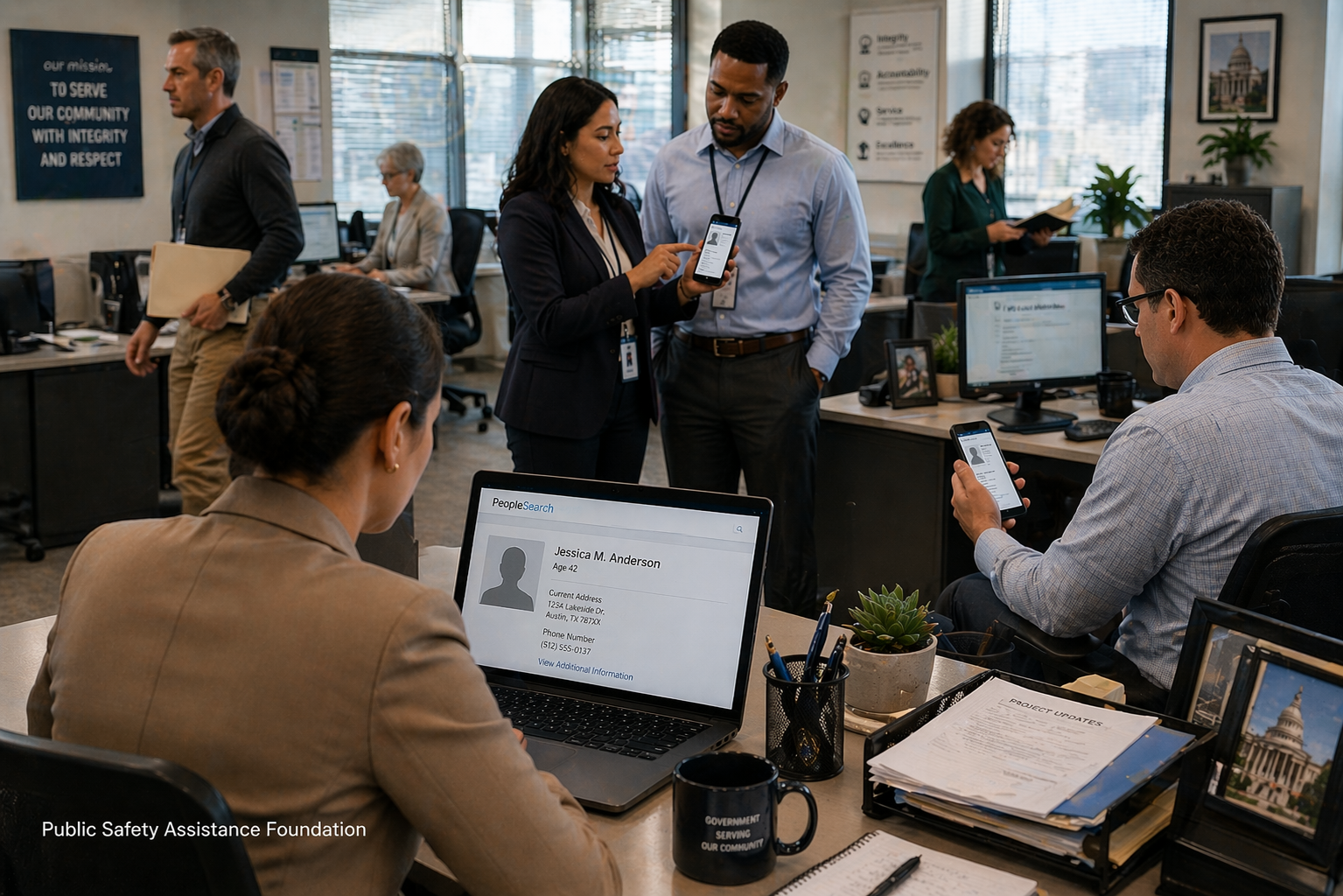
🔍 When One Listing Becomes Many
A law enforcement officer’s home address appears on a data broker site.
At first, it feels contained.
One website. One listing. One place to remove it.
It may not even feel urgent right away. After all, it’s just one page buried somewhere online. Something that can be handled later.
But someone sees it.
They take a screenshot.
In that moment, the situation changes completely.
That information is no longer just a listing tied to a single website. It becomes a standalone copy, something that can be saved, shared, and redistributed without any connection to where it originally came from.
Within minutes, it can be:
- Texted to someone else
- Shared in a private group
- Uploaded to social media
- Stored and reshared at any time
And just like that, the exposure moves beyond the original source.
This is the screenshot problem—and it’s one of the most important reasons online privacy for law enforcement officers and public officials can’t be treated as a one-time fix.
📱 What Is the Screenshot Problem?
The screenshot problem is straightforward, but its impact is often underestimated:
Once personal information is visible online, it can be captured and redistributed instantly, without your knowledge or control.
It doesn’t matter if:
- The listing is removed later
- The website takes it down
- Access becomes restricted
If someone captured it before that happened, the information can continue to exist—and circulate—independently.
This is where the shift happens.
Exposure is no longer tied to a single platform.
It becomes mobile, transferable, and persistent.
For law enforcement officers, that distinction matters. Because once information leaves its original source, it becomes significantly harder to track, manage, or contain.
🔁 From Listing to Distribution
What begins as a single data point can quickly evolve into a much broader issue.
Here’s how that progression typically unfolds:
1. Initial Exposure
A home address, phone number, or family connection appears on a data broker or people-search site.
2. Capture
Someone screenshots the information.
At this point, it is no longer dependent on the original website.
3. Sharing
That screenshot is sent through text messages, direct messages, or shared within online communities.
4. Redistribution
Others download, repost, or forward it, sometimes adding commentary, assumptions, or intent.
5. Persistence
Even if the original listing is removed, the screenshot continues to circulate in different spaces.
At this stage, the issue is no longer about visibility in one place.
It’s about how many copies now exist.
⚠️ Why This Hits Differently for Law Enforcement
For the general public, a screenshot might be an inconvenience.
For a law enforcement officer or public official, it can introduce a very different level of risk.
Because the type of information being captured often includes:
- Home addresses
- Family member names
- Contact details
- Location history or patterns
This isn’t just data, it’s context.
And once that context is shared, it can reach individuals who were never intended to have access to it.
There’s also another layer that makes screenshots especially problematic:
They remove context and control.
A screenshot doesn’t show:
- Where the data came from
- Whether it’s accurate or outdated
- Whether it has already been removed elsewhere
It simply presents the information as a fixed, credible snapshot in time.
That makes it easier to misunderstand, misuse, or deliberately spread.
🧠 The Multiplier Effect of Exposure
One of the most important realities to understand is that exposure doesn’t grow in a straight line.
It multiplies.
A single listing might only be seen by a handful of people.
But once it’s captured:
- One person shares it with several others
- Each of those people can save and resend it
- Each share creates new, independent copies
Very quickly, one source becomes many.
And those copies are no longer connected to the original listing or to each other.
That means removing the original source doesn’t eliminate the exposure—it only addresses where it started.
This multiplier effect is what turns a manageable situation into something far more difficult to contain.
⏱️ Why Timing Matters More Than Most People Think
The screenshot problem makes timing critical.
Because the longer personal information remains publicly visible:
- The more opportunities there are for someone to capture it
- The higher the likelihood it will be shared
- The greater the chance it spreads beyond the original source
Removing personal information early:
- Reduces how many people see it
- Limits the window of exposure
- Decreases the chance of replication
Waiting, even briefly, increases the risk that the information is captured and redistributed in ways that can’t be undone.
This is where many people underestimate the situation.
They assume removal solves the problem.
But removal after exposure is very different from removal before exposure spreads.
🔒 Visible vs. Contained Information
There’s a common assumption that if information is only listed in one place, it’s manageable.
But there’s a critical difference between information that is visible and information that is contained.
Visible information:
- Publicly accessible
- Easy to find
- Easy to capture and share
Contained information:
- Removed from major sources
- Harder to access
- Less likely to be discovered or redistributed
The goal isn’t just to remove information.
It’s to reduce the likelihood that it spreads in the first place.
Because once it spreads, containment becomes significantly more difficult.
🌐 Where Screenshots Actually Go
One of the challenges with the screenshot problem is that it’s largely invisible.
There’s no central place where shared images live, and there’s no reliable way to track where they end up once they leave the original source.
Once captured, screenshots can move through:
- Private group chats
- Encrypted messaging apps
- Social media platforms
- Online forums and communities
- Personal devices and cloud storage
Some may be shared once and forgotten.
Others may be saved, organized, and resurfaced later, sometimes days, months, or even years after the original listing was removed.
In some cases, screenshots are also re-uploaded to entirely different platforms, creating new versions of the same information in places you may never think to look.
That means the exposure doesn’t just spread, it can reappear.
And when it does, it often shows up without warning, without context, and without any connection to the original source.
That unpredictability is what makes screenshot-based exposure so difficult to control.
It doesn’t follow a clear path, and it doesn’t come with an expiration date.
🧭 Rethinking Online Privacy
The screenshot problem shifts how online privacy needs to be understood.
It’s no longer just about:
- What’s online
- Where it’s listed
It’s about:
- How quickly it can be copied
- How easily it can be shared
- How long it can continue to exist outside your control
For law enforcement officers and public officials, that means privacy is not a one-time task.
It’s an ongoing process focused on reducing exposure before it has the opportunity to spread.
Because once information is widely shared, the conversation changes from prevention to containment.
🚔 Stop the Spread Before It Starts
Once your information is captured and shared, you’re no longer dealing with a single source, you’re dealing with copies that can continue to move, resurface, and reappear over time.
That’s what makes early action so important.
Every listing that’s removed before it’s seen…
is one less opportunity for it to be screenshotted, shared, and multiplied.
Because once it spreads, it’s no longer just about removal.
It’s about trying to contain something that’s already been copied.
Privacy for Cops was built to address this exact problem.
We don’t just remove personal information from data broker and people-search sites—we work to reduce your overall online exposure so there’s less available to capture in the first place.
For law enforcement officers and public officials, that proactive approach can make the difference between information that stays contained, and information that continues to circulate.
Visit Privacy for Cops to learn how our team helps remove and monitor your personal information, before it has the chance to spread beyond where it started.
About Us