
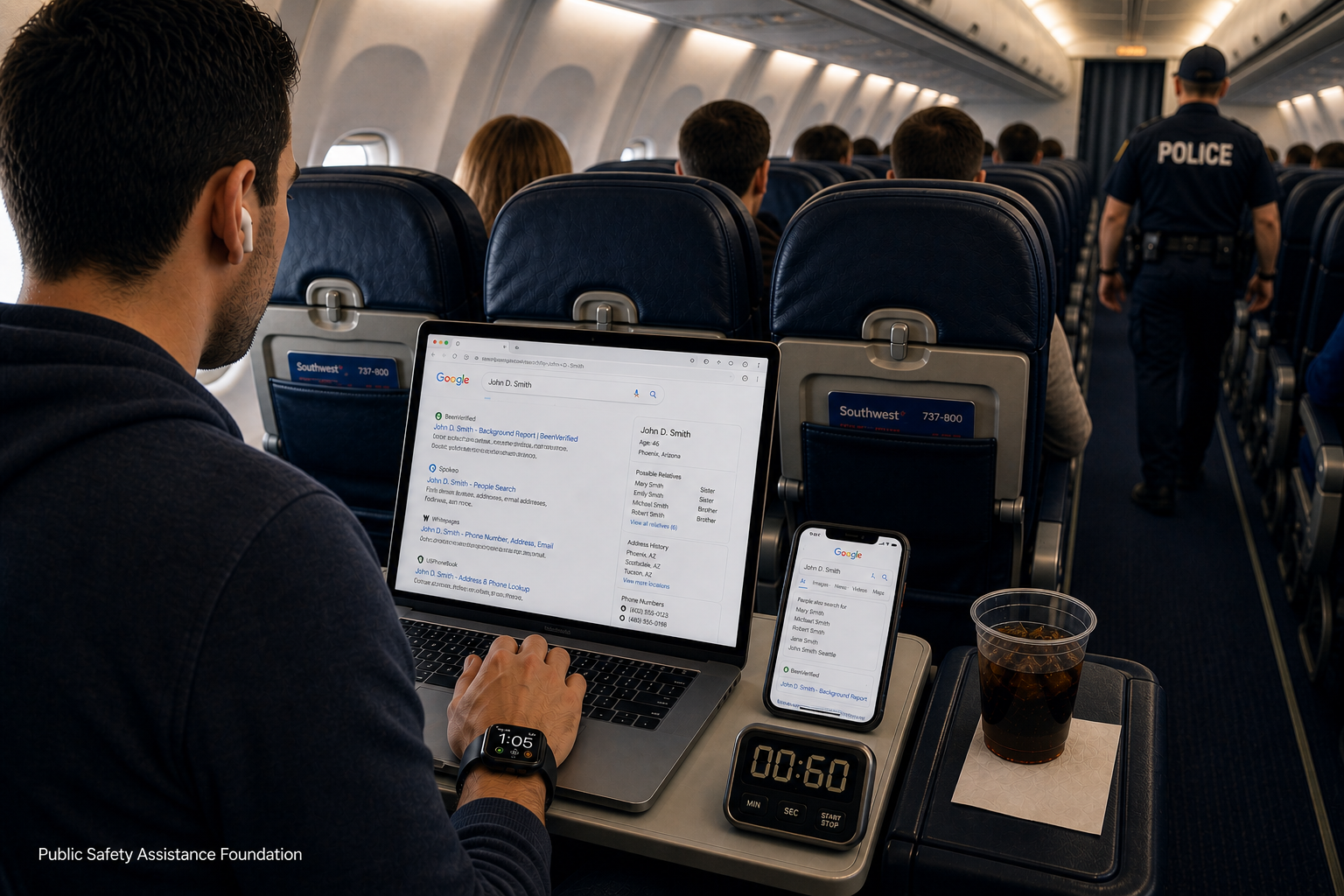
It doesn’t take long.
In fact, it happens faster than most people realize.
The moment someone types your name into a search bar, a process begins. One that can quietly reveal far more than expected in less than a minute.
No special tools.
No advanced skills.
Just a name.
For law enforcement officers and public officials, that simple action can open the door to a level of exposure that often goes unnoticed until it matters most.
And by then, the clock has already started.
🔎 The Search Starts Here
Picture this.
Someone hears your name.
Maybe it’s from a call, a report, a courtroom, or even a passing mention in conversation.
Out of curiosity, or something more intentional, they decide to look you up.
They open a browser.
They type your name.
And they hit search.
That’s second zero.
What happens next is where things begin to change.
Seconds 1–10: The First Layer Appears
The initial results load almost instantly.
At first glance, it may not seem like much.
A few links.
Some familiar platforms.
Possibly a professional mention or two.
But even in these first few seconds, patterns start forming:
- Variations of your name
- Possible locations tied to you
- Past affiliations or roles
- Mentions in directories or listings
For someone searching, this is enough to confirm they’re looking at the right person.
And once that confirmation happens, the search becomes more focused.
Seconds 10–30: The Profile Begins to Build
Now the process shifts from curiosity to construction.
The person searching starts clicking.
Opening multiple tabs.
Comparing results.
And this is where more detailed information often begins to surface:
- People-search websites listing age ranges and associated cities
- Aggregated profiles hinting at relatives or known connections
- Public records pointing to past or current addresses
- Cached data from older listings that may no longer be obvious at first glance
None of this requires deep digging.
It’s all within reach. Just a few clicks away.
And more importantly, it’s connected.
Seconds 30–45: The Connections Expand
At this point, the searcher is no longer just looking at you.
They’re looking around you.
This is where the “puzzle effect” comes into play.
Small pieces of information begin to connect:
- A name on one site matches a relative on another
- An address appears across multiple listings
- A phone number is tied to multiple profiles
- A past location leads to additional records
The search becomes faster, not slower.
Because each piece of information makes the next one easier to find.
Seconds 45–60: The Picture Comes Together
By the end of the first minute, something significant has happened.
The searcher now has:
- A general idea of where you live or have lived
- Names of possible relatives or associates
- Multiple sources confirming overlapping details
- Enough information to continue digging deeper if they choose
And they got there in under 60 seconds.
No barriers.
No alerts.
No indication to you that it’s even happening.
Why This Matters More Than Ever
For most people, this kind of access feels surprising.
For law enforcement officers and public officials, it carries real-world implications.
Because the search isn’t always driven by curiosity.
Sometimes it’s driven by:
- Frustration after an interaction
- Disagreement with a decision
- Intent to gather information for personal reasons
- A desire to escalate a situation beyond the moment
And when that happens, the speed of access becomes part of the risk.
The Shift Most People Miss
There was a time when finding personal information required effort.
You had to visit offices.
Request records.
Search through physical documents.
That friction acted as a natural barrier.
Today, that barrier is gone.
Information is:
- Indexed
- Aggregated
- Replicated across hundreds of platforms
- Constantly updated and redistributed
Which means the question is no longer:
“Is my information out there?”
It’s:
“How quickly can someone find it?”
The Illusion of Control
A common assumption is:
“I don’t post anything online, so I’m fine.”
But most of the information that appears in those first 60 seconds doesn’t come from social media.
It comes from:
- Data broker websites
- Public record aggregators
- Background listing services
- Marketing databases
These platforms collect, package, and display information without requiring active participation.
So even if you’re careful about what you share, your information can still appear and spread.
🧑🧑🧒 It’s Not Just About You
One of the most overlooked parts of this process is how quickly it extends beyond the individual being searched.
Within that same 60-second window, it’s common for:
- Spouses to appear in associated profiles
- Family members to be listed as possible relatives
- Shared addresses to connect multiple people
- Additional names to become searchable on their own
The search doesn’t stop at one person.
It branches.
And once it does, the exposure multiplies.
The Speed Is the Risk
The biggest takeaway isn’t just that information is accessible.
It’s how fast it becomes accessible.
Because speed changes behavior.
When something takes hours or days to uncover, most people won’t pursue it.
When it takes seconds, more people will.
That shift increases the likelihood that:
- More searches happen
- More profiles are built
- More information is shared
And all of it happens quietly.
The Gap Between Awareness and Action
Many people are aware that their information might be online.
But awareness alone doesn’t change what appears in search results.
It doesn’t remove listings.
It doesn’t stop data from being re-posted.
And it doesn’t slow down that first 60 seconds.
That’s where the gap exists.
Between knowing and doing something about it.
What This Means for Law Enforcement Officers
If your role already places you in situations where your name can become known, this process is even more relevant.
Because the trigger doesn’t have to be major.
It can be:
- A routine interaction
- A name mentioned in passing
- A report or document
- A public-facing role or decision
From there, the search begins.
And once it does, the timeline is the same.
Seconds, not hours.
💻 The Reality Most People Don’t See
The first search is just the beginning.
What often follows is:
- Saving information
- Sharing links
- Revisiting profiles later
- Watching for updates
Which means the exposure doesn’t disappear after those first 60 seconds.
It continues.
And in many cases, it grows.
Closing the Loop
The idea that someone can learn meaningful personal details about you in under a minute isn’t an exaggeration.
It’s the current environment.
And while you may never know when a search happens, you can control what’s available when it does.
Because in today’s world:
- Names lead to searches
- Searches lead to data
- Data leads to access
And access is what turns information into risk.
Take Control Before the Search Happens
The reality is simple: you won’t always know when someone searches your name.
But you can take steps to limit what they find when they do.
At Privacy for Cops, we work with law enforcement officers and public officials to reduce their online exposure by removing personal information from data broker sites and continuously monitoring to keep it that way.
We handle the process for you, so you’re not left trying to track down hundreds of listings on your own.
Because the goal isn’t just awareness.
It’s action.
And in an environment where everything starts with a search, taking control before that moment happens can make all the difference.
Every day that information remains online is another opportunity for it to be found, copied, and shared. Most people don’t realize how widespread their data is until they try to remove it themselves, and quickly see how complex and time-consuming that process can become. That’s where having a dedicated system in place matters. Not just for removal, but for ongoing monitoring as new listings appear over time.
You’ve already seen how fast the first 60 seconds can unfold. The next step is making sure that when that search happens, the results don’t tell your story for you. Taking action now helps shift that outcome, reducing what’s visible, limiting what can be connected, and putting you back in control of your information.
Exclusive Privacy Plans