
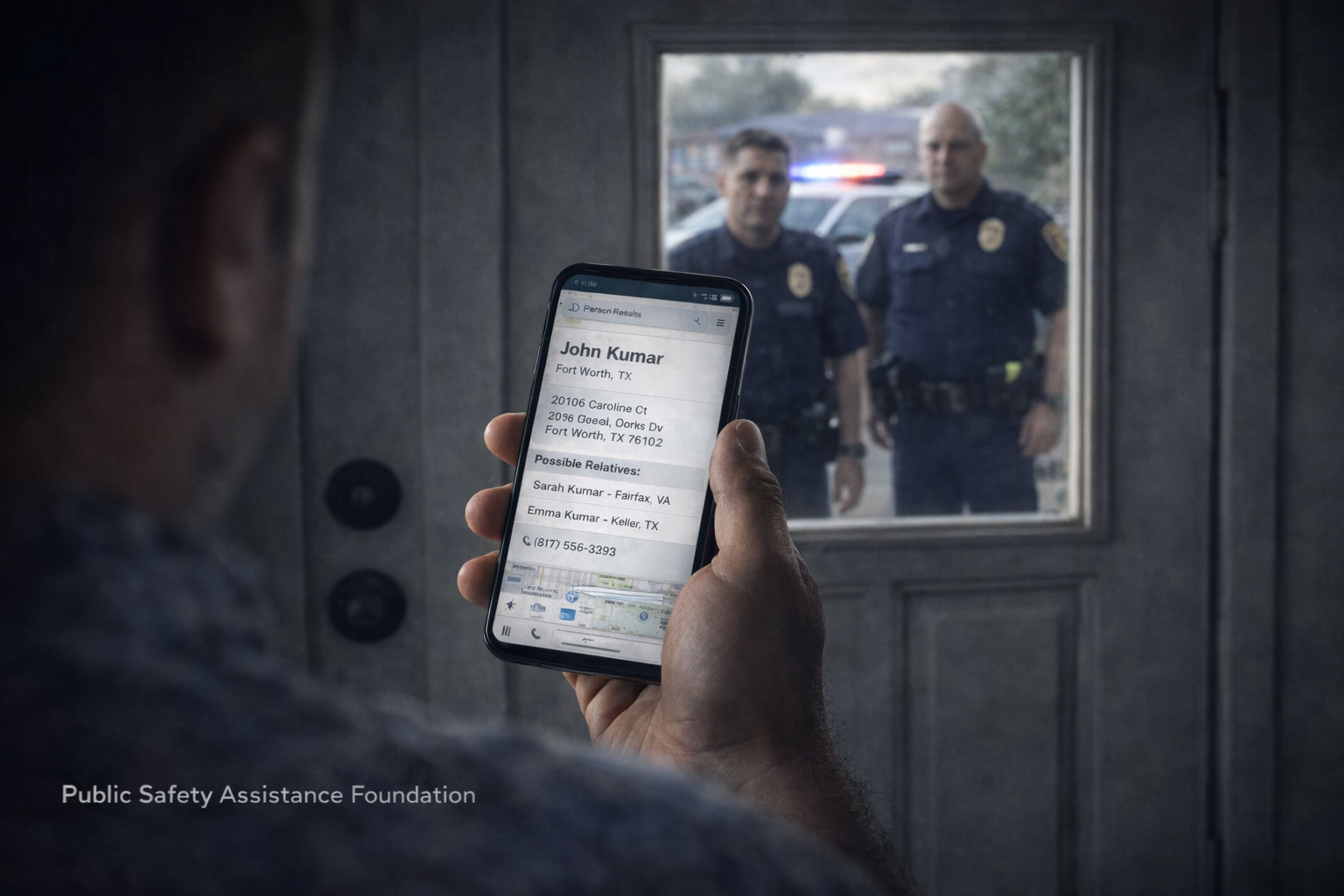
The call hasn’t even started yet.
No lights.
No sirens.
No knock on the door.
But something is already happening.
Inside the residence, or down the street, or even from a parked car nearby, someone is holding a phone. And they’re searching.
Not for directions.
Not for weather.
But for a name.
A quick search. A few taps. A scan of results.
And in seconds, pieces of information begin to appear.
Not all at once.
Not always complete.
But enough to start forming a picture.
Before Arrival Isn’t What It Used to Be
There was a time when responding to a call meant stepping into an unknown.
Limited information.
Limited context.
Limited visibility.
That uncertainty shaped how law enforcement officers approached every situation.
But today, that dynamic has shifted.
Because the unknown doesn’t just apply to officers anymore.
The person on the other side of the door may also be gathering information—sometimes in real time, sometimes before contact ever happens.
And what they can find has changed dramatically.
Access to information is no longer limited to official systems or specialized tools.
It lives in search engines, public records, and aggregation platforms that are designed to make information easy to find and even easier to connect.
The Search Starts with a Name
It doesn’t take much.
A name overheard on a radio scanner.
A badge number mentioned in passing.
A previous interaction.
A social media reference.
That’s all it takes to start a search.
From there, the process is fast.
Search engines return results in seconds.
Data broker sites surface personal details.
Aggregator platforms connect information across multiple sources.
Even if the information is incomplete, it rarely stays that way.
Because one result leads to another.
A name leads to an address.
An address leads to a property record.
A property record leads to associated individuals.
What starts as a single query can quickly become a chain of connected information.
What Can Be Found in Minutes
What someone can access in a short amount of time may include:
- Current or past home addresses
- Names of family members or associates
- Phone numbers
- Property ownership records
- Previous locations or cities of residence
- Possible connections between individuals
- Fragments of social media presence
And importantly, this information doesn’t need to be perfectly accurate to be useful.
It just needs to be close enough to create context.
A partial address can confirm a neighborhood.
A relative’s name can confirm identity.
A past city can suggest patterns.
That’s how small details begin to carry weight.
Even outdated information can still provide direction.
It may not be perfect, but it rarely needs to be.
That’s how small details begin to carry more weight than expected.
From Information to Awareness
This isn’t about assuming intent.
It’s about understanding capability.
Because access to information changes awareness.
And awareness changes behavior.
When someone can quickly look up:
- Where an officer may live
- Who they may be connected to
- What other details exist online
It introduces a different layer to the situation.
Not necessarily visible.
Not always obvious.
But present.
And that presence can influence how someone thinks, reacts, or prepares before an interaction ever occurs.
Even a small amount of information can shift perception.
And perception often shapes response.
The Gap Between What Officers Know and What Others Can Learn
Law enforcement officers are trained to gather information.
To assess.
To observe.
To anticipate.
But the environment they operate in now includes something new.
Open access to information that exists outside of official channels.
Information that can be searched, shared, and interpreted by anyone with a phone.
That creates a gap.
Not in training.
Not in awareness.
But in how information is distributed and used.
Officers rely on structured, verified systems.
The public can rely on fragmented, publicly available data that still forms a meaningful picture.
That difference matters.
Because even incomplete information, when combined, can feel complete.
Real-Time Access Changes the Equation
The key shift isn’t just that information exists.
It’s that it can be accessed quickly.
In real time.
During a call.
Before a response.
Between interactions.
This isn’t theoretical.
It’s practical.
And it’s happening in a way that doesn’t always leave a trace.
No alert.
No notification.
No indication that a search even occurred.
That means officers may never know when their information has been accessed, reviewed, or interpreted.
And that lack of visibility adds another layer to the challenge.
Because information can be accessed without ever being seen.
The Role of Scanner Apps and Open Information
Technology has made real-time awareness more accessible than ever.
Scanner apps, online radio feeds, and publicly available information streams allow individuals to monitor activity as it happens.
While these tools serve legitimate purposes, they also create an environment where:
- Names may be heard
- Locations may be identified
- Timing may be tracked
Combined with online search capabilities, this creates a powerful combination:
Real-time awareness + immediate access to personal data.
That combination is what makes this shift significant.
Why This Matters Beyond the Moment
What happens during a call is only part of the picture.
Because information doesn’t disappear once the interaction ends.
If anything, it becomes easier to find.
Names may appear in reports.
Details may be referenced online.
Search results may expand over time.
That means the window of exposure isn’t limited to the moment of contact.
It extends beyond it.
And in some cases, it grows.
That combination shortens the gap between hearing information and acting on it.
What once took time can now happen almost instantly.
It’s Not One Search, It’s What That Search Leads To
A single search result might not reveal much.
But it rarely stops there.
Because search leads to:
- Additional platforms
- Related profiles
- Connected individuals
- More detailed records
That’s how scattered data becomes structured information.
And structured information becomes understanding.
Each step adds clarity.
Each connection adds context.
And over time, that context becomes easier to navigate.
The Part That Often Goes Unnoticed
There’s no obvious signal when this happens.
No visible shift.
No clear moment where exposure changes.
Just a quiet accumulation of information.
Which is why it’s easy to overlook.
Because from the outside, nothing appears different.
But access has changed.
And access influences how situations unfold.
Reducing What Can Be Found Before It’s Searched
If information can be accessed before a call, then reducing that information becomes part of preparation.
Not as a reaction.
But as a proactive step.
Because once something is searchable, it’s already in motion.
Removing personal data from data broker and people-search sites helps limit what can be quickly found and connected.
And just as important, ongoing monitoring helps ensure that once information is removed, it doesn’t quietly return.
Because in today’s environment, information doesn’t just exist, it reappears.
A Different Kind of Awareness
Situational awareness has always been a core part of law enforcement.
Understanding surroundings.
Reading behavior.
Recognizing risk.
Today, that awareness extends beyond the physical environment.
It includes understanding how information exists, how it moves, and how it can be accessed.
Not just during a call.
But before it even begins.
And in many cases, before officers even realize it.
Looking at the Full Picture
The call may not have started yet.
The knock hasn’t happened.
But information is already in play.
And in many cases, it’s shaping awareness before any interaction takes place.
That doesn’t change how officers do their job.
But it does change the environment they’re doing it in.
Take Control Before the Search Happens
The goal isn’t to control every variable.
It’s to control what’s within reach.
Because once information is easy to find, it becomes easy to use.
If you’re a law enforcement officer or public official, your personal information may already be available across multiple sites, ready to be searched, connected, and interpreted in ways you never intended.
Taking action now, with Privacy for Cops, to have that information professionally removed and continuously monitored, helps reduce what can be found before it’s ever searched.
Because what happens before the knock may matter more than most people realize.
Exclusive Privacy Plans