
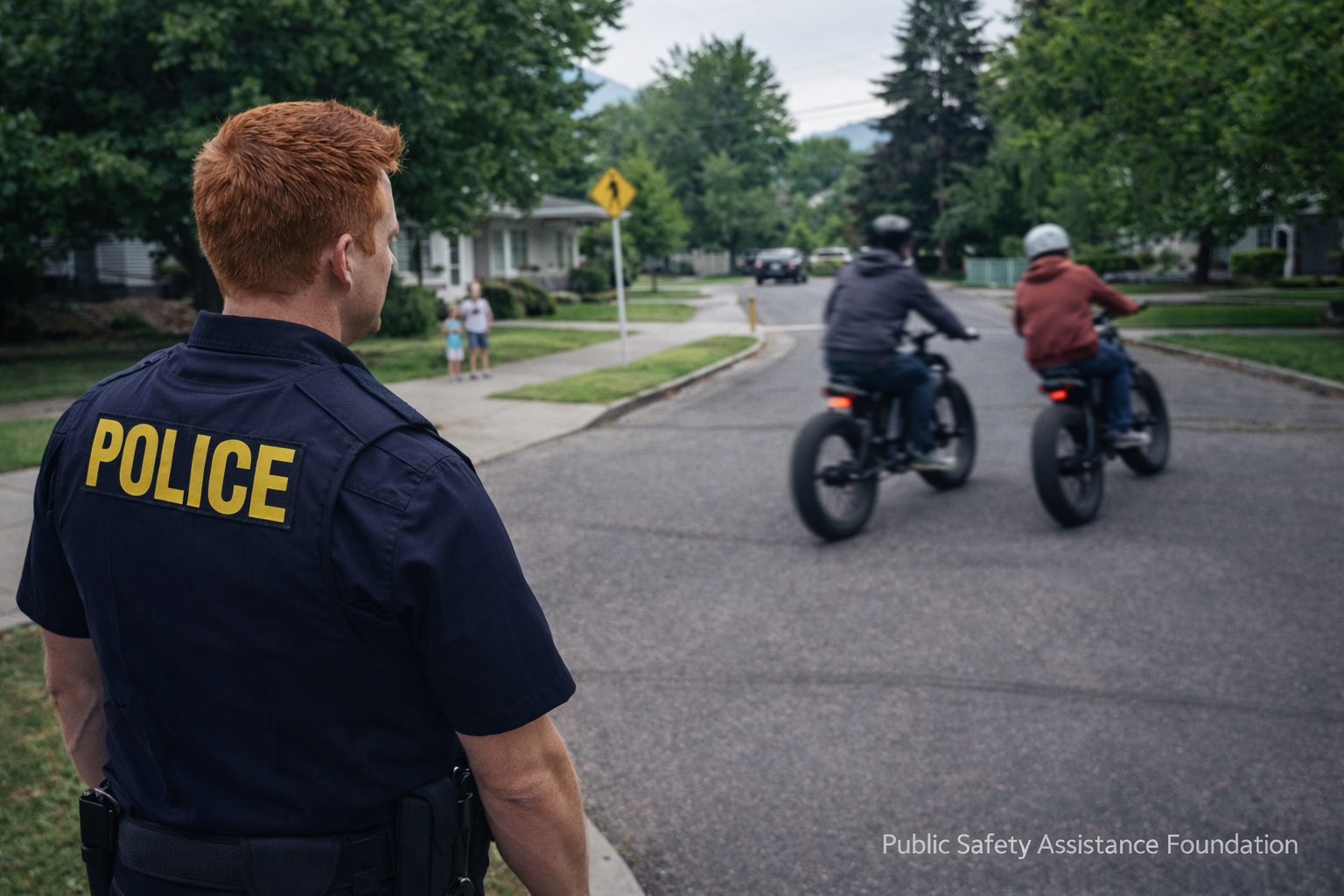
E-bikes are becoming a common sight in neighborhoods, parks, and city streets across the country.
What started as a convenient, eco-friendly transportation option has quickly expanded into something more complex. With increased speed, accessibility, and popularity—especially among younger riders, law enforcement agencies are raising concerns about how e-bikes are being used in public spaces.
Reports of reckless riding, near-misses with pedestrians, and riders ignoring traffic laws are becoming more frequent. Sidewalks, bike paths, and intersections are no longer predictable environments. Instead, they are shared spaces where speed and behavior can change in an instant.
This is not just a traffic issue.
It is a visibility issue.
And for law enforcement officers and public officials, visibility carries a different kind of risk.
The Shift From Controlled to Unpredictable Environments
Traditionally, many safety considerations for law enforcement officers have focused on structured environments. Traffic stops, calls for service, or coordinated operations.
E-bike activity does not fit into those categories.
These encounters often happen:
- In residential neighborhoods
- Near schools and parks
- On sidewalks and shared pathways
- During off-duty hours
There is no warning. No controlled setup. No clear expectation of behavior.
An officer could be:
- Walking with family
- Driving through their neighborhood
- Spending time in a public park
… and suddenly encounter a fast-moving, unpredictable situation.
That shift matters.
Because when environments become less predictable, the nature of risk changes with them.
Public Interactions Are Increasing and So Is Exposure
E-bike-related encounters are not always enforcement situations.
In many cases, they are brief interactions:
- A warning
- A quick conversation
- A moment of intervention to prevent harm
But even brief interactions create visibility.
And today, visibility does not end when the moment is over.
In a world where nearly everyone carries a smartphone, any interaction can be:
- Recorded
- Shared
- Revisited later
What may seem like a routine moment can become something more.
Not because of the interaction itself, but because of what happens afterward.
When the Moment Doesn’t Stay in the Moment
This is where the conversation shifts.
In the past, an encounter in a neighborhood or park would typically end when both parties went their separate ways.
Today, that is not always the case.
An individual who has had an interaction with an officer can later:
- Search their name
- Look up public records
- Identify an address
- Locate family members
The encounter becomes a starting point.
From there, online information fills in the gaps.
This is how a brief, public interaction can evolve into something more personal.
The Role of Online Information in Modern Risk
Personal information is widely available across the internet.
It exists on:
- Data broker and people-search websites
- Public record databases
- Social media platforms
- Aggregated data sources
Often, this information is:
- Easy to access
- Frequently updated
- Shared across multiple platforms
For someone with intent, it does not take much to connect the dots.
A name from an interaction can lead to:
- A home address
- A phone number
- Names of relatives
- Additional personal details
This is not a technical process.
It is a simple one.
And that simplicity is what makes it concerning.
Off-Duty Does Not Mean Out of View
One of the most important realities to recognize is that many of these interactions happen off duty.
An officer may not be in uniform.
They may not be in a marked vehicle.
They may simply be present in their community.
But even off duty, they are still visible.
And visibility creates the potential for recognition.
Once recognized, the line between professional and personal space begins to blur.
That is especially true when personal information is accessible online.
The Family Factor
E-bike encounters often occur in places where families are present.
Neighborhood streets.
Parks.
School zones.
These are shared environments.
That means family members may be nearby during or after an interaction.
This introduces an additional layer of concern.
Because when personal information is accessible, it does not stop with the individual.
It can extend to:
- Spouses
- Children
- Household members
A moment that began as a public safety concern can expand into something that affects the entire family.
Changing Environments Require a Broader View of Safety
E-bike safety concerns highlight a larger shift.
Risk is no longer confined to clearly defined situations.
It is:
- Mobile
- Public
- Unpredictable
And increasingly, it is connected to what happens after the interaction.
This requires a broader view of safety.
One that includes not only physical awareness, but also digital awareness.
Understanding how personal information is:
- Shared
- Stored
- Accessed
… is now part of the overall safety picture.
Why Proactive Protection Matters
Once personal information is accessed, options become more limited.
At that point, the situation becomes reactive.
The focus shifts to responding instead of preventing.
That is why proactive protection is critical.
It is about reducing the amount of information available before it can be used.
This includes:
- Removing personal data from data broker and people-search sites
- Limiting unnecessary exposure
- Maintaining awareness over time
Because exposure is not static.
It changes.
New information appears. Existing data is republished. Listings re-emerge.
Without consistent attention, gaps can form.
Ongoing Monitoring in a Changing Landscape
One of the challenges with online exposure is that it is not a one-time issue.
Even after information is removed, it can return.
This happens through:
- Data resellers
- Public record updates
- Platform changes
- Third-party sharing
That is why ongoing monitoring is essential.
It ensures that:
- New exposures are identified
- Previously removed data does not reappear unnoticed
- Individuals maintain control over their personal information
Consistency is what makes protection effective.
Turning Awareness Into Action
E-bike safety concerns are not just about speed or behavior.
They are a reflection of how public environments are changing.
They show how quickly everyday situations can become unpredictable.
And they highlight an important reality:
Visibility does not end when an interaction ends.
For law enforcement officers and public officials, risk now extends beyond the moment and beyond the badge.
Reducing online exposure is one way to stay ahead of that risk.
Learn more about Privacy for Cops.
Help safeguard your home and your family by having your personal information removed from data broker and people-search sites, before exposure turns into risk.