
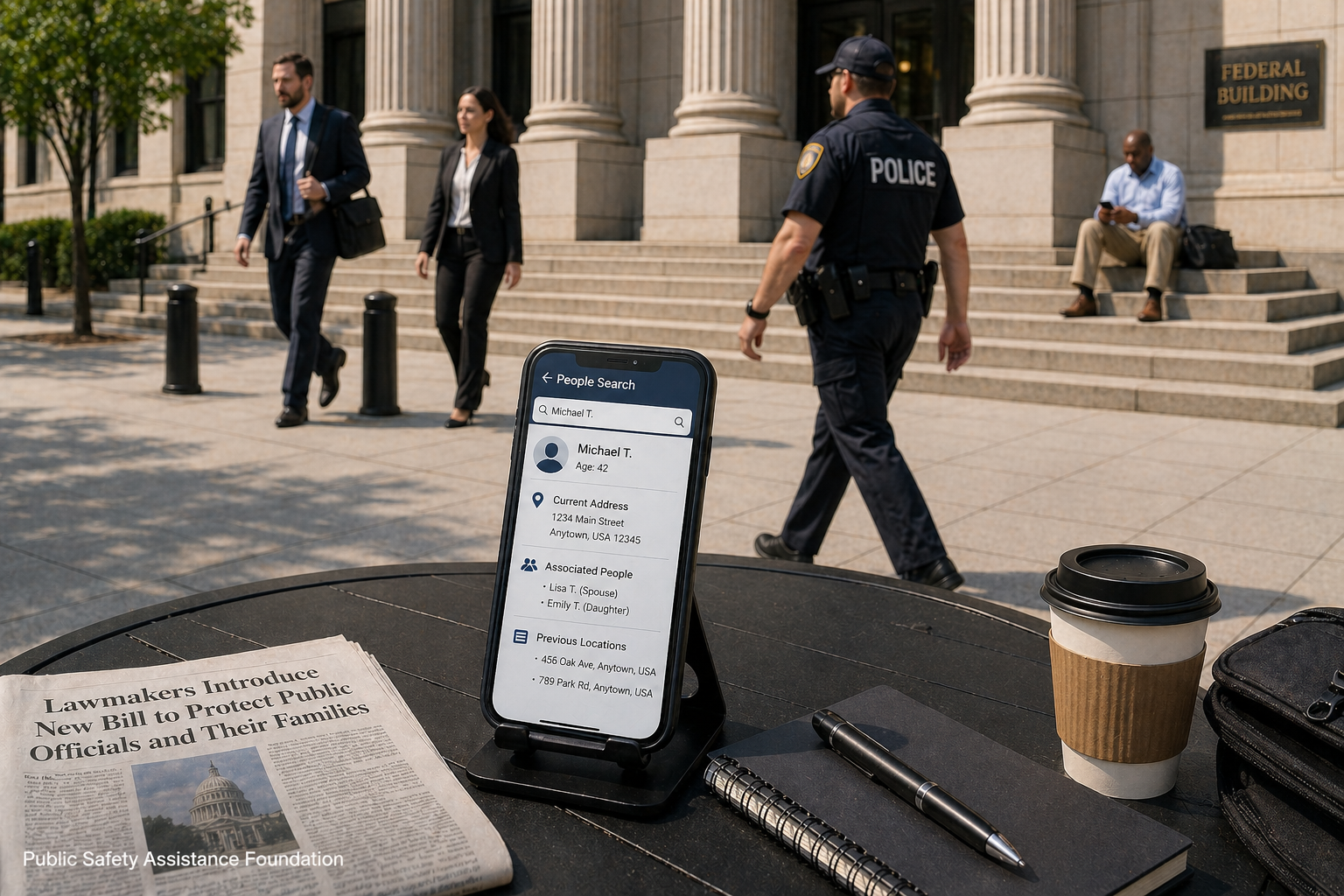
It’s not often that legislation directly reflects a problem many people are still trying to understand.
But this one does.
In April 2026, lawmakers introduced the PROTECT Act, a bipartisan effort aimed at addressing a growing and dangerous issue: the exposure of personal information tied to law enforcement officers and public officials, and the real-world consequences that follow.
At its core, the bill focuses on one thing. Protecting personally identifiable information.
That might sound technical. Even routine.
But behind that language is a much more serious reality.
Because this isn’t just about data anymore.
It’s about access.
It’s about visibility.
And increasingly, it’s about risk.
The Problem Isn’t New. It’s Just Escalating
Threats against law enforcement officers and public officials have changed in a very specific way over the last decade.
They’ve become more personal.
More targeted.
And more accessible.
What’s changed is not just access to information, but the speed and intent behind it.
In the past, learning details about someone in one of these roles often required time, effort, and proximity. Someone had to physically observe, ask questions, or dig through records manually. Today, that barrier has been removed almost entirely.
Now, information can be gathered remotely, anonymously, and instantly.
That shift matters.
Because, it allows individuals to move from curiosity to action without ever being seen. There is no interaction, no warning, and no visible buildup. What used to take days or weeks can now happen in minutes, often without the subject ever knowing their information was searched in the first place.
The PROTECT Act highlights something many already understand: attackers don’t need to guess anymore. They can search.
They can find addresses.
They can identify family members.
They can connect dots across multiple platforms.
And in many cases, they can do it in minutes.
This is where escalation becomes more concerning.
It is not just that more information is available. It is that the pathway from information to action has become shorter, quieter, and significantly more efficient.
Why This Legislation Matters
The PROTECT Act doesn’t just acknowledge the issue, it attempts to standardize how it’s handled.
Right now, there is no consistent approach across agencies when it comes to protecting personal data tied to officers and officials.
Some departments take proactive steps.
Others rely on outdated processes.
Many simply don’t have the resources or guidance to address it effectively.
This bill aims to change that by directing federal leadership to develop and distribute best practices for protecting personal information across all levels of government.
That includes:
- Law enforcement officers
- Federal agents
- Judges and prosecutors
- Elected officials
- Other public officials and government personnel
It’s a broad, coordinated effort.
And it’s long overdue.
But Here’s the Reality Most People Miss
Legislation doesn’t remove exposure.
It responds to it.
By the time a bill like this is introduced, the underlying issue is already widespread.
That’s the part that often gets overlooked.
Because while policies are being written and guidance is being developed, the information is still out there.
Already indexed.
Already shared.
Already circulating across hundreds of sites.
That gap matters.
And it’s where risk lives.
The “Searchability” Problem
One of the biggest shifts in recent years isn’t just data availability.
It’s how easily that data can be found.
Search engines have become the starting point.
People-search sites have filled in the gaps.
Data brokers have connected the dots.
What used to require effort now requires a name.
Or even just part of one.
From there, it’s not uncommon to uncover:
- Current and previous home addresses
- Names of relatives and associates
- Phone numbers
- Property ownership records
- Historical location data
Individually, each piece might seem insignificant.
Together, they create a clear, actionable profile.
And it’s exactly what turns scattered information into something much more dangerous.
Another layer to this issue is how search engines prioritize and organize information.
Results are not random. They are structured to surface what appears most relevant, most connected, and often, most detailed. That means when multiple data points exist across different platforms, they are often pulled together in ways that make them easier to interpret.
In other words, the internet does not just store information, it helps assemble it.
Even outdated or partially accurate details can still contribute to a larger picture. A previous address here, a relative’s name there, a phone number tied to an old account, each piece adds context.
And context is what turns data into something usable.
Why Law Enforcement Officers and Public Officials Are Unique Targets
The PROTECT Act makes it clear that this issue isn’t limited to one role, but law enforcement officers and public officials face a distinct level of exposure.
Their roles already involve visibility.
Authority.
Decision-making.
And sometimes, confrontation.
That makes them more likely to be searched.
More likely to be identified.
And more likely to be targeted.
There is also an expectation factor that comes into play.
Those serving in law enforcement and public office are often expected to remain accessible, transparent, and accountable. While those are important qualities, they can unintentionally increase personal exposure in a digital environment.
Professional visibility can blur into personal visibility.
A name published in a report, a quote in a news article, or a role listed on a department website. These are all routine. But they also serve as starting points for deeper searches.
Once a name is known, it rarely stays confined to its original context.
It expands outward, connecting to other platforms, other records, and other pieces of information that were never intended to be viewed together.
That’s where the risk begins to grow.
The Gap Between Awareness and Action
There’s a growing awareness around online exposure.
You see it in conversations.
In policy discussions.
In legislation like this.
But awareness alone doesn’t change the outcome.
Because knowing the risk exists is not the same as reducing it.
Most people assume:
- Their information is harder to find than it actually is
- Someone would need a reason to look them up
- Exposure is limited to a few websites
In reality, the opposite is often true.
The information is easier to find.
The barrier to access is lower.
And the number of sites involved is much larger than expected.
The Lag Problem
Here’s something legislation can’t fix quickly.
Speed.
The internet moves faster than policy.
Data is collected, aggregated, and redistributed constantly.
New sites appear.
Old data resurfaces.
Information is copied and mirrored across platforms.
Even when something is removed, it often reappears somewhere else.
There is also the issue of persistence.
Information online does not disappear simply because it is outdated or no longer relevant. In many cases, it remains archived, cached, or duplicated across multiple sites.
That means even if one source removes it, another may still display it.
And over time, that duplication increases.
This creates a cycle where information continues to circulate long after it should have faded, making it difficult to fully contain or control.
Removing information once is not the same as keeping it removed.
What This Means Moving Forward
The introduction of the PROTECT Act is a signal.
Not just of intent, but of urgency.
It confirms that:
- The threat is real
- The exposure is widespread
- The impact is serious enough to require federal attention
But it also highlights something else.
Protection isn’t automatic.
It’s not built into the system.
And it doesn’t happen passively.
It requires consistent, ongoing action.
Turning Awareness Into Action
There is a tendency to view this issue as something that will be solved at the policy level.
But policy sets direction. It does not remove what is already in circulation.
And it does not account for how quickly new data is created, shared, and indexed.
That is why timing matters.
Because the longer information remains accessible, the more opportunities exist for it to be found, saved, and redistributed.
That is why proactive steps are not just helpful, they are necessary.
This includes:
- Identifying where personal information is currently visible
- Having that information removed from data broker and people-search sites
- Monitoring for reappearance across platforms
- Maintaining long-term protection, not just one-time removal
This is not a one-step process.
It’s ongoing.
Because the environment is constantly changing.
Take the Next Step
The conversation around online exposure is evolving.
Policies are being introduced. Awareness is growing. But the information tied to your name may already be circulating across hundreds of sites right now.
That’s where action matters most.
Privacy for Cops helps law enforcement officers, public officials, and their families have personal information professionally removed from data broker and people-search sites, and continuously monitored over time.
This isn’t a one-time fix.
It’s an ongoing process designed to reduce exposure and help you stay ahead of it.