
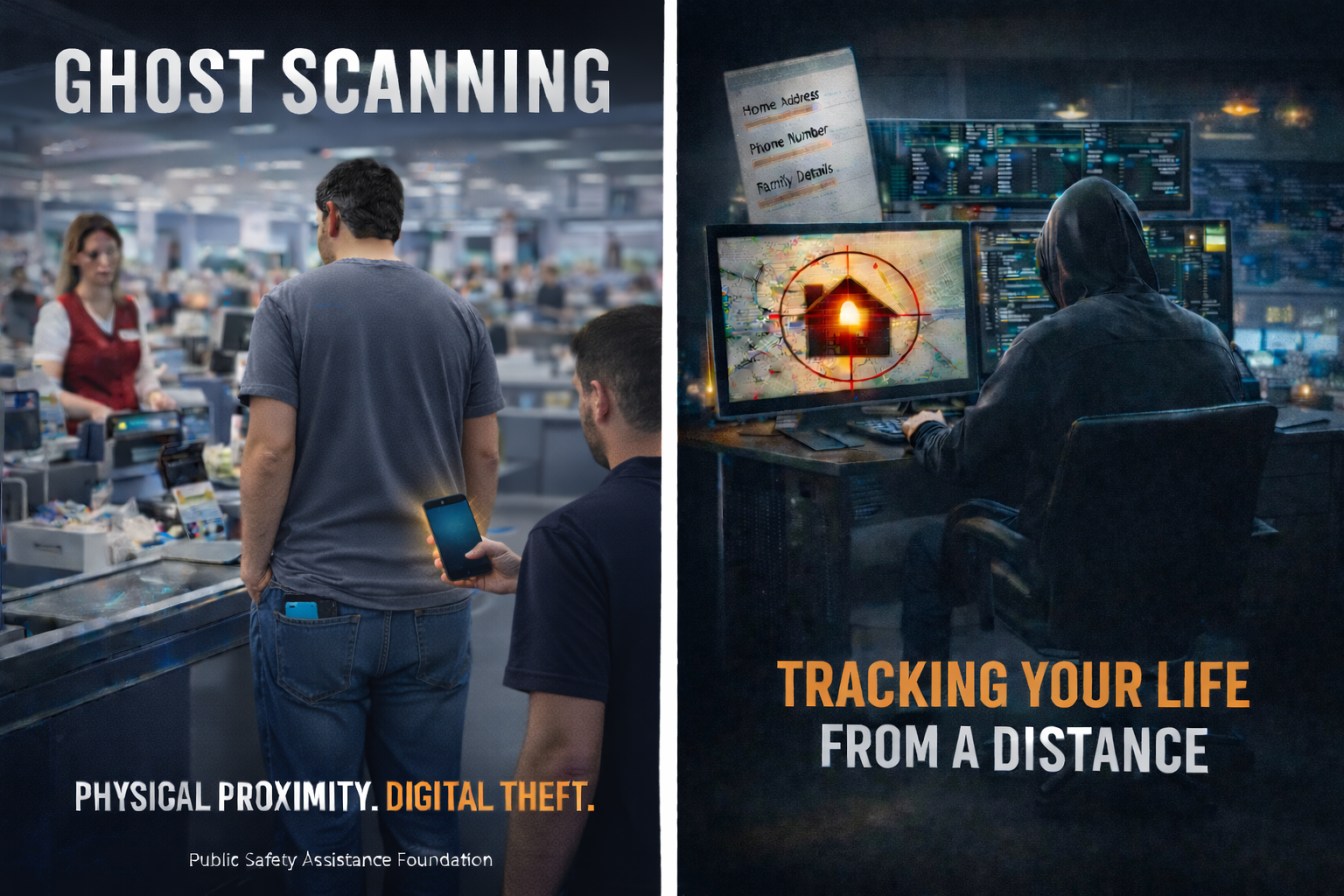
Most officers are trained to be situationally aware.
They notice hands.
They notice movement.
They notice proximity.
That awareness has traditionally focused on physical space. Who is standing too close? Who is acting suspiciously? Who appears to be watching more than participating?
But what happens when proximity itself becomes a digital tactic?
Recently, a term sometimes referred to as “ghost scanning” has circulated in fraud prevention conversations. The concept describes a scenario where a bad actor attempts to use NFC-enabled technology to detect or interact with digital payment cards stored in a nearby smartphone.
Whether the technical feasibility is overstated in some online discussions is almost secondary.
What matters is the mindset behind it.
Criminals continue to look for low-effort, low-visibility ways to collect information.
And that mindset extends far beyond tap-to-pay technology.
For law enforcement officers, public officials, and their families, this trend reflects something much bigger: the evolution of access.
Understanding the Technology Behind “Ghost Scanning”
Most modern smartphones use Near Field Communication (NFC) to enable contactless payments through digital wallets. NFC works only over very short distances, usually just a few centimeters. That limited range is a built-in security measure.
Digital wallets also use tokenization and encryption. Instead of transmitting a full credit card number, they generate a temporary transaction token. This dramatically reduces the risk of traditional skimming compared to older magnetic stripe technology.
In other words, modern mobile payment systems are not easily compromised.
However, the interest in “ghost scanning” highlights something important. Even when financial theft is difficult, the desire to quietly detect, confirm, or harvest small bits of information persists.
Fraud rarely begins with a dramatic breach. It begins with curiosity, testing, and incremental data gathering.
A device ping.
A confirmed active phone.
A partial data exchange.
Each small success informs the next attempt.
This layered approach mirrors how online targeting works.
From Physical Pickpocketing to Digital Profiling
In the past, a criminal needed physical access to your wallet. Today, criminals often prefer distance.
If someone attempted to stand close enough to you in a crowded space to “scan” your phone, that proximity would still require risk on their part. They would need to be physically present. They would need equipment. They would need opportunity.
But online data exposure eliminates those barriers entirely.
There is no need to stand next to an officer in a grocery store if their home address is already indexed online.
There is no need to get close to a public official’s phone if their family connections, property records, and phone numbers are easily searchable across data broker platforms.
Physical proximity is limited.
Digital proximity is scalable.
That difference matters.
The Real Threat: Passive Information Harvesting
The most concerning element of ghost scanning is not whether it can instantly drain a bank account. It is the concept of passive harvesting.
Information collected without alerting the target.
In the digital world, passive harvesting happens constantly.
Data brokers aggregate:
- Home addresses
- Past addresses
- Phone numbers
- Email addresses
- Relative names
- Property records
- Professional history
- Voter registration details
- Social media associations
This data is compiled, cross-referenced, and resold repeatedly.
The individual officer does not receive a notification.
There is no alert that says your personal profile has been indexed.
There is no warning that someone searched your name yesterday.
Access occurs quietly.
Just like proximity-based scanning attempts.
The difference is scale.
Why Officers and Public Officials Face Amplified Risk
Most private citizens experience data exposure.
Law enforcement officers experience magnified data exposure.
Officers frequently operate in environments where their names appear in:
- Arrest reports
- Court records
- Media coverage
- Public meeting minutes
- Civil filings
- Online commentary
Public visibility increases search frequency.
Search frequency increases discoverability.
Discoverability increases vulnerability.
For officers involved in high-profile cases, controversial incidents, or enforcement actions that generate public reaction, online searches often spike dramatically.
When those searches lead directly to residential addresses or family member information, risk shifts from professional scrutiny to personal vulnerability.
That is where digital exposure becomes a safety issue, not just a privacy issue.
Financial Fraud vs. Personal Targeting
There is a distinction worth making.
Financial fraud is disruptive.
Personal targeting is destabilizing.
Banks can cancel a compromised credit card.
They cannot cancel your home address once it has been replicated across dozens of websites.
They cannot retract your spouse’s name once it has been indexed by search engines.
They cannot erase years of aggregated data from third-party brokers.
Ghost scanning conversations tend to focus on financial theft.
At Privacy for Cops, our focus is different.
We focus on reducing the accessibility of the personal data that enables targeting, harassment, doxxing, and intimidation. Because for officers and their families, exposure has consequences that go beyond financial inconvenience.
The Compounding Effect of Data Over Time
One of the least understood aspects of digital exposure is longevity.
Information does not simply appear online. It accumulates.
An old address from ten years ago.
A phone number tied to a public record.
A relative listed through a property deed.
A news article mentioning a family connection.
Individually, these fragments may seem harmless.
Together, they create a detailed personal map.
Bad actors rarely rely on a single source. They compile information across platforms, confirming details piece by piece. This is the same strategy seen in fraud attempts, social engineering schemes, and targeted harassment campaigns. The more data points available, the easier it becomes to craft believable messages, impersonation attempts, or intimidation tactics.
Ghost scanning represents one moment of attempted access.
Online data aggregation represents continuous access.
Officer Safety Beyond the Streets
For decades, officer safety meant tactical positioning, communication protocols, and situational awareness during calls for service.
Those remain critical. But modern officer safety must also include digital awareness. It recognizes that protecting officers today means addressing not only physical risks on the job, but also digital exposure and personal vulnerability beyond the badge.
An officer can be highly trained in defensive tactics and still have their family information widely searchable.
A public official can implement robust physical security measures while their home address circulates through multiple data broker networks.
Safety is no longer confined to geography. It includes search results.
What Can Be Controlled
We cannot eliminate every threat.
We can reduce exposure.
Removing personal information from data broker sites does not eliminate public record systems. It does not rewrite history. It does not silence media reporting.
What it does is reduce unnecessary indexing and resale. It decreases the ease with which someone can:
- Locate a residential address
- Identify family members
- Confirm phone numbers
- Cross-reference household connections
- Aggregate multiple data points quickly
Reduced accessibility increases friction. In risk management, friction matters.
The more effort required, the less likely opportunistic targeting becomes.
The Lessons Behind the Headline
- Ghost scanning headlines may come and go
- The broader lesson remains constant
- Criminal tactics evolve toward efficiency
- They seek information that is easy to access and low risk to obtain
- Digital exposure provides exactly that
- When personal data is widely searchable, the barrier to targeting decreases
- When personal data is actively removed and monitored, the barrier increases
- That shift alone can change outcomes
A Proactive Approach to Protection
Privacy for Cops works specifically with law enforcement officers, public officials, and their families to reduce online personal data exposure.
Our process focuses on identifying where personal information is published, requesting removal where legally applicable, and continuously monitoring for reappearance.
We understand the unique visibility challenges that officers face.
We understand the intersection between public service and personal privacy.
And we understand that waiting until an incident occurs is not a strategy.
It is a reaction.
Proactive data removal is a preventative measure.
It strengthens modern officer safety by limiting what bad actors can access in the first place.
Take Back Distance
If criminals are searching for ways to get closer to your information, the solution is not fear.
It is distance.
Distance between your professional role and your home address.
Distance between public records and searchable data broker profiles.
Distance between curiosity and confirmation.
You dedicate your career to protecting your community. Let us help you protect your personal life.
If you are a law enforcement officer, public official, or family member concerned about how much of your personal information is searchable online, we invite you to learn more about our privacy protection services today.
Explore our membership options.
Review how our data removal process works.
See what proactive protection can look like for you and your family.
Sign up to begin reducing your digital exposure and strengthening your overall safety strategy.
Because in today’s environment, officer safety is not just about who stands next to you.