
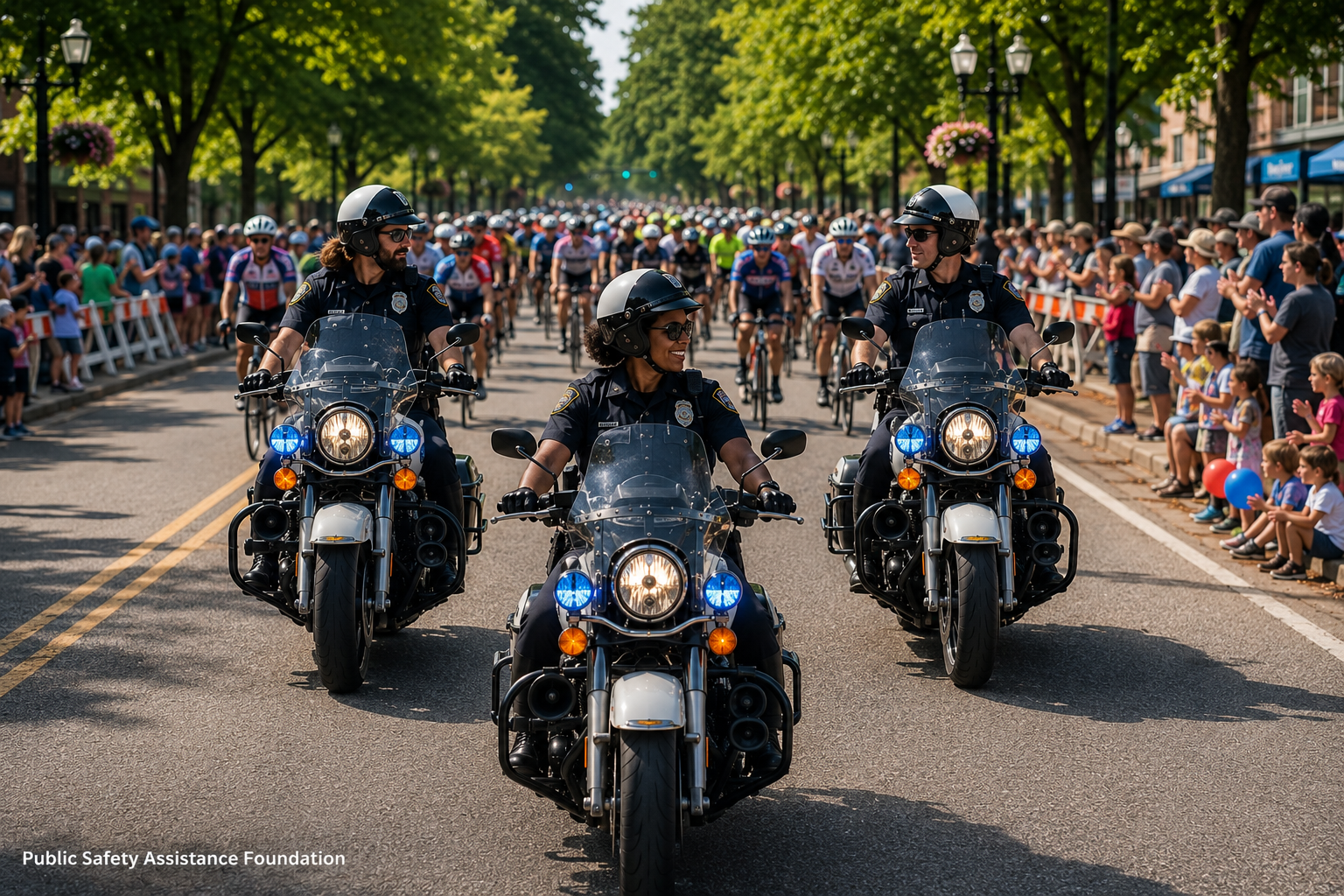
Motorcycle officers are often among the most recognizable members of an agency. As visibility increases, so does the importance of maintaining clear boundaries between public service and personal life.
Few assignments in law enforcement are as visible as motorcycle duty.
Motorcycle officers spend their shifts in plain view of the public. Whether directing traffic during a collision, leading a funeral procession, assisting at a community event, or patrolling busy roadways, they are often among the most recognizable members of an agency.
The role requires a unique combination of skill, focus, and situational awareness. Riding a motorcycle in traffic while monitoring surrounding vehicles, pedestrians, road hazards, and radio traffic demands constant attention. Every movement matters. Every decision matters.
Most conversations about motorcycle units focus on training, equipment, and roadway safety. Those topics are important and deserve attention.
But there is another aspect of visibility that is rarely discussed.
Today, a brief encounter on the roadway can leave a much longer digital footprint.
Information is easier to find, easier to share, and easier to connect than ever before.
A Highly Visible Assignment
Motorcycle officers often serve in positions that place them directly in front of the public.
They may work traffic enforcement on major corridors. They assist with large-scale events. They participate in parades, community outreach programs, and ceremonial functions. Their motorcycles make them highly recognizable, and their presence often attracts attention.
Unlike officers operating inside a patrol vehicle, these officers are more exposed to observation. Members of the public can easily see uniforms, equipment, appearance, and identifying details.
Many people remember the motorcycle officer they encountered during a traffic stop or saw assisting at a local event.
Most interactions are routine and professional.
Yet increased visibility also increases familiarity.
And familiarity can sometimes lead to curiosity.
📲 The Internet Has Changed Curiosity
Years ago, a brief interaction with a public employee often ended when the encounter was over.
Today, information is far easier to access.
A name mentioned online, a photograph shared on social media, or a public record posted on a website can become the starting point for additional searches.
What begins as curiosity can quickly turn into research.
People-search websites, data brokers, social media platforms, and public databases can assemble information from numerous sources and present it in a way that feels surprisingly complete.
An individual may never have intended to expose personal details. In many cases, information appears online through public records, third-party data collection, historical databases, or information shared by others.
The result is that someone who spends their professional life in public view may find that portions of their personal life have become visible as well.
Recognition Happens Faster Than Ever
Technology has changed how quickly information travels.
A photograph taken during a public event can be uploaded within seconds. A comment on a social media platform can be shared widely. A public discussion about a local incident can attract attention from people far outside the community where it occurred.
Motorcycle officers often work assignments that place them directly in these environments.
Large events, festivals, sporting activities, community gatherings, and traffic operations frequently involve dozens or hundreds of cameras.
Most people are carrying a smartphone capable of capturing high-quality images and video.
The overwhelming majority of this activity is harmless.
Still, it demonstrates how visibility has expanded far beyond physical spaces.
Being seen no longer means being seen by a handful of people standing nearby.
It can mean being viewed by thousands of individuals online.
Professional Exposure and Personal Exposure Are Different
Law enforcement officers understand that visibility is part of the profession.
Public service often requires operating in public spaces.
The challenge arises when professional visibility begins crossing into personal visibility.
An officer’s professional role may be public.
Their home address should not be.
Their family members should not become part of the conversation.
Their personal contact information should not be easily accessible simply because they perform a public-facing job.
These distinctions matter.
Most people would agree that serving the community should not automatically require sacrificing personal privacy.
Yet online information ecosystems often blur those boundaries.
The Importance of Digital Boundaries
Officers spend significant time maintaining physical awareness.
→ They watch traffic patterns.
→ They anticipate hazards.
→ They identify potential risks before they become emergencies.
→ The same mindset can be useful when considering online exposure.
→ Digital boundaries are not about secrecy.
→ They are about maintaining reasonable separation between responsibilities and personal life.
For law enforcement officers, that separation can support both safety and peace of mind.
It can also help reduce opportunities for unnecessary exposure involving spouses, children, and other family members.
Just as officers routinely inspect equipment before a shift, it can be valuable to understand what information may be circulating online and where it appears.
Awareness often becomes the first step toward reducing exposure.
Visibility Is Not Limited to Motorcycle Units
While motorcycle officers provide a useful example, this challenge extends across law enforcement.
Bike officers, K-9 handlers, school resource officers, detectives, command staff, federal agents, and public officials all operate in roles that may attract public attention.
The details of the assignment may differ.
The reality of online exposure does not.
The internet does not distinguish between a patrol officer, a motorcycle officer, a judge, or a prosecutor when collecting and distributing personal information.
Data brokers and people-search websites can amplify that visibility in ways many individuals never anticipated.
🔵 Supporting Those Who Serve Beyond the Shift
Motorcycle units represent professionalism, training, and dedication.
They are often among the first personnel community members to be noticed during public events and traffic operations.
→ Their visibility is part of the job.
→ Their personal information should not be.
As conversations about officer safety continue to evolve, it is worth remembering that safety is not limited to the roadway. It is not limited to protective equipment, traffic awareness, or operational training.
In today’s connected world, safety also includes understanding how personal information moves across the internet and taking reasonable steps to reduce unnecessary exposure.
Privacy for Cops helps law enforcement officers, public officials, and their families reduce online exposure through nonprofit privacy services designed to support stronger digital boundaries. Because being seen while serving the community should not mean being easy to find when the workday is over.
Learn more about us today!
About Us