
Online privacy has become a growing industry.
Every year, more companies appear offering monitoring services, identity protection, and data removal tools designed to help people reduce their online exposure. For many consumers, those services are simply another subscription intended to make life a little more convenient.
But for law enforcement officers, public officials, and their families, online exposure is often far more personal than that.
A searchable home address is not just a line of text on a website.
A phone number listed online is not simply an inconvenience.
A family member’s name connected to an officer’s profile is not just another piece of public information.
In the wrong hands, that information can create real-world risks that follow people long after a shift ends.
That reality is one of the reasons online privacy protection has become increasingly important for those who serve. It is also why the mission behind a privacy organization matters.
Online Exposure Is No Longer Passive
Years ago, finding personal information about someone often required significant effort.
Today, that process can take seconds.
Data broker websites, people-search platforms, public databases, social media accounts, and cached search results can quickly assemble personal details into a profile that becomes surprisingly easy to access. Even small fragments of information can create a larger picture when combined together.
Sometimes that exposure comes from public records.
Sometimes it comes from old online accounts.
Sometimes it comes from information shared by others without realizing the broader impact.
And sometimes the exposure spreads faster than people expect through screenshots, reposts, archived pages, and search engine indexing.
For law enforcement officers and public officials, the concern is not simply visibility—it is accessibility.
The internet has made it easier than ever for strangers to locate names, addresses, relatives, and other identifying information with very little effort. In many cases, that information reaches far beyond the individual employee and extends directly to their family members and home life.
That is why online privacy protection has become less about convenience and more about reducing unnecessary exposure before it becomes a larger problem.
Not Every Privacy Service Is Built the Same
As awareness around online privacy has grown, so has the number of companies offering removal and monitoring services.
Some focus primarily on consumers.
Some focus on identity theft prevention.
Some offer automated software tools.
Some operate on large-scale subscription models.
There is nothing inherently wrong with those approaches. But for law enforcement officers and public officials, online privacy concerns often require a more specialized understanding of the risks involved.
That distinction matters.
Because when someone works in a profession that involves public visibility, investigations, enforcement actions, or emotionally charged situations, online exposure carries a different weight.
The risks are not always theoretical.
- Harassment
- Targeted threats
- Doxxing
- False complaints
- Unwanted contact at home
The ability for someone to quickly gather personal details online can escalate situations that once remained isolated to the workplace.
That is why trust matters in this space.
And it is why mission matters too.
Why a Mission-Driven Approach Matters
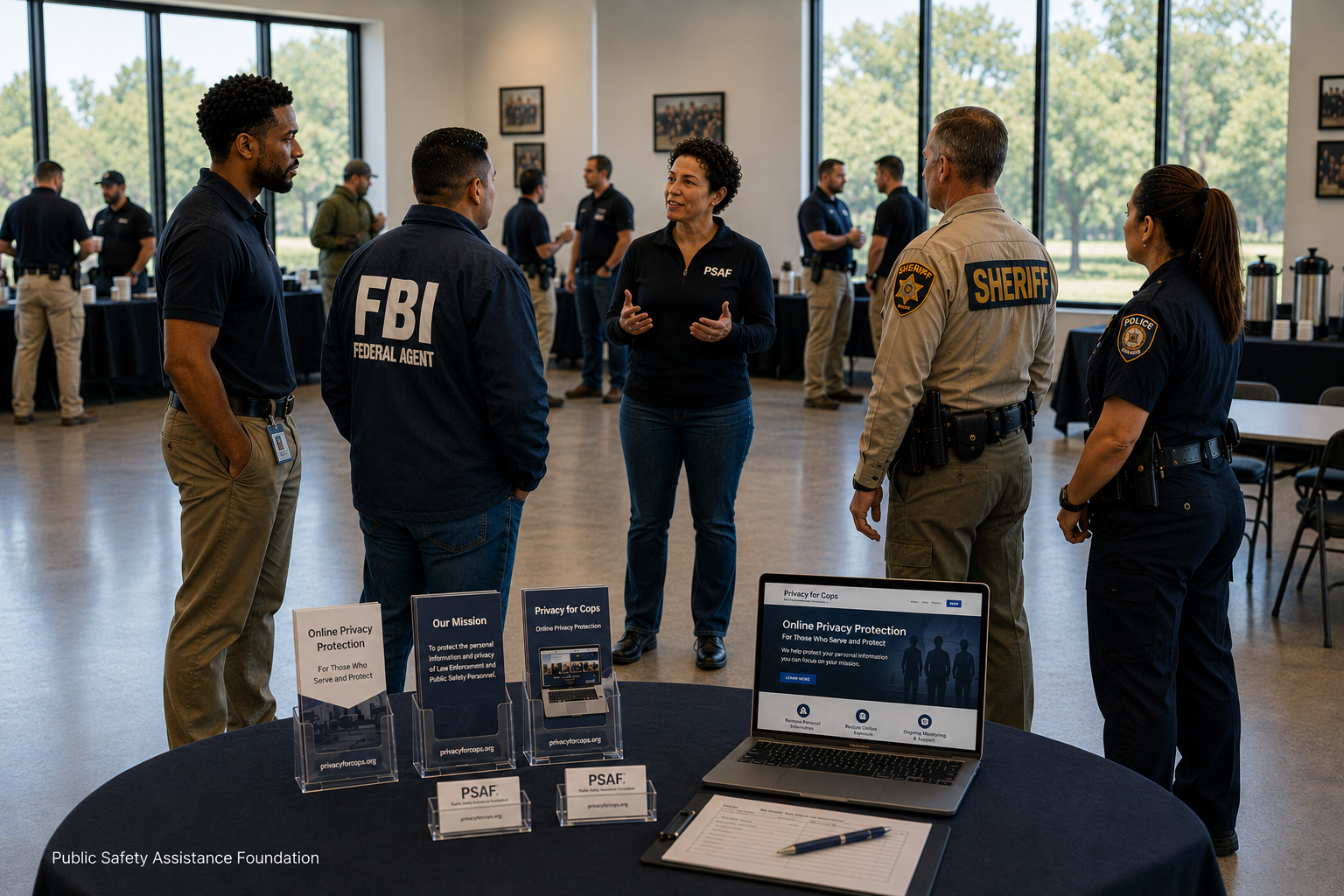
At the Public Safety Assistance Foundation (PSAF), online privacy protection was not created simply as a business opportunity.
It was created as part of a mission to help protect law enforcement officers, public officials, and their families from unnecessary online exposure.
That distinction shapes the entire approach.
As a nonprofit organization, the focus is not centered on maximizing profits or building the largest subscription base possible. The focus is centered on helping reduce online exposure risks for the people and families being served.
That mission-driven structure allows the organization to remain deeply connected to the realities officers and public officials face both on and off duty.
That commitment also extends beyond online removals alone. PSAF continues to support organizations and initiatives connected to the law enforcement and veteran communities through outreach efforts, partnerships, and awareness initiatives focused on protecting those who serve others.
Support has included organizations and events such as the Baker to Vegas Challenge Cup Relay, the Guardian Group’s anti-trafficking efforts alongside law enforcement agencies nationwide, and initiatives connected to the Wounded Warrior Project supporting veterans and their families.
Because behind every removal request is a real person trying to maintain boundaries between work and home life.
Behind every exposed address is a family trying to feel safer where they live.
And behind every online search result is the understanding that public-facing work should not automatically mean unlimited personal exposure online.
The goal is not simply to remove information.
The goal is to help reduce unnecessary risk.
Privacy Protection Is About More Than Technology
Many conversations about online privacy focus heavily on technology.
Algorithms.
Monitoring tools.
Search engines.
Automated scans.
While those systems matter, online privacy protection is ultimately about people.
It is about helping officers feel more comfortable knowing their information is being monitored.
It is about helping families reduce anxiety surrounding what can easily be found online.
It is about creating stronger boundaries between public responsibilities and personal lives.
And it is about recognizing that exposure online can impact mental well-being just as much as physical safety.
For many officers, the stress does not always end when the workday is over. The internet has created an environment where exposure can continue long after someone leaves the office, courtroom, station, or patrol vehicle.
That is one reason ongoing monitoring matters so much.
Online exposure is not static.
→ New websites appear.
→ Information resurfaces.
→ Search results change.
→ Databases update.
A one-time removal does not always mean the issue disappears permanently.
Reducing online exposure often requires continued attention over time.
A Growing Conversation Around Online Safety
Conversations surrounding officer safety often focus on physical environments.
Traffic stops.
Emergency responses.
Public events.
Operational planning.
But online safety has increasingly become part of that larger discussion.
The information available online can influence real-world interactions in ways many people do not immediately realize.
A simple online search can reveal patterns, locations, associations, and personal details that were once much harder to obtain.
That is why awareness continues to grow around the importance of proactive online privacy protection.
Not because people expect complete invisibility online.
But because reducing unnecessary exposure can help create safer boundaries.
For law enforcement officers and public officials, those boundaries matter.
And for families, they matter too.
Protecting the People Behind the Profession
One of the most important reminders in conversations about online privacy is that police officers and public officials are still people outside of their roles.
→ They are parents
→ Spouses
→ Neighbors
→ Friends
→ Community members
They deserve the ability to live their personal lives without unnecessary exposure becoming part of everyday stress.
That belief is part of what makes a mission-driven approach meaningful.
When an organization exists specifically to support those who serve others, online privacy protection becomes more than a service offering. It becomes part of a broader commitment to helping reduce preventable risks before they escalate.
At PSAF, that mission continues through professional opt-out services, ongoing monitoring, and continued efforts to help law enforcement officers, public officials, and their families reduce unnecessary online exposure across hundreds of data broker and people-search websites.
Because protecting personal information online is not just about privacy anymore.
It is about helping protect the people behind the profession.
Learn more about PSAF’s mission and sign up for online privacy removal.
About Us