
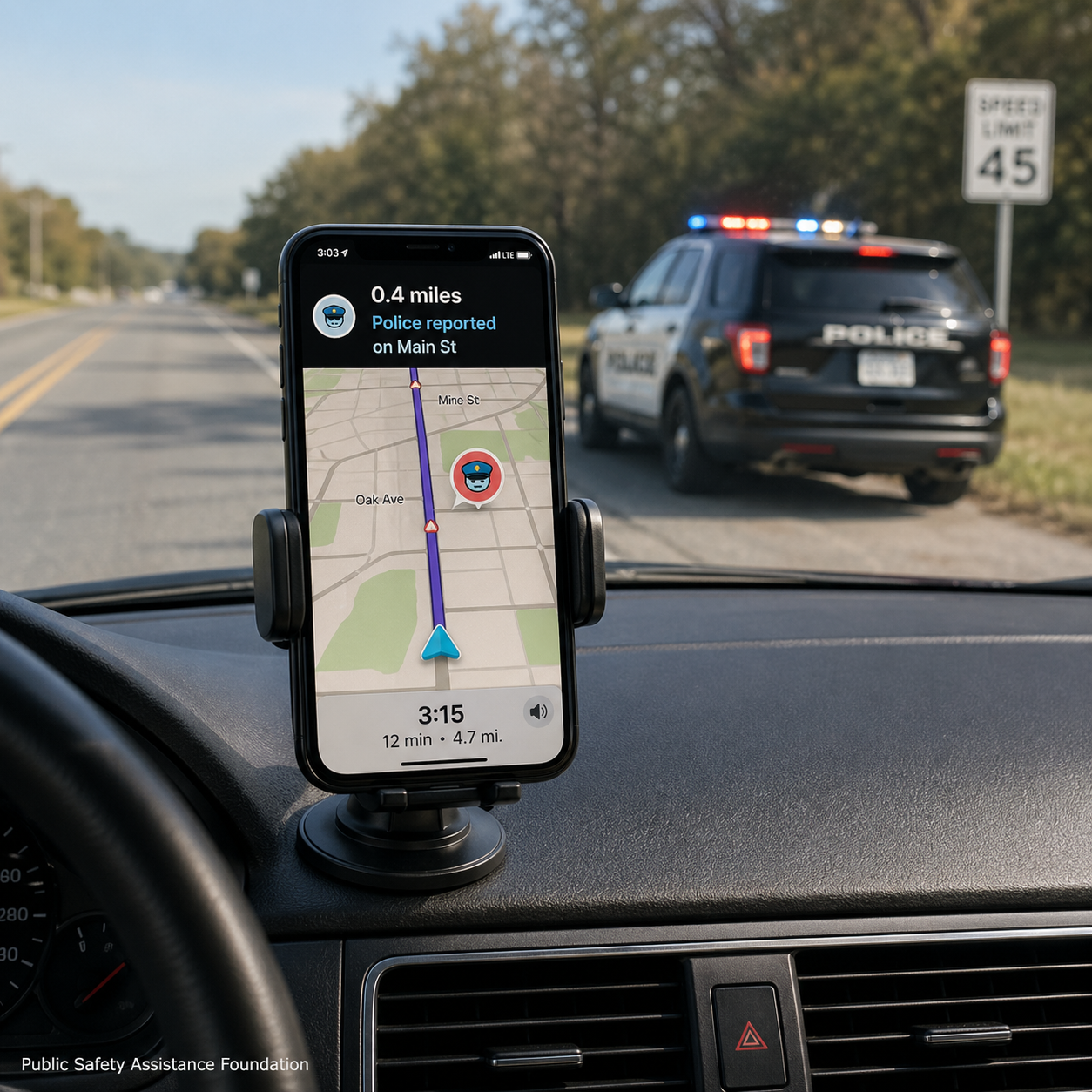
There was a time when knowing where a law enforcement officer was required proximity.
You had to see the patrol car.
You had to hear the radio traffic.
You had to be there.
That is no longer the case.
Today, information travels faster than movement. In many situations, it is available before an officer even arrives on scene, and it doesn’t stay confined to that moment. It spreads, it’s stored, and it becomes part of something much larger.
What started years ago as a debate over a single traffic app has evolved into a much broader concern. The issue is no longer just about whether someone can spot an officer on the road. The real question is how easily someone can track patterns, monitor activity, and connect that information to a real person behind the badge.
And in 2026, that shift is impossible to ignore.
📍What Started with Traffic Apps Has Grown Into Something Else
Back in 2016, much of the attention centered around apps like Waze.
The concern was straightforward. Users could report where law enforcement officers were located, creating a crowdsourced map of police presence. For many drivers, it was simply a way to avoid delays or citations.
From a law enforcement officer’s perspective, however, it introduced a new layer of visibility—one that felt unnecessary and, at times, uncomfortable.
But looking back now, that concern was only scratching the surface.
Because today, it’s not just one app.
It’s an entire network of tools and platforms that provide real-time awareness, including:
- Scanner apps that stream radio traffic across jurisdictions
- Social media posts shared instantly from active scenes
- Livestreams that broadcast officer activity without delay
- Online forums and group chats that crowdsource updates
- AI-driven search tools that organize and summarize information within seconds
What once required effort, timing, and physical presence now requires almost none.
And more importantly, what used to be temporary has become persistent and searchable.
The Difference in 2026: Speed, Scale, and Connection
The biggest change over the last decade isn’t just access, it’s connection.
In the past, seeing where an officer was located didn’t necessarily tell you who they were.
Today, that gap has narrowed significantly.
With just a few data points, it’s possible to connect:
- A name or partial name
- A department or jurisdiction
- A location tied to activity
- A vehicle or assignment pattern
- Family members or associates
- A home address
Not because that information is handed over directly, but because it exists across hundreds of data broker sites, public records, and aggregated platforms.
This is what’s often described as the “puzzle effect.”
One piece alone may not mean much.
But when combined with others, it creates a detailed and actionable profile.
So, the concern has shifted.
It’s no longer just:
🔵 “Can someone see where an officer is?”
It’s:
🔵 “Can someone figure out who they are, and follow that information beyond the job?”
Real-Time Awareness Creates Real-World Risk
It’s important to recognize that most people using these tools are not doing so with harmful intent.
But risk is not measured by the majority. It’s measured by what the wrong individual can do with the information that is available.
When real-time location awareness intersects with personal data exposure, it creates a different type of vulnerability. One that extends beyond a single moment or location.
For example:
- Someone can monitor where officers are responding in real time
- They can begin to recognize patterns in movement or assignment
- They can identify specific personnel over repeated observations
- And they can connect those observations to online data
That connection is where the risk expands.
Because once an officer is identified, the focus can shift quickly:
- From patrol activity to personal routine
- From department affiliation to home location
- From the individual to their family
And none of this requires access to restricted systems. It relies entirely on information that is already available, scattered across the internet.
The Overlooked Role of Social Media and Sharing
One of the biggest accelerators of this issue in recent years has been social media.
A single post from a bystander can now include:
- A photo or video of an active scene
- A timestamp and location
- Commentary or assumptions
- And immediate distribution to a wide audience
From there, it can be reshared, reposted, or archived indefinitely.
Even when the original intent is harmless, the result can still contribute to exposure.
Because once that content is online, it becomes:
- Searchable
- Indexable
- Screenshot-able
- And reusable in ways the original poster never intended
This is how isolated moments turn into lasting digital records.
Why the Risk Doesn’t End When the Scene Does
One of the most important shifts to understand is that exposure is no longer tied to the moment.
In the past, visibility ended when the interaction ended.
Today, it doesn’t.
Information connected to a single incident can continue to circulate long after:
- It may appear in search results weeks or months later
- It can be referenced alongside unrelated data
- It may be combined with other sources to build a broader profile
Over time, these fragments accumulate.
And as they do, they create a more complete picture.
The Gap Between “Public” and “Accessible”
There is a common belief that if something is public, it’s not a concern.
But that assumption doesn’t reflect how information works today.
What has changed is not just what is public, but how accessible it has become.
Technology now makes it possible to:
- Aggregate data from multiple sources
- Organize it into a single profile
- Search it instantly
- And share it widely
This is what creates the real gap.
Not between public and private, but between what exists and how easily it can be accessed and used.
For law enforcement officers and public officials, that gap can mean:
- Personal details appearing across multiple platforms
- Family connections becoming easier to identify
- Home addresses being listed and relisted
- Old information resurfacing in new ways
All without any direct action from the individual.
Where This Leaves Law Enforcement in 2026
The early concerns about a “police tracker” app were valid.
But they only addressed one part of a much larger issue.
Today, the environment has evolved into something far more interconnected.
The question is no longer whether someone can see where an officer is located.
It’s whether they can:
- Follow the digital trail
- Connect multiple data points
- And build a profile that extends beyond the uniform
That is the reality law enforcement is operating in today.
And it’s why the conversation around safety has expanded beyond the scene itself.
Managing Exposure in a Constantly Updating Environment
One of the biggest challenges with online exposure is that it is not static.
Information doesn’t just exist—it moves.
It is:
- Collected by data brokers
- Shared across people-search platforms
- Updated and refreshed regularly
- Replicated across multiple sites
Which means removing it once is not enough.
It requires an ongoing process to:
- Identify where information appears
- Submit removal requests
- Monitor for reappearances
- And address new exposures as they surface
This is where many individuals underestimate the scope of the issue.
Because while the exposure grows automatically, reducing it does not.
A More Complete Approach to Protection
Understanding the risk is an important first step.
But what matters most is what happens next.
Reducing online exposure requires more than awareness. It requires action that is consistent, structured, and ongoing.
Especially in an environment where:
- Information is constantly being collected
- New platforms continue to emerge
- And existing data is continuously being republished
For law enforcement officers and their families, this isn’t just about privacy.
It’s about control.
Don’t Wait for Exposure to Become a Problem
By the time personal information becomes easy to find, it has often already been circulating for some time.
That’s what makes proactive protection so important.
Privacy for Cops helps law enforcement officers, public officials, and their families have their personal information professionally removed from data broker and people-search sites, with ongoing monitoring designed to keep it from coming back.
If you’re ready to take a more proactive approach to protecting your personal information and limiting your digital exposure, contact us today to get started.
Exclusive Privacy Plans