
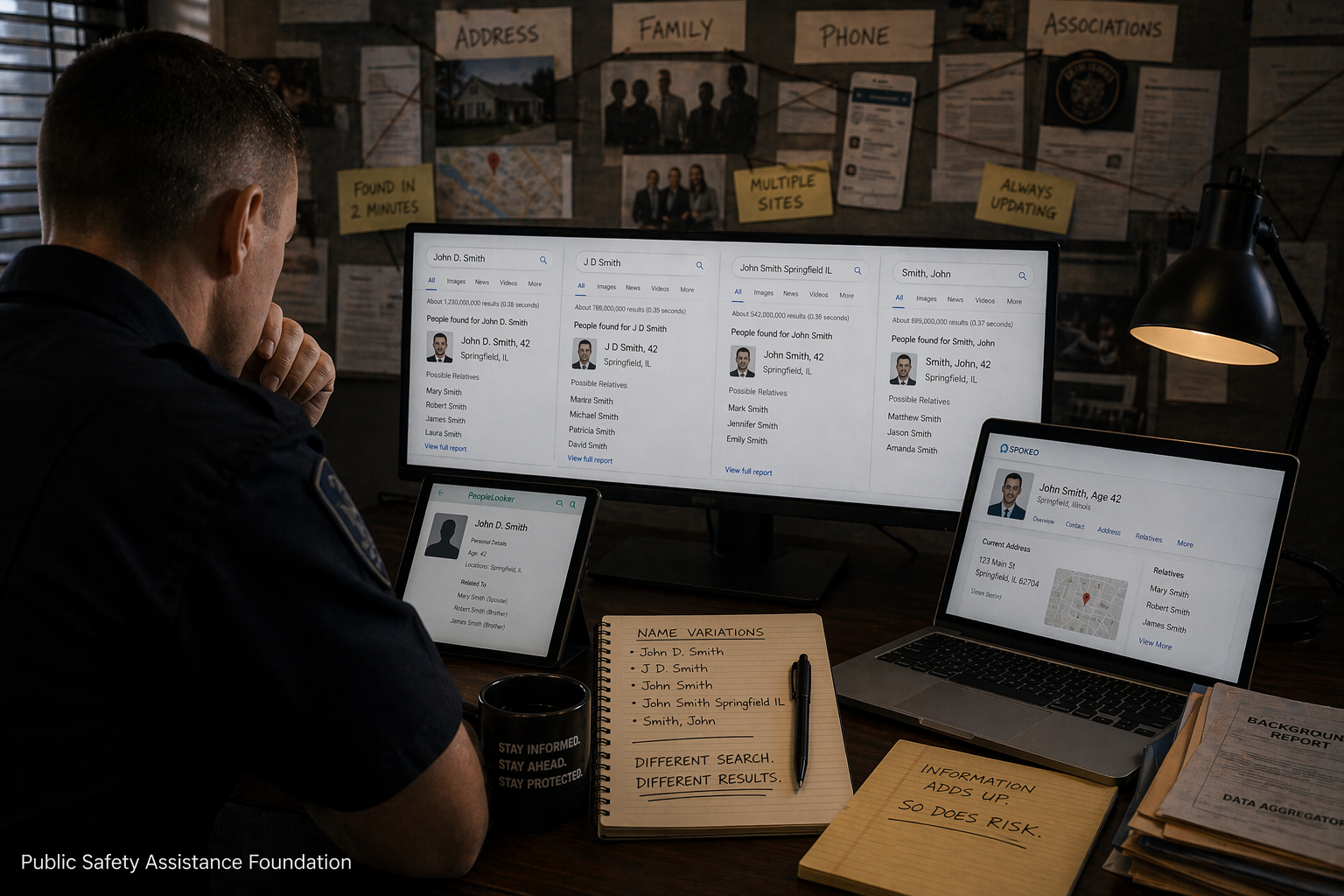
🔎 What You See Isn’t What Everyone Else Sees
Most people have searched their own name at some point.
Usually, it’s casual. A quick search out of curiosity. Maybe you’re checking what a colleague might see or trying to find an old profile. You glance at the first few results, recognize a few familiar links, and move on.
But here’s the problem.
That quick check is not how someone else searches for you.
A stranger doesn’t have your context. They don’t know which profiles are outdated, which addresses are old, or which relatives are no longer connected to you. They aren’t skimming, they’re looking.
And more importantly, they’re looking with a purpose.
That difference changes everything.
For law enforcement officers and public officials, what appears in a simple search is not just informational. It can shape perception, reveal personal details, and create connections that were never meant to be public.
So today, instead of a casual search, try something different.
Search your name like a stranger would.
What comes up might surprise you.
Step 1: Start With a Clean Slate
Before you type anything into a search bar, pause.
If you’re logged into your Google account, your results are already being filtered. Search engines personalize results based on your history, location, and behavior. That means what you see is not what others see.
To get closer to a neutral view:
- Open an incognito or private browsing window
- Log out of your accounts
- Avoid clicking your own links during the search
This creates a more realistic starting point.
Now type your full name into the search bar.
Not a nickname. Not just your first and last name if you commonly use a middle name. Use the version someone else would most likely search.
And then stop scrolling for a moment.
Look at the first page carefully.
Because that’s where most people stop.
Step 2: Scan the First Page Like It’s Not You
The first page of results is your digital front door.
This is where someone forms their first impression, and often, their only impression.
Instead of asking, “Do I recognize this?” ask something different:
- What would someone assume based on these results?
- What information is immediately visible without clicking anything?
- Does anything stand out in a way that feels unnecessary or overly personal?
You may see:
- Social media profiles (active or inactive)
- Old articles or mentions
- Professional directories
- Public records
- Aggregated profile previews
Even without clicking, search results often show:
- Cities you’ve lived in
- Age ranges
- Possible relatives
- Employment associations
This is passive exposure.
No digging required.
And for someone who is intentionally gathering information, this is just the starting point.
Step 3: Click What a Stranger Would Click
Now take the next step.
Click the results that look the most informative.
Not the ones you prefer. The ones that someone else would find useful.
This is where the experience usually changes.
People-search sites and data broker platforms often appear high in search results. These sites compile information from multiple sources and package it into easy-to-read profiles.
Within seconds, you may find:
- Current and previous addresses
- Phone numbers (past and present)
- Names of relatives and associates
- Property ownership details
- Date of birth or age range
Some listings are free. Others require payment to unlock more details.
But even the free portions can reveal more than most people expect.
And the key issue isn’t just accuracy.
It’s accessibility.
Because even outdated or partially incorrect information can still point someone in the right direction.
Step 4: Look for Patterns, Not Just Data
At this point, it’s easy to focus on individual data points.
An address here. A phone number there.
But what matters more is the pattern.
Ask yourself:
- Can someone connect my name to a physical location?
- Can they identify family members or close associates?
- Can they piece together a timeline of where I’ve lived or worked?
Individually, each piece may seem minor.
Together, they create a much clearer picture.
This is how digital exposure works.
It’s not always about a single piece of sensitive information. It’s about how multiple pieces combine to create visibility.
And once that visibility exists, it becomes easier to build on it.
Step 5: Search Variations of Your Name
A thorough search doesn’t stop with one version of your name.
Try variations:
- First name + last name
- First name + middle initial + last name
- Last name + city or state
- Name + profession
Each variation can produce different results.
In some cases, you may uncover listings that didn’t appear in your original search.
This is especially common on data broker sites that categorize information differently based on how the search is performed.
Someone looking for you isn’t limited to one search.
And neither should you be.
Step 6: Don’t Forget Images and Maps
Search results are not limited to text.
Click on the “Images” tab.
You may find:
- Profile pictures from old accounts
- Photos tied to articles or events
- Images pulled from social platforms
Now check the “Maps” results if they appear.
Sometimes addresses or associated locations can be displayed in ways that feel more visual and immediate.
These elements can reinforce what someone has already found.
And in some cases, they make the information feel more real.
Step 7: Ask the Most Important Question
After going through this process, pause again.
And ask one simple question:
“If I didn’t know me, what would I think?”
Would the information feel routine?
Or would it feel like more than expected?
For many people, especially those in public-facing roles, the answer is somewhere in the middle.
Nothing feels extreme on its own.
But collectively, it’s more visibility than they realized existed.
Why This Matters More for Law Enforcement and Public Officials
For law enforcement officers and public officials, this exercise carries more weight.
Because the people searching are not always neutral.
Some may be curious.
Others may be intentional.
And the difference between those two matters.
When personal information is easily accessible:
- It can create unnecessary familiarity
- It can connect professional roles to personal lives
- It can extend visibility beyond the workplace
This is where online privacy becomes more than a general concern.
It becomes part of how exposure is managed over time.
Because information online is not static.
It updates. It spreads. It reappears.
And without active management, it tends to grow.
The Reality: Awareness Is Just the First Step
Searching your name is valuable.
It builds awareness.
It shows you what’s visible at a surface level.
But it doesn’t remove anything.
And it doesn’t stop new information from appearing.
That’s where many people get stuck.
They see what’s out there, but they don’t have the time, tools, or process to address it effectively.
Because removing information from data broker sites is not a one-time task.
It requires:
- Identifying where your information exists across hundreds of sites
- Submitting removal requests correctly
- Following up when listings reappear
- Monitoring ongoing changes
It’s not a quick fix.
It’s an ongoing process.
Turning Awareness Into Action
Seeing your information online is one thing.
Deciding what to do about it is another.
For law enforcement officers and public officials, reducing unnecessary exposure is not about reacting after something happens.
It’s about staying ahead of what’s already visible.
At Privacy for Cops, that’s exactly what we do.
We professionally remove personal information from data broker and people-search sites and continuously monitor for new exposure over time.
No guesswork. No do-it-yourself process.
Just a structured, ongoing approach designed to reduce your digital footprint and help limit what others can easily find.
Because the goal isn’t just to know what’s out there.
It’s to take control of it.
See What’s Already Visible, Then Take Control of It
You’ve seen how quickly information can surface.
In just a few minutes, a simple search can reveal more than expected.
Now imagine what that looks like over time, across hundreds of sites, with constantly updating data.
That’s the gap most people don’t see.
And it’s exactly where we come in.
What appears in a search can shape more than perception. It can create access.
Privacy for Cops provides a professional, ongoing solution to remove personal data and limit what others can easily find about you and your family.
Take a proactive step toward reducing your exposure with a system built for long-term protection.
Exclusive Privacy Plans