
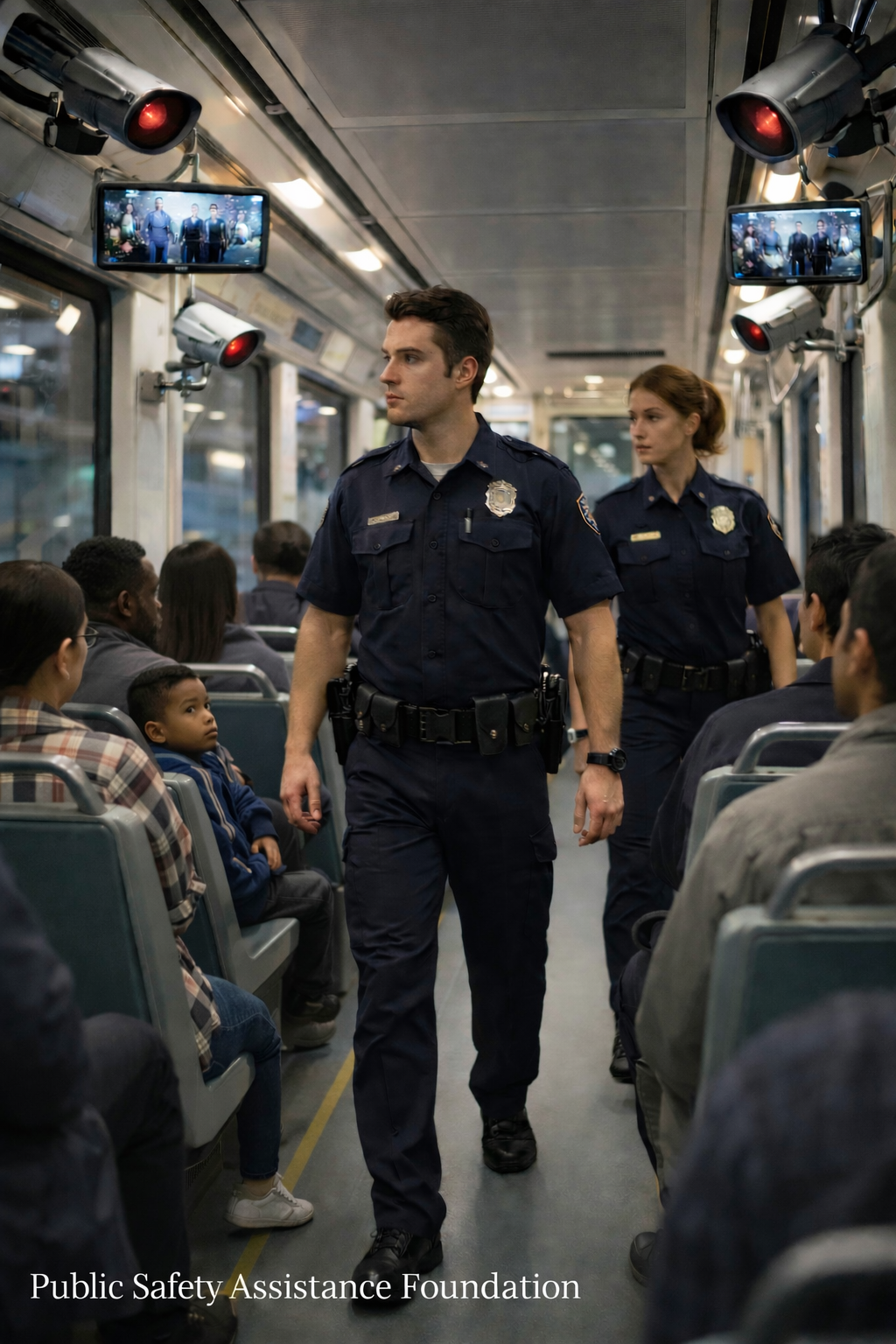
A recent change in a California transit security program made headlines for operational reasons—staffing shortages, agency restructuring, and expanded resources. But beneath the administrative shift sits a broader story about how the environments law enforcement officers work in are evolving.
The updated safety approach relies on multiple layers of monitoring operating simultaneously: surveillance cameras, real-time observation centers, public reporting tools, and integrated communications. Each element is intended to improve response and awareness.
At first glance, this appears to be a straightforward safety upgrade.
In reality, it reflects a fundamental change in the conditions officers perform their duties within every day.
Public spaces are no longer simply observed.
They are continuously documented.
And documentation rarely ends when the call ends.
The Permanently Recorded Workplace
An officer responding to a call today is often captured from numerous sources at once:
- body-worn cameras
• fixed government surveillance systems
• private business cameras
• residential doorbell cameras
• dashboard cameras
• civilian smartphones
• reporting applications
• media footage
Years ago, most encounters were preserved only through written reports and occasional video evidence. Now the same moment may be recorded repeatedly before the officer leaves the scene.
Each recording exists independently.
Each recording may be stored indefinitely.
Each recording may reappear at any time.
The shift is subtle but important: public safety work has moved from situational documentation to persistent documentation.
The officer clears the call.
The digital record continues to exist.
Documentation Is No Longer Centralized
In previous decades, records were controlled by agencies. Access required time, effort, and process. Even public records required intentional searching.
Today documentation is decentralized.
Information lives across social platforms, private companies, archived news footage, search engines, community forums, and data brokers. None of these systems need to coordinate for information to become connected. Search technology does that automatically.
An interaction does not need to go viral to become permanent.
It only needs to be stored somewhere searchable.
This creates a situation where exposure forms gradually rather than dramatically.
From Observation to Discoverability
Visibility used to depend on attention. If few people witnessed an event, it faded naturally.
Now visibility depends on discoverability.
Public reporting tools allow witnesses to upload photos and video directly into safety systems. These tools improve communication and can prevent crime, but they also multiply the number of pathways through which an officer’s identity may be preserved.
A recording created for safety may later appear:
- reposted online
• copied into compilation videos
• referenced in unrelated discussions
• indexed by search engines
• attached to commentary
• rediscovered years later
No single person intends lasting exposure. The internet simply preserves and reorganizes information as new context appears.
The Mechanism Behind Exposure: Correlation
Recording itself is rarely the source of risk. The connection of separate data points is.
A single image shows very little. But multiple fragments gathered over time can reveal far more than expected.
A visible name becomes searchable.
The search reveals a licensing record.
The record reveals a property listing.
The listing reveals a residence.
The residence reveals family members.
Every step uses lawful public information. The concern is how easily unrelated details combine.
This process happens quietly and gradually. Officers rarely see it forming. They only see the result once the profile already exists.
Why Exposure Often Appears Later
Digital exposure usually does not cause immediate problems. Its impact is delayed.
Search engines constantly reorganize information as new material appears online. That means older recordings can suddenly return to visibility after years of inactivity.
A routine call today may not resurface until a future event draws attention to similar incidents. At that point archived material becomes newly relevant and appears alongside current information.
The officer remembers the interaction as ordinary.
The internet treats it as recent.
This delayed rediscovery is one of the most common sources of unexpected exposure.
Transparency and Personal Boundaries
Transparency strengthens public confidence and supports accountability. Documentation helps clarify events and resolve disputes. Online privacy protection does not conflict with transparency.
The concern is unintended personal traceability.
Agency records exist within controlled systems. Online ecosystems do not. Once information leaves official channels, duplication becomes unpredictable and persistent.
A recording intended to document professional activity can unintentionally become a reference point linking to private life.
Professional visibility is part of the job.
Personal accessibility should not automatically follow.
The Expanding Data Environment
Safety technology continues improving coordination and response effectiveness. Real-time monitoring and reporting tools benefit both agencies and communities.
However, each additional data source increases the likelihood that information can be cross-referenced elsewhere online.
Exposure commonly follows a pattern:
- An interaction is recorded
- The recording is stored or shared
- Identifiers become searchable
- Databases collect related information
- A profile forms unintentionally
No single step creates concern alone. Accumulation does.
Why Families Feel the Impact
For many law enforcement officers, the concern is not recognition during duty hours. It is how easily professional exposure reaches home life.
When personal information becomes easily discoverable, it may reveal:
- home address
• relatives and associates
• previous residences
• contact details
• routine locations
Often this information already existed separately online. Recording simply connected the pieces.
The objective is not anonymity.
It is separation between public duty and private life.
A Behavioral Shift Officers Now Face
The profession has quietly added a new responsibility: managing long-term visibility.
Officers are trained to evaluate immediate surroundings—exits, cover, positioning, and communication. Increasingly they must also consider how an event may exist after it concludes.
Questions that rarely mattered before now matter:
Will this appear online later?
Could this be searchable next year?
Could unrelated records connect to it?
This is not about changing behavior in the field. It is about understanding how documentation persists beyond the moment.
Informational Exposure as a Safety Consideration
Traditional safety planning emphasizes awareness and positioning. These remain essential.
But informational exposure has become another layer of risk management.
A shift may end physically while continuing digitally.
Reducing unnecessary discoverability helps prevent routine encounters from turning into long-term personal visibility. It does not interfere with accountability. It reduces how easily unrelated personal data attaches to professional activity.
Preparing Before Attention Happens
Recording technology will continue expanding across transportation systems, schools, businesses, and neighborhoods. Officers cannot control whether they are recorded during duty.
They can control how easily recordings lead back to their personal information.
Preventative action is most effective early. Once information spreads widely, removing connections becomes significantly more difficult.
Planning ahead preserves boundaries between work and home.
Looking Ahead
Public safety environments are becoming permanently documented spaces. This benefits coordination, response, and understanding. It also changes how officers must think about privacy.
The primary change is not simply observation.
It is lasting searchability.
Recognizing this difference helps officers adapt to a world where documentation is constant and rediscovery is unpredictable.
Continuous recording means an interaction may exist long after the moment has passed. Taking proactive steps to reduce personal discoverability helps keep professional service from extending into private life.
Visit Privacy for Cops to see what information about you is already online and learn how our removal and monitoring services help law enforcement officers and public officials reduce unnecessary exposure.
Enroll today and start separating your professional role from your personal life.
Your career serves the public.
Your home life deserves distance.