
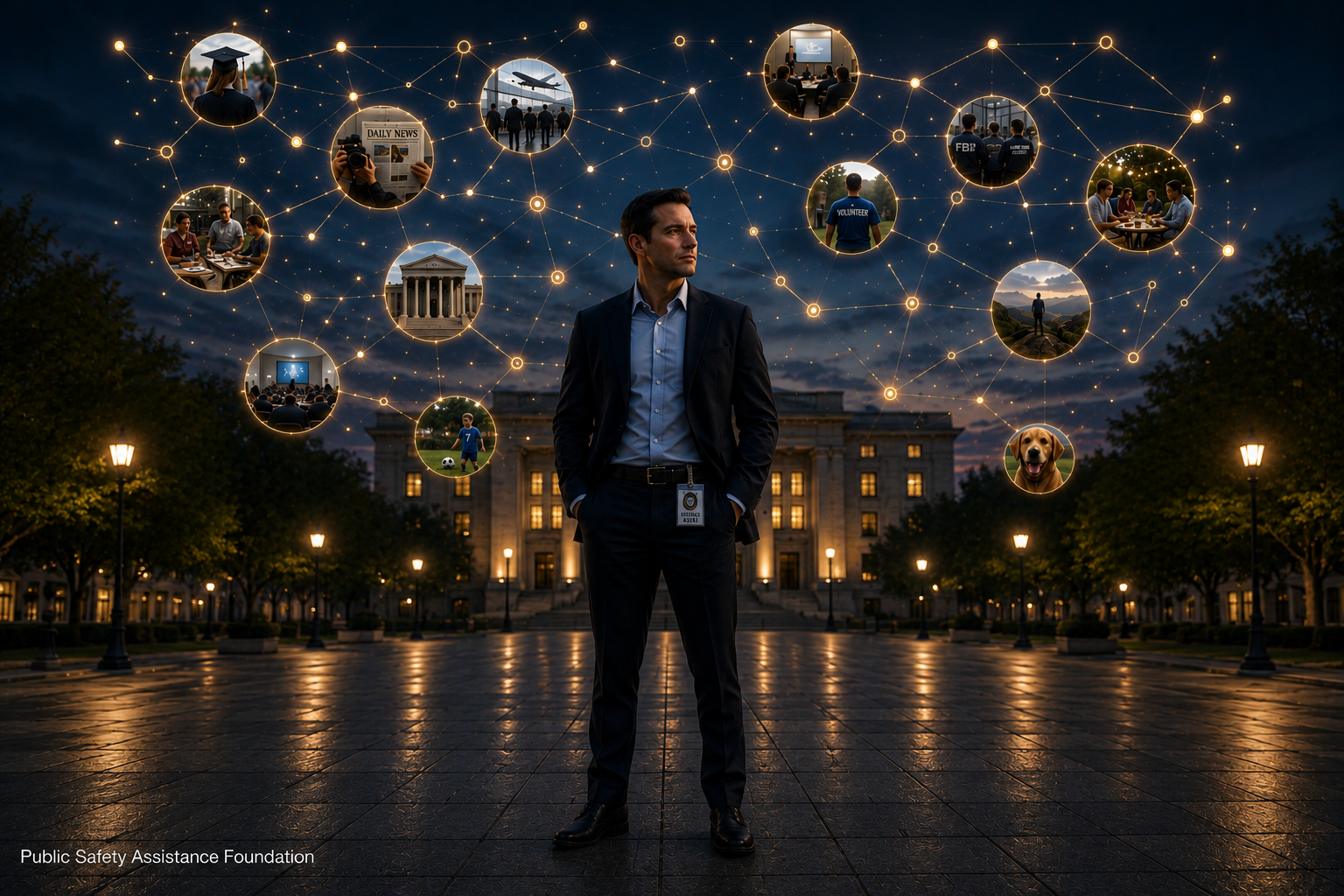
The Difference Between Storing Information and Telling a Story
When most people think about online privacy, they picture a single piece of information they wish wasn’t available. It might be a home address on a people-search website, an old news article, a property record, or a family photograph shared years ago.
Those individual pieces of information often receive the most attention because they are easy to identify. You can point to them, recognize them, and understand why they matter.
What is often overlooked is something much larger.
The internet doesn’t simply store information—it connects it.
Search engines, public records, archived webpages, directory listings, news articles, community organizations, and social media references all exist independently. Yet together, they can create something far more revealing than any single webpage ever could.
They create a narrative.
For law enforcement officers and public officials, understanding how that narrative develops is an important part of understanding online privacy.
Individual Pieces Often Seem Harmless
Most online references are not created with malicious intent.
An academy graduation announcement celebrates an accomplishment.
A charity event recognizes volunteers.
A neighborhood newsletter thanks community members.
A race registration confirms participation in a local event.
An association directory lists professional involvement.
A spouse posts family vacation photos.
None of these examples are inherently dangerous on their own.
In fact, many represent positive moments that families are proud to share.
The challenge isn’t necessarily the individual webpage.
It’s what happens when someone views all of those pages together.
→ Search Engines Don’t Think Like People
When we remember someone, we usually think about a handful of experiences.
Search engines work differently.
They collect connections:
- One search result leads to another
- A directory links to an organization
- An organization mentions an award
- The award references a community event
- The community event includes photographs
- The photographs identify family members
- A family member appears in another public post
What initially seemed like isolated pieces of information gradually become connected.
Over time, those connections begin telling a story.
Not because anyone intentionally created one—but because the internet naturally organizes information in ways that make relationships easier to discover.
The Narrative Grows Over Time
Many people assume their online presence reflects what they’ve shared recently.
In reality, it often reflects years or even decades of activity.
Older newspaper articles may still appear in search results.
Archived webpages remain accessible long after organizations redesign their websites.
Professional biographies may continue to exist years after positions change.
Volunteer recognition pages, alumni directories, conference attendance lists, community announcements, and public records often remain available long after people have forgotten about them.
Meanwhile, new information continues to appear:
- A school event
- A charity fundraiser
- A retirement celebration
- A neighborhood project
- A youth sports tournament
Individually, these moments may seem insignificant.
Collectively, they continue expanding the story available online.
Context Is Created by Connection
One piece of information rarely provides complete context.
Several pieces often do.
For example, an archived article may mention the city where someone lives.
A volunteer recognition page identifies a local nonprofit.
A public directory lists a professional affiliation.
A family photograph reveals familiar landmarks.
A race registration confirms participation in an annual event.
None of these pages may contain sensitive information by themselves.
Together, however, they begin establishing patterns:
- Patterns about locations
- Patterns about routines
- Patterns about family
- Patterns about community involvement
This is why online exposure is rarely about one webpage.
It’s about the relationship between many webpages.
The Story Isn’t Always Accurate
Another important consideration is that online narratives are not necessarily complete—or even correct.
Search engines don’t understand context.
They don’t know which information is outdated.
They don’t recognize whether someone has moved.
They don’t distinguish between current employment and former employment.
They don’t know whether a family member’s public profile has changed.
Instead, they simply present information that appears relevant.
Someone reviewing those results may draw conclusions that are partially correct, completely outdated, or entirely inaccurate.
Yet those conclusions can influence perceptions.
That’s one reason managing unnecessary online exposure matters.
It’s not about hiding.
It’s about reducing the amount of outdated, unnecessary, or overly revealing information that contributes to an incomplete picture.
Family Members Become Part of the Narrative
For many officers, online visibility extends well beyond their own name.
Family members naturally contribute additional information.
A spouse may receive recognition at work.
A teenager may participate in school activities.
Parents may appear in local organizations.
Relatives may post photographs from holidays, graduations, or community events.
Again, none of these activities are problematic.
They’re simply part of everyday life.
The challenge is that search engines don’t separate these connections the way people often do.
Instead, they recognize relationships.
Over time, the online story becomes less about one individual and more about an entire network of people connected through ordinary experiences.
Digital Narratives Continue to Evolve
One of the biggest misconceptions about online information is that it remains static.
It doesn’t.
New webpages are published every day.
Directories update.
Organizations recognize volunteers.
Community groups post event photos.
Archived content resurfaces.
People-search websites refresh their databases.
Information that wasn’t visible six months ago may appear tomorrow.
Likewise, information that seemed insignificant years ago may become easier to discover as search technology continues evolving.
This is one reason online privacy should be viewed as an ongoing process rather than a one-time task.
Visibility changes.
Search results change.
The online narrative changes.
Reducing Exposure Helps Change the Story
No online privacy service can erase every reference that exists across the internet.
Public records, legitimate news reporting, and certain government information may remain publicly available according to applicable laws and regulations.
However, that doesn’t mean nothing can be done.
Reducing exposure from hundreds of people-search websites can significantly limit how easily personal information is collected and connected.
Ongoing monitoring also helps identify newly published listings so they can be addressed over time.
Rather than allowing unnecessary information to continually expand the online narrative, proactive privacy management helps reduce the number of details that contribute to it.
The objective isn’t to disappear.
It’s to make it more difficult for strangers to assemble an increasingly complete picture of your personal life.
Every Story Deserves Thoughtful Editing
Every law enforcement officer builds a story over the course of a career.
That story includes service, sacrifice, professionalism, community involvement, and family milestones.
Those are meaningful parts of life.
Unfortunately, the internet often writes its own version of that story by connecting thousands of unrelated pieces of publicly available information.
Most people never intended to publish a detailed profile of themselves or their families.
It simply developed over time through ordinary participation in everyday life.
Understanding how that happens is the first step toward understanding why online privacy matters.
Sometimes the greatest risk isn’t a single search result.
It’s the complete narrative that emerges when all of those search results are viewed together.
Your career tells one story. Your family tells another. The internet doesn’t always know the difference. Privacy for Cops helps remove personal information from hundreds of people-search websites while continuously monitoring for new listings, helping place more distance between your professional role and your personal life. Explore our Exclusive Privacy Plans to learn how ongoing privacy protection can help preserve that separation over time.