
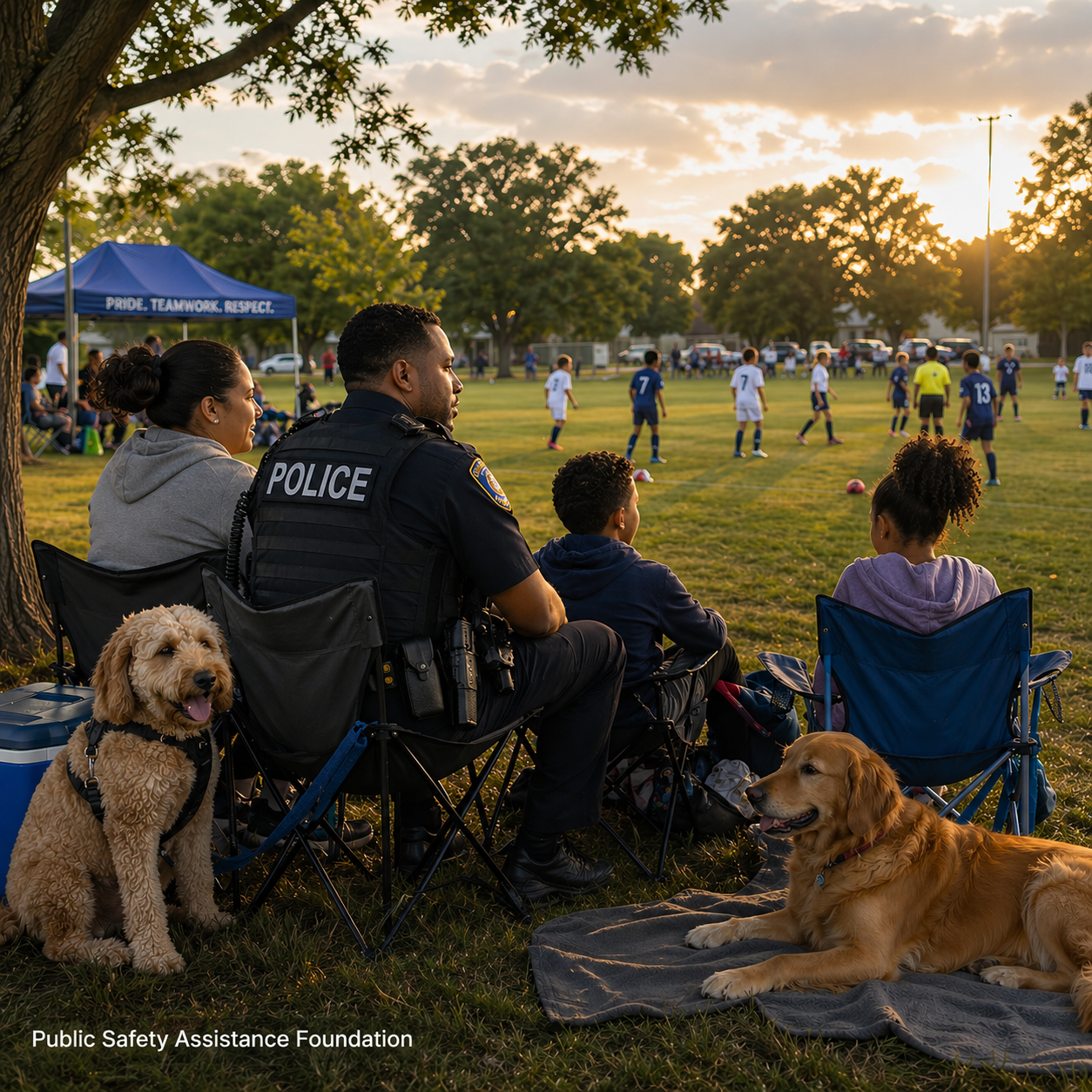
🧑🧑🧒🧒 Family members’ online activity can quietly connect back to law enforcement officers, expanding the digital footprint far beyond one name
When people think about safety in law enforcement, the focus is almost always on the officer.
Training. Equipment. Awareness. Preparation.
These are the areas that receive the most attention, and for good reason. They are critical to the job and essential in the field.
But there is another layer of exposure that often goes unnoticed. It does not begin on duty, and it does not stay contained to the individual wearing the badge.
It begins at home.
Because today, an officer’s digital footprint is not limited to what they choose to share. It extends outward through the people closest to them. Spouses, children, and relatives all contribute to a connected online presence that can reveal far more than anyone intends.
This is where the conversation is starting to shift. Not just toward individual awareness, but toward understanding how an entire household becomes part of the picture.
The Exposure That Builds Quietly
There was a time when protecting personal information felt more straightforward. If you avoided posting certain details and stayed mindful of what you shared, you could limit your visibility.
That is no longer the case.
Information now moves across platforms, databases, and third-party sites that most people never directly interact with. A single data point can appear in multiple places, often without the individual ever realizing it.
This is especially true for family members.
A spouse updates a profile.
A relative shares a photo.
A child tags a location or posts something routine.
None of these actions seem significant on their own. In fact, they are normal parts of everyday life. But over time, these small pieces begin to connect.
Names become associated with addresses.
Locations become tied to routines.
Relationships become visible through shared data.
What starts as everyday activity becomes a broader digital footprint that is far more detailed than it appears at first glance.
When Small Details Start to Connect
Think of it as a collection of fragments.
- One site lists a name and an address
- Another includes possible relatives
- A third shows past locations
- A fourth connects a phone number or email address.
Individually, each piece feels incomplete. Together, they begin to form a clear picture.
This is not happening in one place. It is happening across hundreds of data broker sites and people-search platforms that specialize in collecting and organizing information. Their goal is to build profiles that are easy to search and simple to connect.
That is where the risk increases.
It is not about one post or one record. It is about how quickly information can be layered, matched, and expanded.
And in many cases, those connections lead back to the officer through family members who were never expecting to be part of that equation.
Why Family Members Are More Visible
Family members often have a different relationship with online visibility.
They are not operating with the same level of caution. They are not trained to think about how information might be used or connected. Their online activity reflects everyday life, not professional awareness.
Because of that, their information tends to be easier to find.
A simple search of a spouse or relative can reveal current and previous addresses, associated names, and publicly available contact details. From there, it becomes easier to identify connections within the household.
This does not require advanced tools or specialized knowledge. It is the result of systems that are designed to organize and present information in a way that is easy to access.
The officer may take every precaution personally, but the broader digital footprint is still being shaped by the people around them.
Privacy Settings Are Only One Piece
Many people rely on privacy settings as their primary line of defense.
While these settings are important, they only address a small portion of the overall exposure.
The majority of personal information online does not come from social media posts alone. It comes from data brokers, public records, marketing databases, and third-party aggregators.
These sources collect and distribute information at scale. Once the data is out there, it does not stay contained. It is shared, copied, and republished across multiple platforms.
That means even limited or private social media use does not prevent exposure.
It simply reduces one visible layer, while the rest continues to exist in the background.
The Household Footprint
It helps to think about digital exposure as a shared footprint rather than an individual one.
Every member of a household contributes to that footprint. Each name, account, and record adds another layer of information that can be connected.
This includes:
- Spouses and partners
- Children and their online activity
- Extended relatives
- Associated addresses and historical records
When these elements are combined, they create a more complete and accessible profile of the household.
For law enforcement officers and public officials, that profile carries additional weight. It is not just about visibility. It is about what that visibility can reveal when viewed as a whole.
“I Don’t Post” Does Not Mean “I’m Not There”
A common assumption is that staying inactive online reduces exposure.
In reality, most of the information available online exists independently of personal posting habits.
Even without active participation, individuals can still appear on:
- People-search websites
- Data broker platforms
- Public record listings
- Marketing and contact databases
Names, addresses, and relationships are often pulled from existing records and combined into searchable profiles.
This means that someone who rarely or never posts can still have a significant online presence.
For families connected to law enforcement, this creates a gap between perception and reality. The absence of activity does not equal the absence of exposure.
When Awareness Becomes Personal
This is where the impact becomes more immediate.
The information being shared is not abstract. It is tied to real homes, real families, and real routines.
Addresses can be linked to names. Locations can be inferred through patterns. Relationships can be mapped through shared data points.
For someone looking to gather information, these connections provide a clearer path.
And that path often begins with the people who are least likely to recognize the risk.
This shifts the focus from individual awareness to household awareness.
It is no longer just about what the officer does or does not share. It is about how the entire digital footprint is built and maintained over time.
Expanding the Definition of Protection
Protecting personal information today requires a broader perspective.
It is not enough to think in terms of a single name or profile. The full picture includes everyone connected to the household.
That means considering:
- Where information appears across different sites
- How data points are connected
- How frequently information is updated and redistributed
- How exposure can grow over time without direct input
This level of awareness is not something most people are trained to manage on their own.
And that is where the gap often remains.
Turning Awareness Into Action
Recognizing the issue is the first step.
Addressing it requires a more structured approach.
Reducing online exposure involves:
- Identifying where information exists
- Submitting removal requests, and
- Continuing to monitor for reappearance
It is not a one-time task.
Data that is removed from one site can reappear on another. New records can be created. Existing profiles can be updated and republished.
When this process extends across multiple family members, the scope increases significantly.
That is why many individuals and households never fully address it. The effort required to manage it consistently becomes difficult to sustain.
A More Complete Approach to Privacy
If exposure extends beyond the officer, protection should as well.
That means looking at the full household footprint and taking steps to reduce it across all connected individuals.
At Privacy for Cops, that is exactly what we focus on.
We work with law enforcement officers, public officials, and their families to remove personal information from data broker and people-search sites, while continuing to monitor and address reappearance over time.
The goal is not just to reduce visibility once. It is to maintain that protection as new data surfaces and spreads.
Because in today’s environment, privacy is not static. It is something that needs ongoing attention.
And when that attention includes the entire household, the result is a stronger, more complete layer of protection that reflects how information is actually shared and connected.
Take the Next Step. Learn How our Service Works. Contact Us Today!
How it Works