
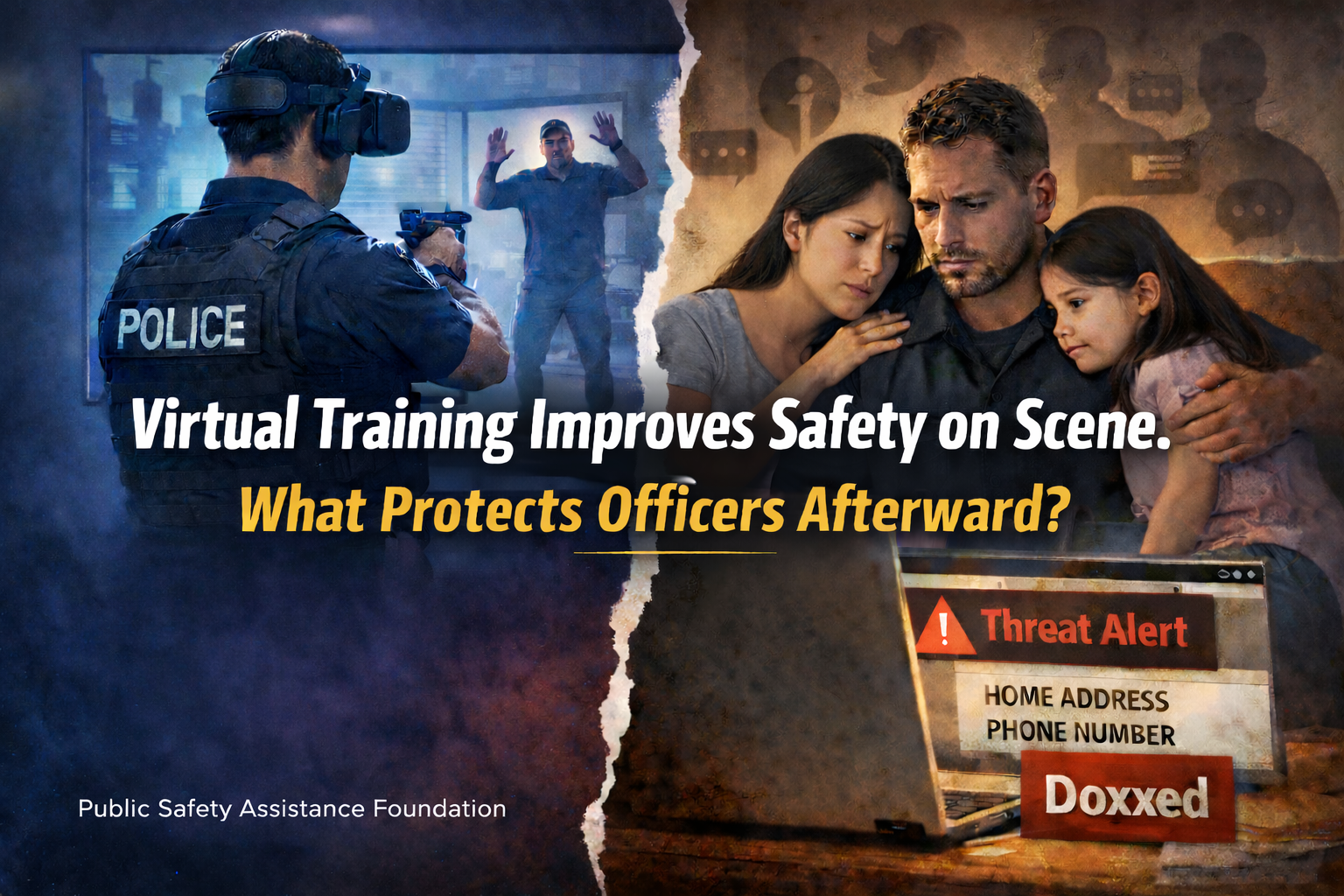
Law enforcement agencies across the country continue to invest in better training, better tools, and better preparation. One recent example highlighted a police department implementing a virtual reality simulator designed to help officers practice real-world encounters in a safe environment. Officers can now step into lifelike scenarios, make decisions under pressure, and improve communication and de-escalation skills without putting anyone at risk.
Programs like these matter. They save lives. They protect officers and the public alike.
They also reveal something important.
Modern policing recognizes that preparation reduces danger. Departments no longer rely only on classroom instruction or field experience. They use scenario-based learning because realistic exposure helps officers react calmly and appropriately during unpredictable situations.
But there is one category of threat that cannot be simulated inside a training room.
And it often begins after the scene is cleared.
Training Prepares Officers for Encounters
Scenario training exists for a reason. The job requires decisions in seconds that will be examined for years. Officers must recognize threats, communicate effectively, and adjust force appropriately while under intense stress. Virtual training allows repetition without consequence. Mistakes become lessons instead of tragedies.
Departments invest heavily in these systems because they know preparation matters. A well-trained officer is more confident. Confidence improves judgment. Good judgment reduces harm.
This philosophy has reshaped modern officer safety. Agencies prepare for traffic stops, domestic disputes, mental health calls, and high-risk encounters. They plan for the unexpected because preparation changes outcomes.
The profession has learned that reacting is not enough. Anticipating is essential.
Yet most officers leave the training environment prepared only for what happens during the call, not what happens after their name becomes public.
The Safety Phase No One Trains For
When a critical incident occurs, the immediate focus is understandably on the event itself. Investigations begin. Reports are written. Supervisors review actions. Body camera footage may be released. Media coverage expands quickly.
Then another process begins quietly in the background.
People start searching.
Within hours, an officer’s name can spread across social media platforms, forums, and websites that aggregate personal data. Public records, address histories, relatives, phone numbers, and photographs often surface within minutes. Some information is accurate. Some is outdated. Some belongs to entirely different individuals.
But once published, it travels fast.
Unlike a physical confrontation, there is no radio call announcing the threat. No perimeter. No dispatcher warning. No training scenario that replicates it.
The officer goes home, but the exposure follows.
From Scene Safety to Personal Vulnerability
Traditional officer safety focuses on awareness, positioning, and communication. Officers learn where to stand, what to watch, and how to control space. They are trained to look at hands, body language, and surroundings.
Digital exposure ignores all of those rules.
An officer can do everything correctly on duty and still face a personal safety risk days later. Family members who were never involved in the incident may become targets of harassment. Children’s schools may receive calls. Spouses may find personal information shared publicly. False narratives can circulate long before official reports are completed.
The event ends, but the attention does not.
The reality is simple: modern incidents do not conclude when the shift ends. They move online, where they can persist indefinitely.
The Permanence Problem
A training simulator resets after each scenario. Officers remove the headset and the environment disappears.
The internet does not reset.
Articles, booking photos, court filings, and commentary remain searchable for years. Even when cleared of wrongdoing, officers may find the incident attached to their name permanently. Search engines do not distinguish context. They display results.
This creates a second stage of risk that officers were never historically required to manage. The profession prepared generations of law enforcement for physical confrontation. It did not prepare them for searchable identities.
Today, reputation can become a safety factor.
A widely circulated name can increase the likelihood of targeted harassment, threats, and doxxing. The danger is not theoretical. It has become a predictable pattern following high-visibility events.
Training protects officers during the moment. Privacy protection protects them after it.
Families Experience the Aftermath Too
Officer safety has always included going home safely at the end of a shift. What has changed is what “home” means in the digital age.
Home is now searchable.
Many officers accept personal risk as part of the profession. Their families did not sign up for the same exposure. Yet personal data websites often connect relatives automatically. Addresses and phone numbers can appear together. A single search result can unintentionally map out an officer’s household.
The consequences are rarely immediate violence. More often they involve intimidation, fear, and disruption of normal life. Repeated phone calls. Messages sent to family members. False complaints. Public accusations shared widely before facts are confirmed.
These experiences rarely make headlines, but they change how families feel about the profession.
Safety is not only physical. It is the ability to live normally outside the uniform.
The Gap Between Preparation and Reality
Departments increasingly recognize that policing requires preparation beyond firearms and tactics. Communication training, crisis intervention, and scenario-based judgment exercises all reflect this understanding.
However, preparation still focuses on what happens during contact with the public.
Digital exposure happens after contact ends.
No simulator recreates the moment an officer discovers their home address posted online. No training exercise prepares a spouse to receive threatening messages tied to an incident they never witnessed. No field tactics guide a family navigating sudden online attention.
This is the modern safety gap.
Agencies train officers to manage encounters responsibly. But once the information environment takes over, responsibility shifts to the individual officer to manage a complex online ecosystem alone.
That expectation is unrealistic.
A Preventative Approach to Post-Incident Risk
The lesson from modern training methods is clear: preparation works best before the critical moment.
The same principle applies to online exposure.
Waiting until an incident occurs to address digital privacy is like issuing protective equipment after entering a hazardous environment. By the time information spreads, containment becomes difficult. Copies exist across multiple platforms, databases, and archived pages.
Proactive removal and monitoring reduce what can be found in the first place. When less information is available, less can be weaponized.
This does not eliminate public accountability or transparency. It simply limits unnecessary personal details unrelated to official duties.
There is a difference between public records and personal vulnerability.
Expanding the Definition of Officer Safety
Officer safety once meant body armor, backup units, and tactical awareness. Over time it expanded to include mental health resources, wellness programs, and improved training methods.
Today it must expand again.
An officer can successfully navigate a difficult call using every skill learned in training, only to face prolonged personal risk afterward because of searchable data. The profession has evolved technologically. Safety strategies must evolve as well.
Preparation now includes managing how easily strangers can locate private living details of public servants.
Just as departments adopted scenario-based training after recognizing its benefits, awareness of digital risk is becoming part of responsible safety planning.
Prepared During the Call, Protected After the Call
The introduction of advanced training simulators shows how seriously agencies take preparedness. They invest in tools that reduce mistakes and improve decision-making because prevention matters.
Digital exposure deserves the same preventative mindset.
Calls for service are unpredictable, but the online reaction following major incidents is increasingly predictable. Information searches, public discussion, and data aggregation occur almost automatically. Officers should not have to navigate that environment without support.
Protection should extend beyond the scene.
True officer safety now includes the period after reports are filed, cameras are turned off, and shifts are completed. It includes the weeks and months when attention remains, but official activity has ended.
A Broader View of Community Safety
Community safety and officer safety are often discussed together because they are connected. Well-prepared officers make better decisions. Better decisions build trust.
The same connection exists with privacy protection. Officers who feel secure at home can focus fully on professional responsibilities. Reducing fear of personal targeting allows attention to remain on service rather than self-protection.
Safety is strengthened when both sides of the uniform are protected: the public interaction and the private life behind it.
Training prepares officers to serve responsibly in public. Online privacy protection helps ensure that service does not create unnecessary personal risk afterward.
Moving Forward
The profession continues to improve how officers prepare for encounters. Technology has enhanced learning, communication, and accountability. Each advancement reflects a commitment to safer outcomes for everyone involved.
Now the conversation is expanding beyond the moment of contact.
What happens after an incident can affect officers just as significantly as what happens during it. Recognizing that reality does not replace traditional training. It completes it.
Preparation should not end when the scenario ends.
Your shift may end, but online exposure doesn’t. Enroll with Privacy for Cops today and start removing the personal information that can put you and your family at risk.
Exclusive Privacy Plans