
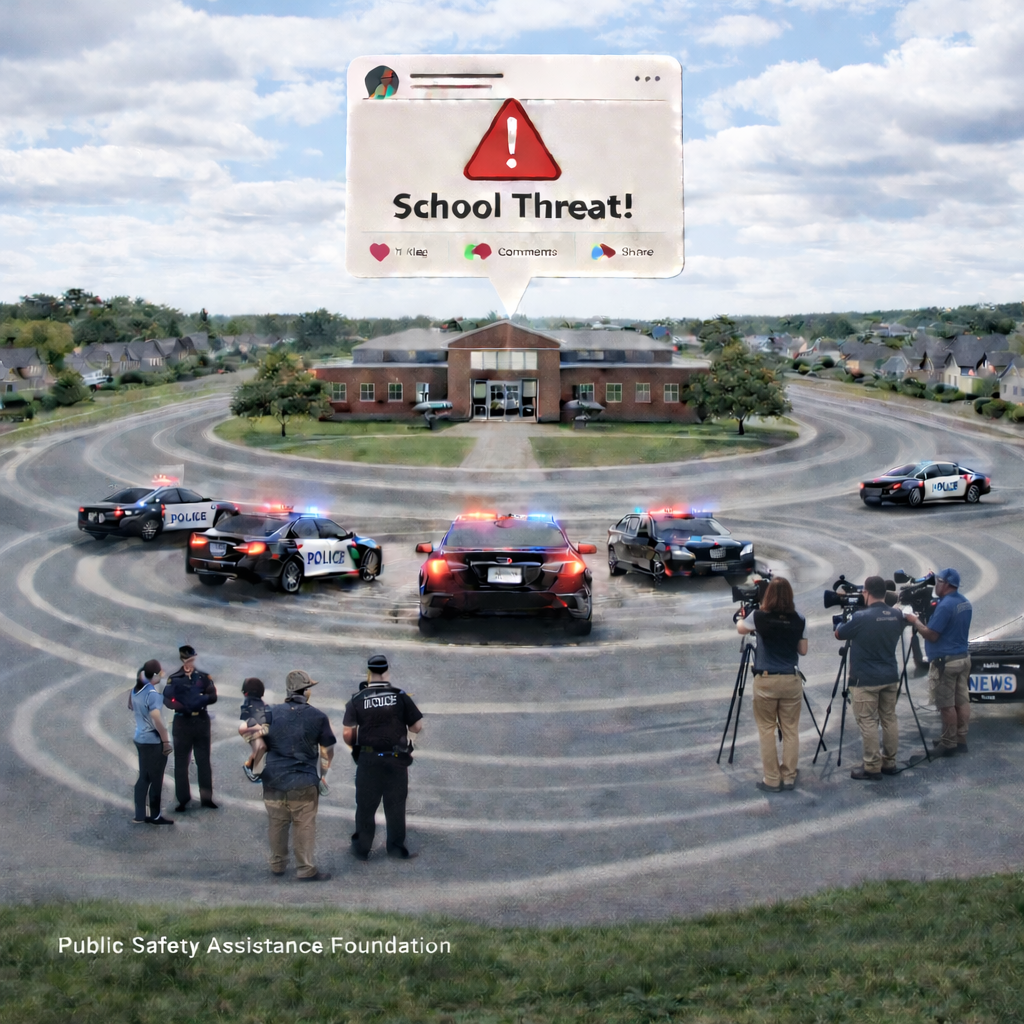
A message appears online.
No verified source. No confirmed timeline. No certainty.
But within minutes, it spreads.
Parents panic. Administrators scramble. Officers deploy. Patrol cars line the streets outside a campus where children should only be thinking about recess.
Recently, law enforcement agencies responded after a social media post threatened multiple schools, including three elementary campuses. Authorities increased patrols while investigators worked with federal partners to determine credibility and intent.
The post did not even include a specific date or time. And yet the impact was immediate.
That is the reality of modern threats. They do not have to be real to be dangerous.
They only have to be believable.
But there is another side to these incidents that rarely gets discussed. Every time officers respond to a high-profile threat, their personal exposure grows. Not just professionally. Personally.
The First Scene Is No Longer the First Risk
Traditionally, public safety threats followed a predictable pattern:
Incident → Response → Investigation → Resolution
Now there is an earlier step.
Exposure.
Before officers even arrive, their agencies, names, locations, and sometimes even families can become searchable within hours of an incident gaining attention online.
School threats amplify this effect.
They involve children, fear, and urgency. That combination drives massive online engagement. Photos of patrol cars, body camera screenshots, and scanner traffic circulate rapidly. People begin searching for information.
Who responded?
Which department?
Which officers?
The internet tries to answer.
And sometimes it succeeds.
The Viral Multiplier
School threats spread faster than almost any other public safety event.
Why?
Because they trigger protective instincts.
Parents share posts instantly. Community groups speculate. Social media accounts attempt to identify suspects or responders. Even well-meaning posts contribute to the amplification.
Researchers have long observed a connection between social media activity and real-world violence patterns, including copycat effects following high-profile incidents.
But even when violence never occurs, the exposure remains.
The officer who responded to a hoax threat can still become a searchable person connected to a “school shooting scare.”
That association does not expire.
The Investigation Ends. The Internet Does Not.
In the Texas case, law enforcement increased presence while working with the FBI and encouraged the public to report suspicious information rather than share it online.
That is the right approach operationally. Yet the internet operates differently. It archives fear.
Articles, reposts, screenshots, and forum discussions persist long after the investigation concludes. Years later, search engines may still surface the event.
A student grows up.
A parent moves on.
An officer changes assignments.
But the digital trail stays.
This creates a new category of risk for public safety professionals:
Not just physical safety.
Reputational permanence.
How Threat Response Creates Personal Exposure
Every school threat generates three overlapping investigative environments:
- The physical response scene
- The criminal investigation
- The online investigation
The third one never officially closes.
In online discussions, people attempt to identify who handled the situation. Sometimes they post officer names taken from reports or radio chatter. Sometimes they guess. Sometimes they get it wrong.
But search engines do not distinguish speculation from fact. They index it all.
This matters because threat assessment today focuses on preventing targeted violence before it occurs.
Unfortunately, targeted violence does not always start with a physical encounter. It often begins with information gathering. And that information increasingly comes from open-source internet searches.
Why Schools and Officers Share the Same Vulnerability
School districts now treat threats seriously even when credibility is uncertain, because the cost of ignoring them is too high.
The same logic applies to digital exposure. The probability of harm may be low. The consequence of being wrong is severe.
Officers responding to school threats frequently become visible community figures overnight. Local news, parent groups, and social media posts connect identities to locations.
For most professions, that fades quickly.
For law enforcement officers, it can create long-term targeting potential.
Criminals, disgruntled individuals, or ideologically motivated actors rarely begin with confrontation. They begin with research.
Where does the officer live?
Where do their children attend school?
What is their daily routine?
Ironically, the same type of information investigators gather about suspects can be gathered about responders. And it is often publicly available.
The Secondary Incident Nobody Tracks
After a threat investigation concludes, agencies evaluate response times, communication, and coordination.
What rarely gets evaluated is secondary exposure:
- The officer whose home address appeared online
- The spouse whose workplace became searchable
- The child whose school information was posted in a forum
These are not dramatic incidents. They are quiet vulnerabilities. But they matter.
Because modern safety is not defined only by what happens during a call. It includes what happens months later when someone searches the officer’s name.
The New Definition of Officer Safety
For decades, officer safety training emphasized awareness, positioning, and decision-making.
Today it also requires privacy awareness.
School threats highlight this shift clearly. They show how quickly a routine patrol response can become a public narrative attached to real individuals.
Modern officer safety recognizes that protecting officers now means addressing digital exposure beyond the badge.
A call for service can become a permanent search result. And search results can become targeting tools.
Why This Matters Even When Threats Are Hoaxes
Many school threats turn out to be false alarms or non-credible warnings. But they still trigger the same cycle:
- Urgency
- Media coverage
- Online speculation
- Archival permanence
The investigation ends.
The internet remembers.
This creates a paradox:
The safer the outcome, the less people realize the risk that remains.
No injury occurred. No suspect acted. No crime materialized. But personal information was still indexed.
The Family Impact
School threats uniquely affect officers because they intersect with family life. Officers responding to protect children often have children of their own. When exposure occurs, it does not stop at the officer.
Family members become searchable extensions of the badge. That is why privacy protection is not simply reputation management. It is preventative safety.
Just as schools conduct threat assessments to intervene early, officers must address exposure early. Waiting until a threat becomes personal is waiting too long.
A Preventable Risk
We cannot stop every person from posting online.
We cannot prevent every rumor.
We cannot eliminate every hoax threat.
But we can reduce how much personal information is available when someone starts looking.
And that changes outcomes.
Most targeted harassment and stalking behaviors rely on accessible data. Remove easy access and you raise the effort required to continue. Safety improves not by eliminating risk, but by increasing difficulty.
The Lesson Hidden Inside School Threats
School threats teach a broader public safety lesson.
The first phase of modern danger is information gathering.
Not confrontation.
Not violence.
Research.
The earlier officers address their digital footprint, the less useful they become as targets.
In other words, preparedness now includes privacy.
Departments train for active threats.
Officers must also prepare for passive ones.
The Quiet Work of Prevention
Public safety culture rightfully celebrates heroic response. But prevention rarely looks heroic. It looks administrative. Proactive. Invisible. Yet the goal of every response is the same outcome achieved before the call begins: Nothing happens.
Online privacy protection works the same way. When done correctly, there is no dramatic moment to point to. Only the absence of one.
No suspicious person at the door.
No targeted harassment campaign.
No escalating contact.
Just normal life continuing.
A Different Kind of Backup
Officers never work alone in the field. They rely on partners, dispatch, and coordinated support. Digital life should be no different. Because threats today do not always start on the street. They often start with a search bar. And the best time to respond is before someone presses enter.
Protectors Deserve Online Protection
School threats remind us how quickly attention focuses on public safety professionals. The moment communities feel vulnerable; they look toward the people sworn to protect them. But those protectors deserve protection too. Not only on duty. At home. Online. Years after the lights and sirens fade.
If your name can be searched, your safety can be mapped.
Privacy protection is no longer optional preparation. It is part of modern officer safety.
Take the same proactive step you take on every call: prepare before the risk becomes real.
Join Privacy for Cops and reduce your digital exposure before someone else discovers it first.
Because the safest response … is the one nobody ever has to make.