
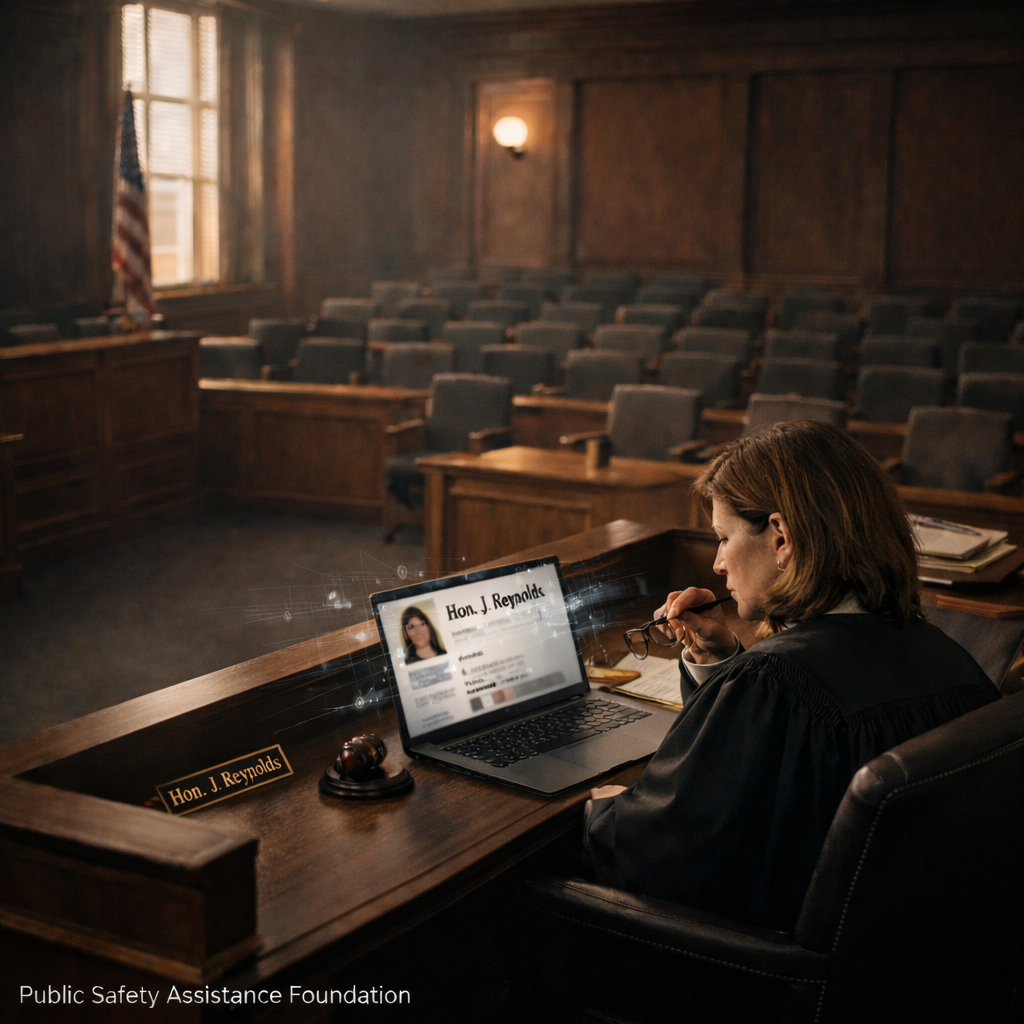
What Rising Threats Reveal About Online Exposure for Public Officials
For many, the role of a judge feels distant. It is a position associated with authority, neutrality, and protection within the courtroom. There is a common assumption that judges operate within a secure environment, insulated from the individuals and cases they oversee.
But that perception is changing.
Recent reporting highlights a sharp rise in threats against state judges across the country. These are not isolated incidents. They are part of a growing pattern that reveals something deeper and more concerning. The risk no longer ends when the courtroom doors close.
For judges, and for public officials more broadly, decisions made in professional settings are increasingly carrying consequences that extend into their personal lives. And one of the most significant drivers of that risk is something far less visible than a courtroom confrontation.
It is their online exposure.
A Growing Trend That Cannot Be Ignored
Threats against judges have historically been associated with high-profile federal cases. However, the landscape has shifted. State judges, who often preside over deeply personal and emotionally charged cases, are now facing escalating levels of hostility.
These threats come in many forms:
- Direct threats of violence
- Harassing messages and online intimidation
- Attempts to locate home addresses or family members
- Public sharing of personal information
What makes this trend especially concerning is how accessible the information has become. Individuals no longer need specialized skills or resources to find where someone lives, who they are related to, or how to contact them.
That information is often just a few clicks away.
In many cases, it is organized across multiple sites, making it easier to confirm details and build a more complete picture of someone’s personal life than most people realize.
How Online Exposure Fuels Real-World Risk
When a judge issues a ruling, it can have life-altering consequences for the individuals involved. Emotions run high. Reactions can be immediate and intense.
In the past, those reactions were largely contained within the courtroom or expressed through formal appeals. Today, they often begin with a search.
A name is entered into a search engine. Within seconds, results can reveal:
- Current and previous home addresses
- Phone numbers
- Names of relatives and associates
- Property ownership records
- Social media profiles
This is where the dynamic shifts.
What begins as frustration or anger can quickly evolve into something more targeted. The digital footprint becomes a roadmap. It provides direction, context, and access.
And in the wrong hands, that information can be used to intimidate, harass, or threaten.
In some cases, it can also be used to validate information gathered from other sources, increasing both confidence and intent.
The Digital Trail as a Threat Map
One of the most important concepts to understand is how fragmented pieces of information come together to form a complete picture.
Individually, a data point may seem insignificant. A name on a people-search site. A partial address. A social media account.
But when combined, these elements create something far more powerful.
They create a threat map.
This map allows someone to:
- Identify where a judge lives
- Determine whether they have a spouse or children
- Locate additional contact information
- Track patterns or affiliations
For public officials, this level of visibility dramatically increases vulnerability. It shifts the risk from abstract to actionable.
And once that information is out there, it does not stay static. It spreads. It is copied, shared, and republished across multiple platforms.
It reduces the effort required to move from curiosity to intent.
Why Judges Are Not the Only Ones at Risk
While the recent focus has been on judges, the underlying issue is not limited to the judiciary.
This is a broader public official exposure problem.
Law enforcement officers, prosecutors, and other public-facing roles operate within the same ecosystem of visibility. Their names are searchable. Their information is collected and sold by data broker sites. Their digital footprint evolves over time.
The difference is not in the level of exposure. It is in the moment that exposure becomes relevant.
For a judge, it may be a controversial ruling.
For a law enforcement officer, it may be an arrest, an investigation, or even routine public interaction.
In both cases, the trigger is different, but the pathway is the same:
Search → discovery → targeting
The Family Factor: Risk Beyond the Individual
One of the most overlooked aspects of online exposure is how it extends beyond the individual.
When personal information is available online, it often includes connections to family members. Spouses, children, and relatives can be identified through publicly accessible data.
This creates an entirely different level of concern.
Threats are no longer limited to the person in the public role. They extend to the people closest to them.
For judges, this means that a decision made in a courtroom could lead to someone identifying where their family lives or attends school. For law enforcement officers, it can mean similar exposure tied to their professional actions.
This is where the impact becomes deeply personal.
It is no longer about professional risk. It is about home life, safety, and peace of mind.
It is about protecting not just the individual, but everyone connected to them.
Why Awareness Alone Is Not Enough
There is a growing awareness around online privacy risks. More public officials understand that their information may be available online.
But awareness alone does not remove that information.
It does not prevent it from being accessed, shared, or used with harmful intent.
The reality is that data broker and people-search sites are designed to collect, aggregate, and distribute personal information. Even when information is removed from one site, it can reappear on another.
This creates a continuous cycle of exposure.
Without ongoing monitoring and removal, the digital footprint rebuilds itself.
New listings appear, old data resurfaces, and the digital footprint continues to expand unless actively managed.
The Shift From Reactive to Proactive Protection
Historically, many individuals have approached online exposure reactively. Action is taken after a threat is received or after personal information is discovered online.
By that point, the information has often already been accessed.
The more effective approach is proactive.
This means:
- Identifying where personal information exists online
- Removing it before it becomes a tool for targeting
- Continuously monitoring for new exposure
For judges and public officials, this shift is critical. It changes the dynamic from responding to risk to reducing it before it escalates.
What This Means for Public Officials Today
The rise in threats against judges is not an isolated issue. It is a signal.
It reflects a broader reality in which digital exposure plays a central role in real-world safety risks.
Public officials today operate in an environment where:
- Information is widely accessible
- Emotions can quickly translate into online searches
- Digital footprints can be leveraged for targeting
This is not about fear. It is about understanding the landscape.
And more importantly, taking steps to reduce unnecessary exposure within it.
Turning Awareness Into Protection
Understanding the risk is the first step. Acting on it is what makes the difference.
For public officials, reducing online exposure is one of the most practical and impactful ways to improve personal and family safety.
It is not about eliminating visibility entirely. That is not realistic in public-facing roles.
It is about limiting what is easily accessible and removing the data points that create a clear path for someone to follow.
Take Control Before Exposure Becomes a Threat
The rise in threats against judges underscores a critical truth. Exposure is not just an inconvenience. It is a vulnerability.
And in today’s environment, that vulnerability can be exploited quickly.
Your personal information may already be visible across multiple websites without your knowledge. Addresses, phone numbers, and family connections can be accessed in seconds.
Take the time to understand what is out there.
The rise in threats against judges is a reminder that visibility can quickly turn into vulnerability. The same online exposure that makes public officials easy to find can also make them easy to target.
Visit Privacy for Cops to begin professionally removing your personal information from data broker and people-search sites, with ongoing monitoring to help keep it from resurfacing. Because when exposure is reduced, so is the opportunity for it to be used against you.
Exclusive Privacy Plans