
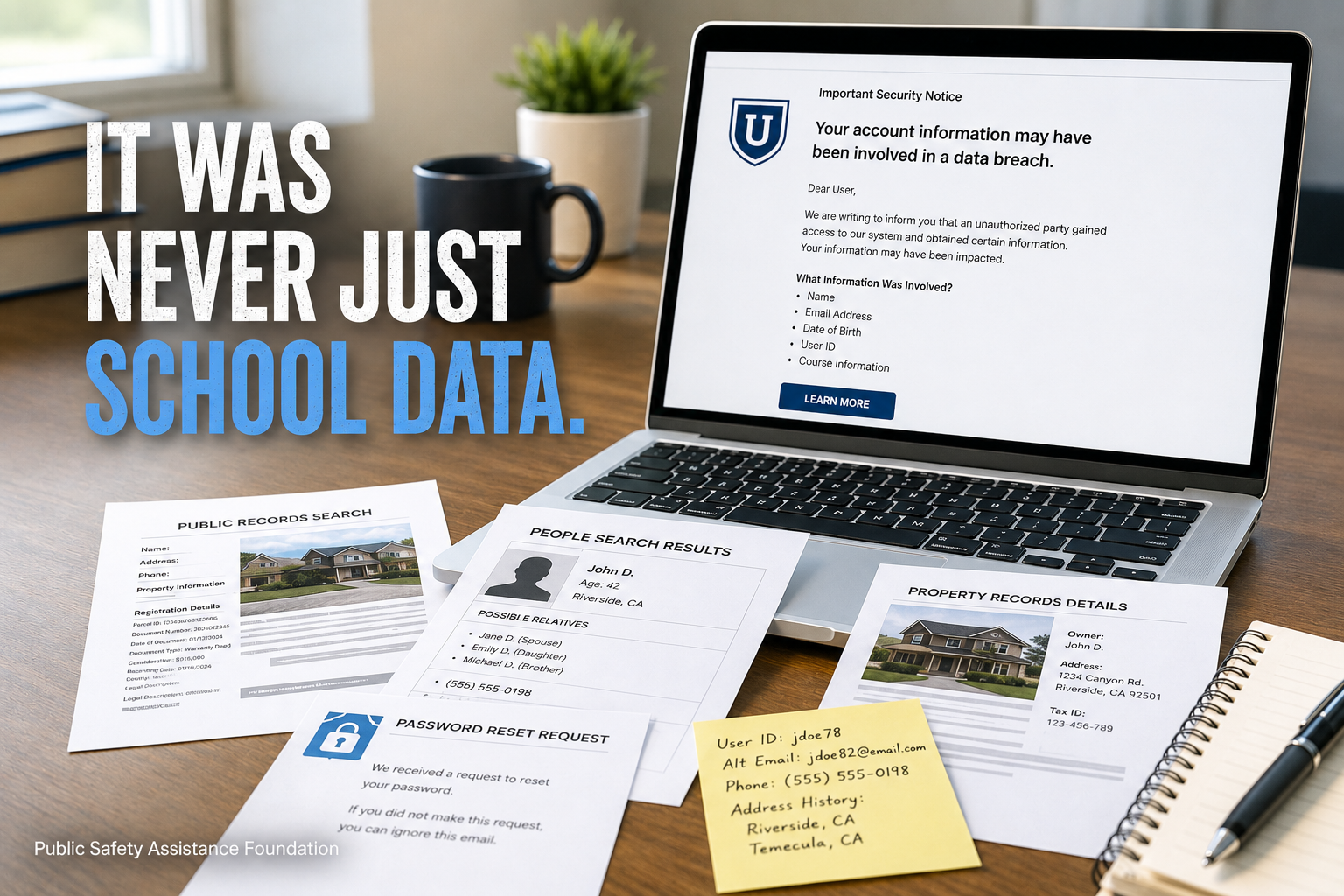
Students across the country logged into their school accounts expecting to prepare for finals.
Instead, many were met with something else entirely:
a ransom message.
In early May 2026, the widely used educational platform Canvas experienced a massive cybersecurity incident affecting colleges, universities, and school systems across the United States and internationally. Reports indicate that names, email addresses, student ID numbers, enrollment information, and even messages exchanged inside the platform may have been exposed. Some reports estimate the breach could impact hundreds of millions of records.
For most people, this story sounds like a school cybersecurity problem.
But there is a much larger lesson underneath it, one that directly impacts law enforcement officers, public officials, judges, prosecutors, investigators, and their families.
Because the real issue is not just the breach itself.
The real issue is what happens when massive amounts of personal information become centralized, searchable, connected, and vulnerable all at once.
And that lesson applies far beyond a college campus.
The Danger of Centralized Personal Data
Canvas is not a social media platform.
It is not a people-search website.
It is not a data broker.
It is simply a system people trusted to organize daily life:
assignments, communication, schedules, records, messages, and identity verification.
That trust is exactly what made it valuable to attackers.
The more centralized the information becomes, the more attractive the target becomes.
That same reality now exists almost everywhere online.
- Data broker websites
- Background check platforms
- Property databases
- Public records sites
- Court filings
- Campaign donation databases
- Social media profiles
- Genealogy sites
- Professional licensing systems
Every platform may only contain a small piece of information.
But together. They create a complete profile.
That is what makes online exposure so dangerous for public officials and law enforcement officers today.
Not because one single website reveals everything, but because modern exposure is built through accumulation.
The “Puzzle Effect” Is Getting Worse
Years ago, someone may have needed serious technical skills to build a profile on another person.
Today, they simply need patience.
- One site reveals a current city
- Another reveals possible relatives
- Another reveals a property record
- Another reveals usernames
- Another reveals an old phone number
- Another reveals an email address
Eventually, the pieces connect.
This is what we often call the “puzzle effect.”
And breaches accelerate it dramatically.
The Canvas incident reportedly exposed information such as usernames, email addresses, enrollment information, and user communications.
Even when financial records or Social Security numbers are not involved, exposed information still creates enormous risk.
Why?
Because attackers rarely rely on one breach alone.
They combine datasets.
They merge information from multiple sources.
They cross-reference old records with new records.
They use exposure to strengthen phishing attacks, impersonation attempts, social engineering campaigns, harassment efforts, and doxxing activity.
For public-facing professionals, that risk multiplies quickly.
Why This Matters to Law Enforcement Officers
Law enforcement officers operate in an environment where visibility creates vulnerability.
An exposed home address is not “just information.”
A family connection is not “just public data.”
A personal email account is not “just another login.”
These details create pathways.
And the modern internet makes those pathways easier to follow than ever before.
The problem is that many officers still think about online exposure in isolated pieces.
They think:
- “I’m careful on social media”
- “I don’t post much”
- “My account is private”
But exposure today often has nothing to do with what you personally post.
Most exposure comes from systems collecting information behind the scenes:
Data brokers
Public databases
Commercial platforms
Third-party integrations
Marketing systems
Leaked databases
Subscription services
Old accounts
Connected records
The Canvas breach is a perfect example.
Millions of users likely had no idea how much information was stored inside the platform until the incident happened.
The same thing occurs every day across countless other systems people barely think about anymore.
One Breach Can Trigger Years of Problems
Cybersecurity stories often disappear from headlines quickly.
But the consequences rarely disappear that fast.
Once information spreads online, it tends to replicate.
- Copies get downloaded
- Databases get mirrored
- Lists get traded
- Screenshots get saved
- Archived versions survive
That means exposure can continue long after a company announces the issue has been “resolved.”
This is particularly important for officers and public officials because online threats are rarely limited to the initial leak itself.
A single exposure event can lead to:
- Targeted phishing attempts
- Credential stuffing attacks
- Identity impersonation
- Harassment campaigns
- Doxxing
- Fraud attempts
- Threats involving family members
- Swatting risks
- Real-world stalking concerns
And in many situations, attackers are not looking for financial gain alone.
Sometimes they are looking for access
Sometimes attention
Sometimes intimidation
Sometimes retaliation
That changes the entire risk equation for people working in public-facing roles.
The “It’s Just School Data” Mindset Is Dangerous
One of the biggest misconceptions surrounding breaches like this is the idea that the exposed information is “minor.”
People hear:
“No passwords were exposed”
“No banking information was exposed”
“No Social Security numbers were involved”
And they assume the situation is less serious.
But exposure is cumulative.
An email address connected to a real name matters
A username matters
A message history matters
A location matters
A relationship connection matters
Modern threat actors are experts at building context.
The more context they have, the more convincing and dangerous their attacks become.
That is why even partial exposure can become a long-term problem.
Especially for public officials whose information may already exist across dozens of other searchable systems online.
Public Officials Face a Different Level of Risk
Most people experience online exposure as an inconvenience.
Public officials often experience it as a safety issue.
That distinction matters.
Judges
District attorneys
Federal agents
Law enforcement officers
Correctional staff
Investigators
Elected officials
These roles come with visibility.
And visibility creates opportunities for malicious actors.
The concern is no longer hypothetical.
Online research now routinely happens before confrontations, harassment campaigns, protests, and targeted intimidation efforts.
Individuals can gather information in minutes that once required serious investigative effort.
And unlike physical surveillance, digital exposure scales instantly.
One person can distribute information to thousands.
One screenshot can travel indefinitely.
One breach can fuel years of secondary exposure.
The Bigger Lesson From the Canvas Breach
The real lesson is not that schools need stronger cybersecurity.
They absolutely do.
But the larger lesson is this:
People dramatically underestimate how much of their personal information exists online in connected systems.
That includes professionals working in public safety.
Most officers are not exposed because they intentionally shared too much.
They are exposed because modern systems collect, aggregate, store, and distribute information constantly.
Sometimes legally
Sometimes commercially
Sometimes carelessly
And once that information spreads, removing it becomes significantly harder.
That is why online privacy today cannot be reactive.
It has to become proactive.
Waiting Until After Exposure Is the Wrong Strategy
Many people only begin thinking about online privacy after a problem occurs.
After a threat
After harassment
After a suspicious incident
After family information surfaces online
After someone appears at a home address
But by then, information may already be deeply distributed across the internet.
The better approach is reducing exposure before it becomes a crisis.
That means understanding:
- What information exists online
- Where it is appearing
- How it spreads
- And how quickly it can multiply after a breach or leak occurs
For law enforcement officers and public officials, that process is no longer optional.
It is part of personal security now.
Turning Awareness Into Action
The Canvas breach may have started as an education story.
But the underlying issue affects nearly everyone living in today’s digital world.
Especially those working in public-facing professions.
Online exposure is no longer limited to social media posts or obvious mistakes.
It grows quietly through databases, platforms, subscriptions, public records, old accounts, third-party systems, and large-scale breaches that connect information together piece by piece.
And once information becomes searchable, shareable, and replicated across the internet, controlling it becomes far more difficult.
That is why proactive privacy protection matters.
Online exposure does not usually come from one single source.
It grows quietly over time through data breaches, public records, people-search websites, data brokers, and connected online systems collecting personal information in the background.
For law enforcement officers, public officials, and their families, that exposure can create unnecessary risk long before there is ever an obvious warning sign.
Reducing your digital footprint is no longer just a privacy decision, it is a proactive step toward limiting visibility and helping protect the people connected to you.