
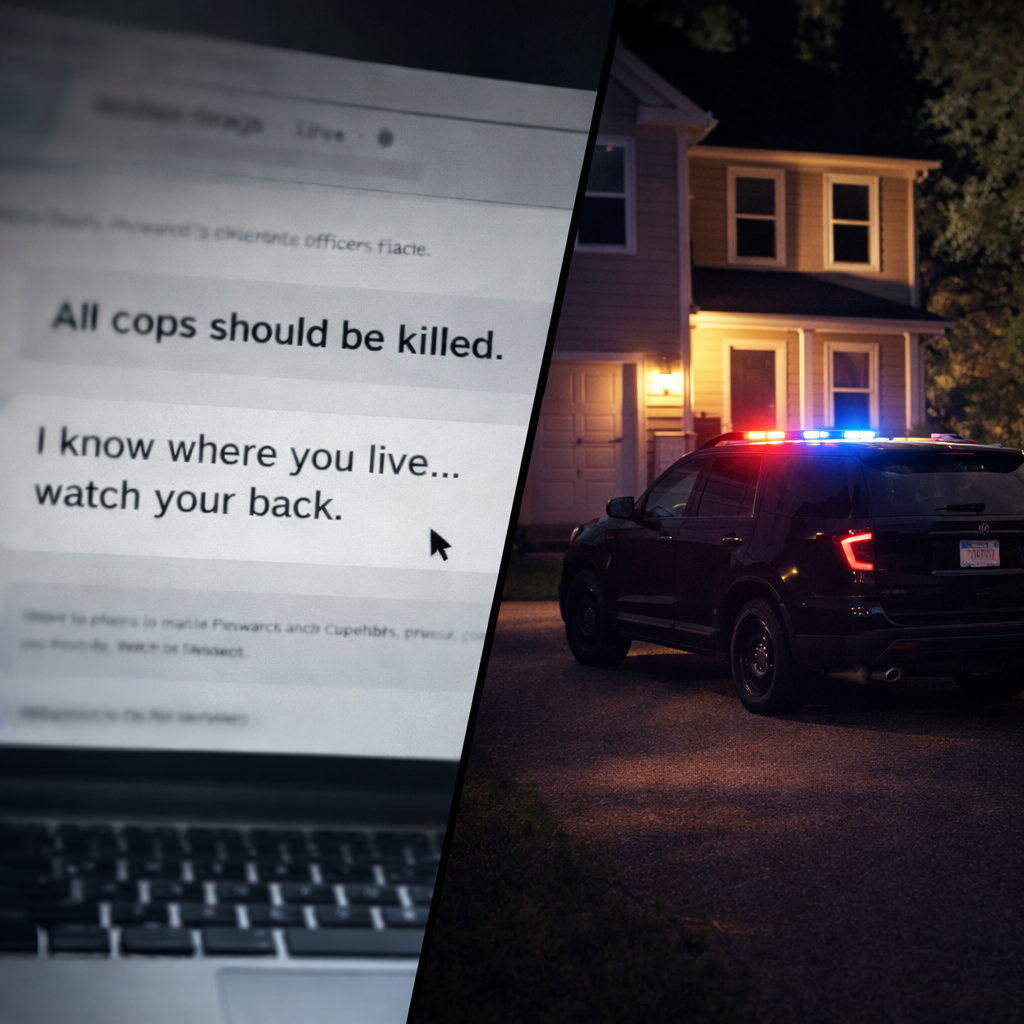
The threat did not begin with a knock at the door.
It did not begin with flashing lights or a call for backup.
It started quietly, behind a screen.
In a recent federal case, a man in Oklahoma allegedly posted repeated threats online targeting federal agents. Over time, those threats intensified. They became more specific. More aggressive. More dangerous.
Eventually, those online statements turned into a real-world confrontation when federal agents attempted to make contact. According to court records, the situation escalated into gunfire during a standoff.
It is a clear example of how digital exposure and online hostility can evolve into physical danger.
For law enforcement officers, the line between online and offline threats is thinner than ever.
The Illusion of “Just Online”
It is easy to dismiss online threats as background noise.
A comment. A post. A username with no face attached.
But that assumption is becoming increasingly dangerous.
Online platforms have created an environment where individuals feel emboldened to say things they might never say in person. The distance of a screen creates a false sense of anonymity and control.
However, the consequences are very real.
In the Oklahoma case, the suspect allegedly used public platforms to make threats over time. These were not isolated comments. They were repeated expressions of intent.
Online behavior leaves a trail. And more importantly, it reveals patterns.
Patterns of escalation.
Patterns of fixation.
Patterns of intent.
What begins as words can evolve into planning.
What begins as frustration can escalate into obsession.
And what begins online does not always stay there.
A Realistic Scenario
Imagine this:
A law enforcement officer finishes a shift and heads home.
The uniform comes off. The badge is set aside.
But online, their identity remains exposed.
Their name appears in public records tied to their profession.
Their home address is connected to property records.
Family members are linked through people-search websites.
Now imagine someone frustrated, angry, or ideologically motivated decides to look them up.
It takes minutes.
A quick search reveals an address.
Another click reveals relatives.
A third search confirms patterns, locations, and connections.
From there, the situation begins to shift.
This is no longer abstract.
It becomes personal.
The individual now feels informed. Empowered. Capable.
This is where risk accelerates.
When Access Meets Intent
The Oklahoma case highlights something critical:
The threat was not random.
It developed over time.
This is often how real-world incidents unfold. Not instantly, but progressively.
Access to information plays a key role in that progression.
When a person can:
- Identify a target
- Locate their home
- Understand their routine
- Connect them to family members
The barrier between thought and action becomes smaller.
This is not about creating fear.
It is about recognizing reality.
Information changes behavior.
Access changes decision-making.
And in the wrong hands, both can lead to escalation.
The Psychology Behind Escalation
Many of these situations involve individuals who feel wronged or develop resentment toward law enforcement. Over time, that mindset can intensify, especially when combined with easy access to personal information. When that happens, the risk becomes more immediate and more personal.
Why Law Enforcement Officers Are Especially Vulnerable
Law enforcement officers face a level of exposure that most professions do not.
Their work places them in public-facing roles.
Their names may appear in reports, court documents, or news coverage.
Their actions may be discussed, analyzed, or criticized online.
This visibility is part of the job. But it comes with consequences.
Unlike many professions, officers cannot fully separate their personal identity from their professional role.
Even off duty, that connection exists.
And when personal information is easily accessible, that connection becomes a point of vulnerability.
The Expanding Digital Footprint
Personal information is now easier to access than ever before, often requiring only a few clicks.
Data broker websites aggregate information from multiple sources and present it in a simplified format.
Search engines prioritize accessibility.
Social platforms encourage sharing.
Together, these systems create a detailed digital footprint.
This footprint can include:
- Current and past addresses
- Phone numbers
- Names of relatives
- Associated locations
- Property ownership
Even small details can contribute to a larger picture.
And that picture can be used in ways that were never intended.
The Escalation Path
Understanding how situations develop is key to preventing them.
A typical progression may look like this:
- Exposure
Personal information is publicly available online. - Discovery
A motivated individual searches and finds that information. - Validation
The individual confirms accuracy through multiple sources. - Fixation
Continued searching and monitoring begins. - Expression
Threats, comments, or hostile language appear online. - Action
The situation escalates into real-world behavior.
The Oklahoma case did not begin with action.
It moved through several of these stages first.
Recognizing this progression is critical.
Because intervention is most effective early, not late.
The Cost of Waiting
One of the most common misconceptions is that risk will be obvious.
That if something is wrong, there will be clear warning signs.
But online exposure does not work that way.
It is quiet.
It is passive.
It exists without notification.
By the time a threat becomes visible, the groundwork may already be in place.
Waiting for a problem to appear means reacting instead of preventing.
And in situations involving personal safety, that difference matters.
Practical Steps to Reduce Exposure
There are proactive steps law enforcement officers can take to reduce their online footprint:
1. Conduct Regular Self-Searches
Search your name and known variations. Identify what information appears and where it is listed.
2. Monitor Data Broker Websites
These sites collect and publish personal data. Many allow removal requests, but the process can be time-consuming.
3. Limit Social Media Exposure
Avoid sharing location-based information in real time. Be mindful of what is visible to the public.
4. Separate Personal and Professional Information
Where possible, limit overlap between work-related visibility and personal details.
5. Stay Consistent
Online privacy is not a one-time task. It requires ongoing attention and maintenance.
These steps can make a meaningful difference.
But they require time, awareness, and persistence.
Why This Matters Now
The current environment has shifted.
Information is easier to access than ever before.
Online behavior can escalate more quickly.
And digital exposure can have immediate real-world implications.
The Oklahoma case is not an isolated event.
It reflects a broader pattern of behavior where online activity serves as the starting point for something more serious.
This is the reality law enforcement officers are navigating today.
A Smarter Approach to Protection
Managing your online presence manually can be overwhelming.
New sites appear regularly.
Information is republished.
Data continues to circulate.
For many law enforcement officers, the challenge is not awareness.
It is time.
This is where professional support becomes valuable.
Services like Privacy for Cops are designed specifically to address these challenges by:
- Identifying where your information appears
- Submitting removal requests on your behalf
- Continuously monitoring for new exposures
This allows officers to focus on their responsibilities while maintaining control over their personal information.
The Line Is Gone
The idea that online threats remain online is no longer accurate.
The line between digital risk and physical danger has blurred.
In many cases, it has disappeared entirely.
What starts as a search can lead to discovery.
What starts as discovery can lead to action.
The question is not whether your information is accessible.
It is how easily it can be found—and by whom.
Take Control of Your Online Privacy
Do not wait for a situation to escalate.
Do not assume your information is protected.
Visit Privacy for Cops today!
Review what information about you is currently visible online, and take action to remove it before someone else finds it first.