
In early January 2026, a new legislative proposal grabbed headlines in federal management circles. H.R. 6935, the Postal Facilities Security Camera Act, introduced by Del. Eleanor Holmes Norton (D-DC), seeks to require the U.S. Postal Service (USPS) to install and expand security camera coverage at postal facilities nationwide, both indoors and out.
The bill responds to growing concerns about employee safety, customer security, and rising incidents of theft and violence occurring at postal locations. In several reported cases, investigations revealed that facilities lacked sufficient surveillance or that existing systems were outdated or nonfunctional. Lawmakers argue that expanding camera coverage is a necessary step toward deterrence, accountability, and improved response after incidents occur.
At first glance, this proposal appears focused squarely on physical security. Cameras help deter crime, provide investigative evidence, and increase visibility in public spaces. These benefits matter. However, the renewed attention on postal facility monitoring highlights a broader and increasingly relevant reality for public institutions today.
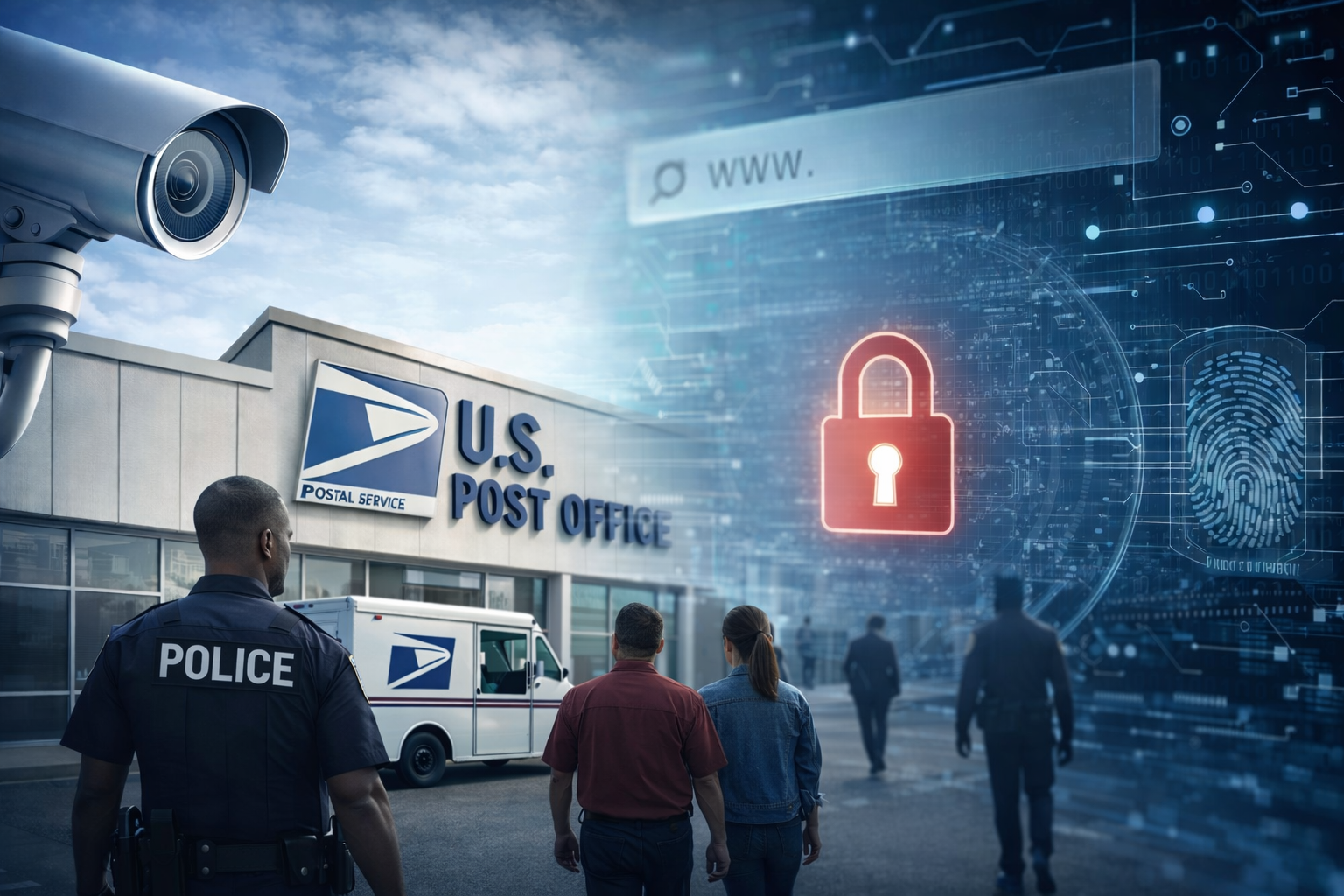
Security no longer stops at the building entrance. For law enforcement officers, public officials, and government employees, modern threats extend beyond physical spaces and into digital environments where personal and professional information is stored, shared, and often exposed.
What the postal security debate reveals is not just a need for better cameras, but a need for a more comprehensive understanding of what safety looks like in a connected world.
📬 Why Postal Facilities Became a Focus
Postal facilities represent critical public infrastructure. Millions of Americans rely on them daily, and thousands of federal employees work in environments that are meant to be safe, predictable, and well monitored. In recent years, however, postal locations have increasingly been targeted for mail theft, robberies, and assaults.
Mail theft, in particular, has drawn national attention. Organized theft rings, opportunistic criminals, and repeat offenders have exploited gaps in security, especially in parking lots, loading areas, and after-hours access points. These incidents have not only resulted in property loss, but also raised serious concerns about worker safety.
The push for expanded surveillance is a response to these realities. Visible security measures can reduce opportunistic crime and provide critical documentation when incidents occur. For physical environments, cameras are often the first line of defense.
Yet physical monitoring addresses only part of the risk landscape.
Physical Security and Online Exposure Are Closely Linked
Mail theft today is rarely just about stolen packages. Increasingly, it functions as an information exposure problem. Stolen mail can include financial statements, government correspondence, legal documents, and personal identifiers. Once removed from secure systems, that information can be misused online in ways that are difficult to trace or reverse.
A single stolen envelope can lead to identity fraud, account takeovers, or targeted scams. In some cases, stolen information is used to harass or intimidate individuals whose roles already place them in the public eye.
This intersection between physical crime and online misuse is not unique to the postal system. Law enforcement agencies and public offices experience similar overlaps, where physical vulnerabilities lead directly to digital consequences.
🚓 What This Means for Law Enforcement Officers and Public Officials
Law enforcement officers and public officials operate under a level of visibility that few professions experience. Names, job titles, affiliations, and work locations are often accessible through public records, agency websites, court filings, or media coverage. While transparency supports public trust, it also creates opportunities for misuse.
Online exposure can include:
- Personal addresses and phone numbers listed on data broker websites
- Family member information linked through public records
- Social media profiles that reveal routines or locations
- Old or forgotten online accounts that remain active
These risks often accumulate quietly over time. They are rarely the result of a single decision, but rather the byproduct of routine digital activity and publicly available data aggregation.
Just as a poorly secured building invites intrusion, unmanaged online exposure creates openings for exploitation.
Why Cameras Alone Are Not Enough
The Postal Facilities Security Camera Act recognizes that physical monitoring is essential. However, cameras cannot prevent doxxing, impersonation, phishing attempts, or targeted online harassment. They do not stop bad actors from compiling personal profiles using publicly available information. They do not protect officers and officials once they leave the workplace.
This distinction matters.
A secure facility does not automatically translate into personal safety. For those in public service, risk often follows them beyond the job site and into their homes, inboxes, and digital identities.
Modern security strategies must account for this reality.
Lessons From Postal Security That Apply Beyond USPS
The renewed focus on postal facility security offers several broader lessons that are highly relevant to law enforcement and public officials.
Security Must Be Proactive
In many cases, calls for expanded surveillance followed serious incidents. While reactive measures are sometimes unavoidable, proactive approaches reduce harm before it occurs. The same principle applies to online exposure. Many people only address privacy risks after experiencing harassment, fraud, or threats.
Identifying vulnerabilities early is a key component of modern safety.
Maintenance and Oversight Matter
Reports have shown that some postal security systems failed not because cameras were absent, but because they were outdated, broken, or poorly maintained. Digital safety tools face similar challenges. Outdated software, reused passwords, and unmanaged accounts can quietly undermine security efforts.
Protection requires ongoing attention, not one-time installation.
Culture Shapes Security Outcomes
Policies and tools are only effective when supported by awareness and accountability. When risks are normalized or overlooked, vulnerabilities persist. Encouraging awareness around online exposure is just as important as training for physical threats.
Security is not only about infrastructure. It is about mindset.
🧩 Practical Steps to Reduce Online Exposure
Addressing online exposure does not require advanced technical knowledge. It requires awareness, consistency, and support.
Foundational steps include:
- Reviewing what personal information appears in online searches
- Reducing unnecessary listings on third-party data sites
- Using strong, unique passwords for all accounts
- Enabling multi-factor authentication wherever available
- Being mindful of what is shared on social media
- Separating professional and personal online identities
These actions may seem small, but together they significantly reduce risk. For law enforcement officers and public officials, protecting personal information also helps protect families, whose details are often linked through public records.
Why Privacy Has Become a Public Safety Issue
The conversation surrounding postal facility security highlights a broader truth. Public safety today depends on more than physical barriers and surveillance equipment. It depends on protecting the people who serve, both on duty and off.
When personal information is easily accessible online, it creates pathways for intimidation and harm that bypass traditional security measures. Recognizing privacy protection as part of modern safety planning is no longer optional.
For officers and officials, threats do not end when a shift ends. They can follow through online channels that are often invisible until something goes wrong.
Bringing Security into the Modern Era
The push to modernize postal facility monitoring reflects an understanding that security must evolve alongside risk. The same principle applies to personal privacy and online exposure.
Modern security is layered. It includes physical safeguards, digital awareness, and proactive protection of personal information. Focusing on one while ignoring the other leaves critical gaps.
For those who serve in visible roles, closing those gaps supports resilience, safety, and long-term well-being.
Why This Matters Now
Security cameras play an important role in protecting public spaces. But as the postal security debate demonstrates, they are only the beginning.
True safety requires looking beyond what can be seen and addressing the risks that exist online, in public records, and across digital systems. For law enforcement officers and public officials, protecting personal information is now a necessary part of modern public safety.
📌 Learn More About Privacy and Officer Safety
At Privacy for Cops, our mission is to help law enforcement officers, public officials, and their families reduce online exposure and better understand the risks tied to personal information in today’s digital environment.
To learn more about who we are, why we were founded, and how privacy protection supports modern officer safety, visit https://www.privacyforcops.org/about-us/
About Us