Why departments are locking down communications, and what it means beyond the radio.
In many communities, police radio traffic has long been part of the public soundscape. Scanner apps, hobbyist listeners, and even media outlets have relied on open radio communications to follow incidents as they unfold in real time.
But that access is changing.
A recent move by Horry County Police to encrypt their radio communications highlights a growing shift in how agencies approach officer safety. The decision was not tied to a single incident. Instead, it reflects a broader recognition that real-time access to law enforcement communications can create unintended risks.
At its core, this change raises an important question:
If departments are taking steps to secure operational communications, what other forms of exposure still remain?
Understanding the Shift to Encrypted Radios
Police radio systems have traditionally operated on open frequencies, allowing anyone with the right equipment or app to listen in. While this transparency has served a purpose, it has also created vulnerabilities.
Encryption changes that.
By limiting access to authorized personnel, agencies can:
- Prevent suspects from tracking officer movements in real time
- Reduce the risk of ambush or evasion
- Protect sensitive details during active incidents
- Maintain better control over evolving situations
This is not about limiting public awareness. It is about recognizing how quickly information can be used against those in the field.
In today’s environment, information moves fast. Faster than ever before.
And when that information includes officer locations, tactics, or response timelines, the consequences can be immediate.
Real-Time Information as a Safety Risk
The concern is not theoretical.
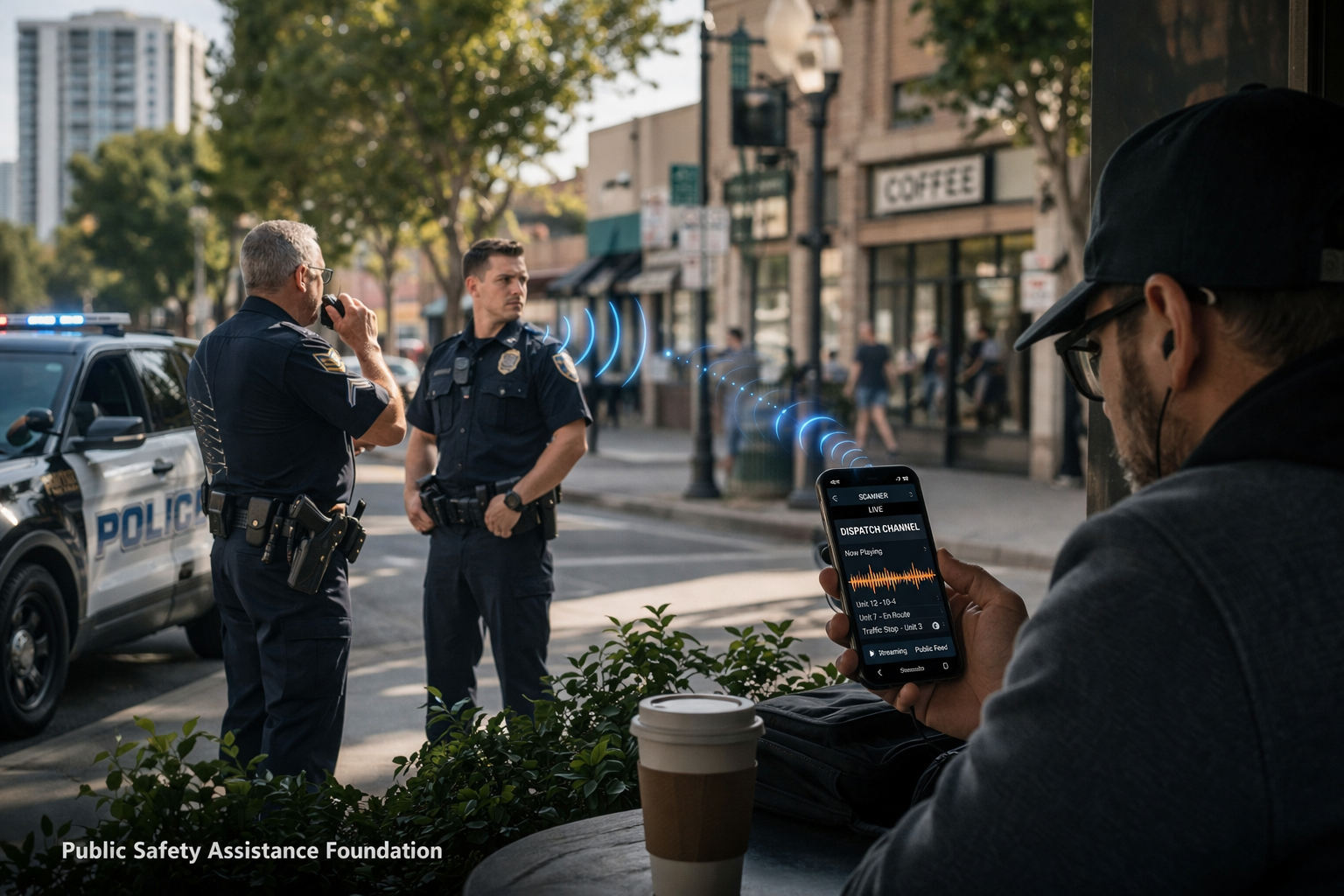
Access to live radio traffic can allow individuals to monitor where officers are responding, anticipate movements, and adjust behavior in real time. With the widespread availability of scanner apps and online streaming tools, this information is no longer limited to a small group of hobbyists. It can be accessed by anyone with a smartphone.
Consider how quickly information can travel during an active incident. A call goes out. It is picked up by a scanner app. Within seconds, it can be shared across social media platforms, group chats, or live streams. What begins as a single transmission can quickly become widely distributed information.
This creates a situation where individuals may gain awareness of law enforcement activity almost as quickly as officers themselves.
Even small pieces of information, such as location updates, vehicle descriptions, or response times can provide insight that may be used to evade detection or interfere with operations.
Law enforcement agencies are increasingly recognizing that information itself can become a tactical advantage or a liability.
Encryption is one way to close that gap.
But it is only one piece of a much larger picture.
The Bigger Issue: Information Exists Beyond the Radio
While radio encryption helps secure one stream of information, it does not address the broader reality officers face today.
Personal information about law enforcement officers and public officials is widely available online.
In many cases, it can be found within seconds.
This includes:
- Home addresses
- Phone numbers
- Names of family members
- Previous addresses
- Vehicle ownership details
- Social media profiles
Much of this information is collected and published by data broker and people-search websites. These platforms aggregate data from public records, commercial sources, and online activity, then organize it into easily searchable profiles.
Unlike radio traffic, this information is not temporary.
It does not disappear after a call ends.
It remains searchable, accessible, and often duplicated across hundreds of websites.
Even if information is removed from one site, it may continue to exist on dozens of others. New listings can also appear over time as databases update and reshare data.
That means even as agencies take steps to protect real-time communications, officers may still be exposed in ways that are far more persistent, and far more difficult to control.
From Scanner Access to Search Engines
Here is where the conversation becomes more important.
If someone can no longer monitor a police radio to understand where an officer is, what happens next?
They may turn to other sources.
Instead of listening in, they can search.
Instead of tracking a patrol unit, they can identify:
- Where an officer lives
- Who lives with them
- What their daily patterns might look like
This shift is subtle, but significant.
It moves the risk from situational exposure to personal exposure.
The Gap Between Operational Security and Personal Privacy
There is a clear contrast emerging.
On one hand:
- Departments are investing in tools and policies to protect operations
- Communications are being secured
- Procedures are evolving to reduce risk in the field
On the other:
- Officers’ personal information remains widely available online
- Data broker and people-search sites continue to publish sensitive details
- Exposure extends beyond the officer to include their families
This creates a gap.
A gap between what is protected during a call and what remains exposed long after.
Closing that gap requires recognizing that officer safety does not end when the radio goes silent.
Why This Matters Beyond the Moment
Encryption protects what is happening now.
Online exposure affects what can happen later.
When personal information is accessible, it can be used to harass or intimidate not only officers, but also their families. Home addresses can be located. Names of relatives can be identified. Social media accounts can provide additional context about daily life, routines, and relationships.
This expands the scope of risk beyond the individual officer.
Family members, who have no role in law enforcement operations, can become part of the exposure.
It also introduces off-duty vulnerability.
An officer may leave a shift, return home, and believe the risk associated with a specific incident has ended. But if personal information is accessible, that risk can continue in a different form.
This is the key difference between operational exposure and digital exposure.
One ends when the call is cleared.
The other remains.
Proactive Safety Is Becoming the Standard
The move to encrypt radio communications reflects a broader shift in mindset.
Agencies are no longer waiting for incidents to occur before making changes.
They are identifying vulnerabilities and addressing them in advance.
This same approach applies to online exposure.
Waiting until personal information is misused is not a strategy.
It is a reaction.
Proactive protection means:
- Identifying where information appears online
- Monitoring for new exposure over time
- Removing data from high-risk websites
- Reducing the overall digital footprint
Because exposure is not static.
It evolves.
A Broader Definition of Officer Safety
Officer safety has traditionally focused on what happens in the field.
But today, safety also includes what is searchable online and what can be compiled from multiple sources.
The line between on-duty and off-duty risk is no longer clear.
Information connects those spaces.
Stay Ahead of What Others Can Find
Radio encryption is a reminder that information matters.
But while departments are working to secure operational data, personal data often remains exposed in ways that are easy to overlook.
Take a moment to consider what information about you may already be visible online.
Then take the next step toward reducing that exposure before it becomes a problem.