
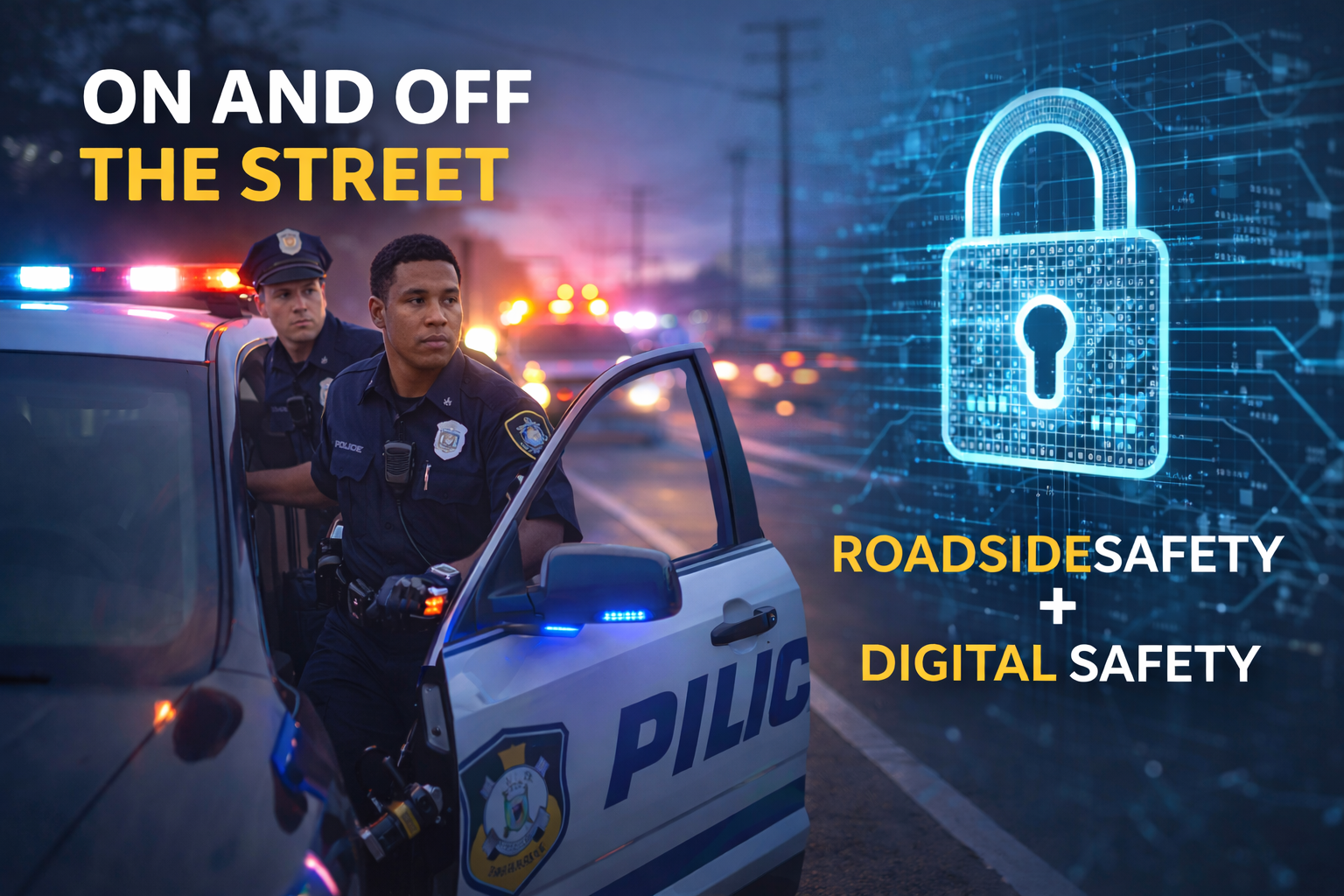
Every day, law enforcement officers put their lives on the line in ways most drivers never fully notice. Responding to emergencies, pulling over vehicles, and assisting stranded motorists are routine parts of the job, but they also place officers directly in harm’s way. A recent initiative by Carmel Police highlights just how serious a threat roadside traffic can be when drivers fail to move over or slow down for emergency vehicles. The department has begun using push notification technology to alert nearby drivers through navigation apps like Waze when a police vehicle is conducting a traffic stop or handling a roadside incident. This type of innovation is crucial, but it also underscores a broader truth. Officer safety is not only about physical gear and equipment. It is about awareness, behavior, and protection that extends beyond the roadway and into the digital world.
In this article, we will explore:
- Why Move Over laws exist
- Why compliance remains a problem
- How roadside incidents put officers at risk
- What communities can do to help, and
- How Privacy for Cops supports officers by reducing their personal online footprint
What the Move Over and Slow Down Law Really Means ⚠️
Most drivers have heard the phrase “move over,” yet many do not fully understand what the law requires or when it applies. In Indiana, motorists are required to change lanes away from stopped emergency vehicles displaying flashing lights whenever it is safe to do so. If a lane change is not possible, drivers must slow down significantly, typically at least ten miles per hour below the posted speed limit. These requirements are designed to create a buffer zone that protects officers, firefighters, EMTs, and other roadside workers. Indiana has had a version of this law in place for decades, and it has expanded over time to include disabled vehicles with hazard lights and additional roadside personnel. Despite this, misunderstanding and noncompliance remain widespread.
Why Drivers Still Fail to Move Over 🚗
Even with clear laws on the books, many drivers continue to ignore or misunderstand their responsibilities. The WRTV report that prompted Carmel Police to deploy navigation app alerts revealed a troubling trend of emergency vehicles being struck while stopped on the roadside. This is not an isolated problem. Studies across multiple states have shown that a significant percentage of motorists neither change lanes nor reduce speed when approaching emergency vehicles. Common contributing factors include:
- Distracted driving
- Overreliance on technology
- Poor awareness of Move Over laws
- Assumption that slowing down is optional
Technology like Waze alerts helps close the awareness gap by notifying drivers before they encounter an emergency scene, but technology alone cannot solve the problem.
The Reality of Roadside Danger for Law Enforcement 🚨
Roadside incidents are among the most dangerous situations officers face. While the public often associates danger with violent encounters, statistics consistently show that a large number of officer injuries and fatalities occur during traffic stops and roadside duties. In the Carmel area alone, multiple Indiana State Police vehicles were struck over a single weekend, underscoring how frequently these incidents occur. Each collision carries serious consequences:
- Risk of severe injury or death
- Disruption to emergency response
- Long term physical and emotional trauma
- Increased strain on department resources
- Lasting impact on officers’ families
Increasing compliance with Move Over laws is not about convenience or courtesy. It is about preventing tragedy.
 Technology Helps but Safety Is More Than Physical 📡
The use of real time alerts through navigation apps is a smart and proactive step toward improving roadside safety. When drivers know in advance that an emergency vehicle is ahead, they are more likely to slow down and move over appropriately. However, physical safety on the roadway is only one part of the officer safety equation. In today’s environment, officers face another category of risk that is less visible but equally serious: digital exposure.
The Hidden Threat of Online Exposure 🖥️
Officers and their families are increasingly vulnerable to threats that originate online. Data broker websites, public records databases, and people search platforms make it easy for anyone to find personal information such as:
- Home addresses
- Personal phone numbers
- Names of spouses, children, and parents
- Employment and service history
- Social media accounts
For law enforcement officers, this kind of access can lead to harassment, doxxing, identity theft, and real-world safety concerns at home. Protecting personal information is no longer optional. It is a necessary part of officer safety.
How Privacy for Cops Reduces an Officer’s Digital Footprint 🔐
Privacy for Cops addresses this growing threat by helping officers take control of their personal information online. One of the primary services offered is data broker removal. Many officers are unaware of how many websites collect and sell their information. We identify these platforms and works to remove data, reducing public visibility and long-term exposure.
Because personal data can reappear over time, ongoing monitoring is critical. Digital privacy is not a one-time fix. Sites often re-post information even when they are supposed to remove personal data completely from their system. It is a continuous safety practice.
Why This Matters to Officers and Communities 🤝
Every officer deserves to return home safely at the end of their shift. Move Over laws exist to protect lives, not just enforce rules of the road. When drivers slow down and give space, they actively contribute to officer safety. At the same time, communities benefit when officers feel supported, protected, and secure both on duty and off. Digital privacy strengthens that sense of security by limiting opportunities for malicious targeting and unwanted exposure.
Steps That Can Be Taken Right Now ✅
For agencies:
– Increase public education on Move Over laws
– Explore technology partnerships that improve driver awareness
– Include digital privacy in officer safety training
For officers:
– Audit personal online presence
– Secure social media accounts
– Work with Privacy for Cops to remove public data
– Educate family members on online safety
For the public:
– Move over and slow down every time
– Share awareness messages on social media
– Support initiatives that protect first responders
Conclusion 🛡️
The Carmel Police initiative demonstrates how innovation can reduce risk during one of the most dangerous aspects of law enforcement work: roadside operations. It also serves as a reminder that officer safety must be approached from multiple angles. While no one can eliminate every hazard officers face on the road, reducing unnecessary digital exposure is a practical and impactful step officers can take to protect themselves and their families. Privacy for Cops supports this effort by helping officers shrink their online footprint and limit access to personal information.
Whether it is moving over for a patrol vehicle or removing an address from a data broker website, safety begins with awareness and is sustained through deliberate action. Officers dedicate their careers to protecting others. Taking steps to protect personal information is one more way to ensure that protection extends beyond the roadway and into their homes.
If you are ready to take control of your digital exposure and safeguard what matters most, take the next step in protecting yourself and your family.
Exclusive Privacy Plans