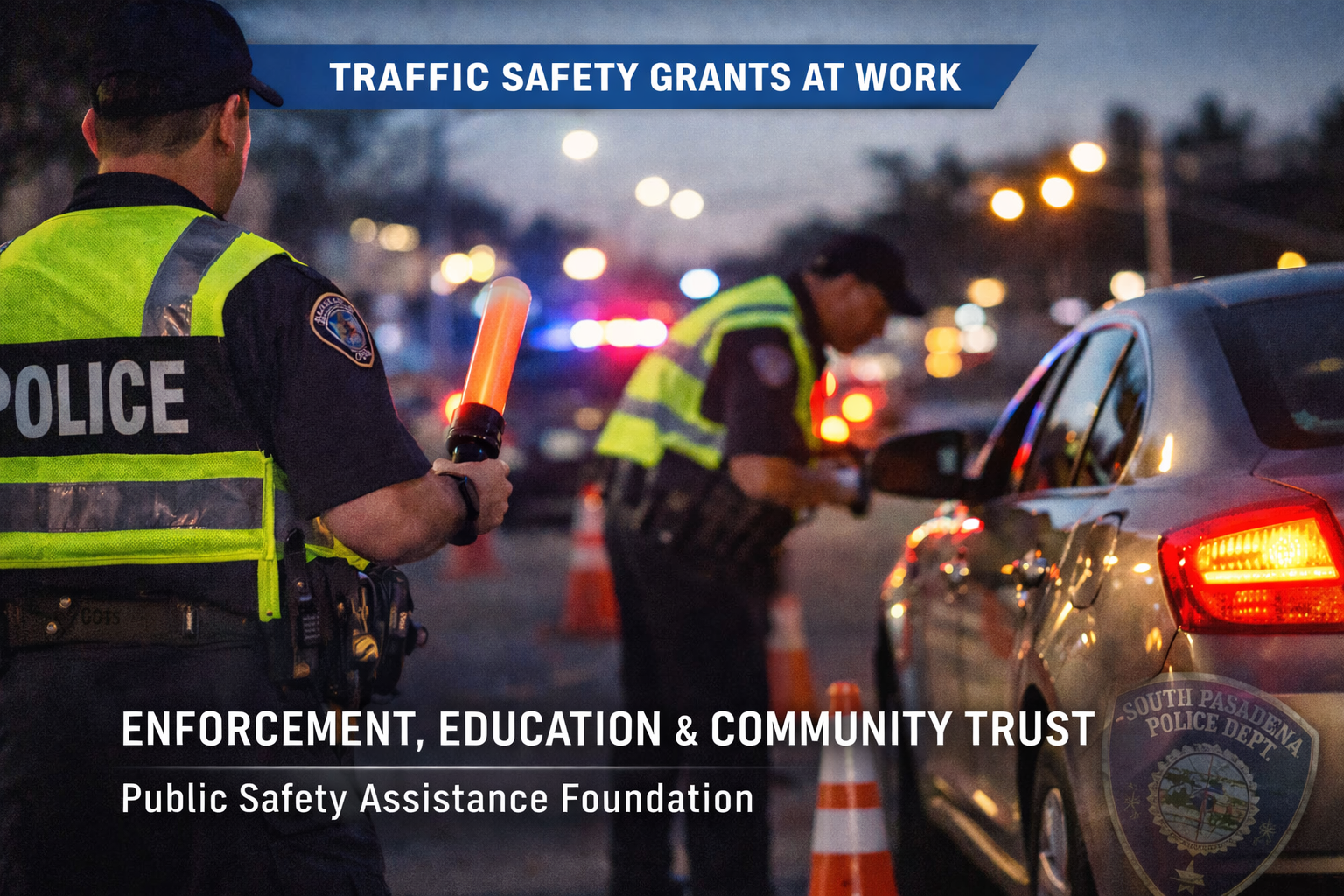
Traffic safety enforcement is a core responsibility for every police department. When done well, it protects lives and reinforces the trust between law enforcement and the communities they serve. Recently, one small California agency received a funding boost that demonstrates how targeted traffic safety programs can achieve both goals.
In December 2025, the South Pasadena Police Department was awarded a $65,000 traffic safety grant from the California Office of Traffic Safety (OTS) to expand enforcement and education efforts through September 2026. The infusion of funds supports proactive policing strategies and encourages broader community participation in road safety.
In this post, we’ll look at how traffic safety grants empower departments, the tactics being used with this new funding, and what lessons other agencies can draw for their own operations.
Why Traffic Safety Grants Matter
Traffic enforcement isn’t just about issuing citations. It’s about preventing crashes, reducing injuries, and creating safer streets for motorists, cyclists, and pedestrians.
Grants from traffic safety offices, such as those administered by the California OTS and supported by the National Highway Traffic Safety Administration, help smaller agencies do more than their budgets would otherwise allow. Funding can pay for overtime patrols, high-visibility checkpoints, training, community education, and partnerships with neighboring police departments.
For departments with limited resources, even modest grants like $65,000 can significantly expand the reach of safety campaigns.
How South Pasadena Is Allocating the Grant
The grant awarded to South Pasadena will go toward a range of enforcement and education efforts designed to reduce dangerous driving behaviors and improve pedestrian and bike safety. According to the official city announcement, funded activities include:
- DUI checkpoints and patrols targeting impaired drivers
- High-visibility distracted driving enforcement focused on violations of hands-free laws
- Enforcement aimed at speeding, failure to yield, red-light and stop sign running, and unsafe lane changes
- Traffic safety presentations for the public covering distracted and impaired driving, speeding, and more
- Collaborative operations with neighboring agencies
- Additional officer training in standardized field sobriety testing and advanced impaired driving detection
Each of these elements forms part of a robust, evidence-informed traffic safety approach.
The Purpose Behind Enforcement and Education
At its core, traffic safety enforcement is designed to prevent harm. Driving under the influence and distracted driving remain leading causes of serious injury and death on roadways nationwide. Targeted checkpoints stop impaired drivers before they can cause harm, and highly visible patrols reinforce safe driving norms.
But enforcement alone isn’t enough.
Educating the public about traffic laws and safe driving behaviors is equally critical. Many drivers underestimate the risks of distracted driving or fail to understand how quickly a crash can occur. Community presentations and targeted outreach can close that gap.
This two-pronged strategy builds a culture where safety is prioritized and high-risk behaviors are socially unacceptable.
Training: Building Officer Expertise
Traffic enforcement is a specialized discipline. Officers must be able to identify impairment, understand the nuances of distracted behavior, and enforce vehicle codes consistently and fairly.
The South Pasadena grant specifically includes funding for:
- Standard Field Sobriety Test (SFST) certification
- Advanced Roadside Impaired Driving Enforcement (ARIDE) training
These certifications help officers detect impairment accurately and process traffic stops with professionalism and legal integrity.
Training also reinforces procedural justice principles, including clear communication and fair treatment during stops. That, in turn, improves public trust—a key consideration for community-oriented policing.
Collaborative Enforcement: Strength in Numbers
Small departments often lack the manpower to sustain frequent traffic operations on their own. Partnering with neighboring agencies helps distribute workloads and allows for coordinated campaigns that cover multiple jurisdictions.
Collaborations can range from joint DUI checkpoints to coordinated distracted driving patrols along shared corridors.
These partnerships also help establish consistent safety expectations across regions, reducing driver confusion and providing uniform enforcement of important laws.
What This Means for Privacy and Trust
Traffic stops are one of the most common points of contact between police and civilians. These interactions can shape public perceptions of law enforcement for years.
When conducted with respect, fairness, and transparency, traffic enforcement builds legitimacy. When poorly handled, it can erode trust rapidly.
Here’s how traffic safety grants like this support both privacy and community trust:
- Focused enforcement minimizes unnecessary intrusion by concentrating resources on high-risk behaviors rather than low-risk technical violations
- Transparent community outreach helps residents understand why enforcement is happening and how it benefits public safety
- Officer training in standardized methods reduces subjectivity and supports lawful, evidence-based behavior
- Collaboration with partner agencies ensures that enforcement standards are consistent and equitable
All of these contribute to a model where safety and civil liberties are balanced, not pitted against each other.
Traffic Stops, Visibility, and the Modern Risk Landscape
Traffic stops remain one of the most common and visible interactions between law enforcement and the public. They are also among the most unpredictable. Officers conducting routine enforcement are often working in open environments, under time pressure, and increasingly under digital scrutiny.
Today, a single traffic stop can be recorded, shared, and analyzed online within minutes. While transparency plays an important role in accountability, the ease with which footage, officer names, and personal details can circulate introduces new risks that departments must acknowledge. Officers are no longer just enforcing the law in real time. They are doing so in an environment where digital exposure can extend well beyond the roadside.
This reality makes professionalism, consistency, and training even more critical. Clear communication during stops, adherence to standardized procedures, and visible public education efforts all help reduce misunderstanding and conflict. At the same time, departments must recognize that officer safety does not end when a shift does. Protecting personal information from misuse is now part of protecting the badge itself.
Traffic safety initiatives are strongest when operational readiness and digital safeguards move forward together. Grants that support enforcement and education create safer streets. Policies that protect officer privacy help ensure those efforts are sustainable.
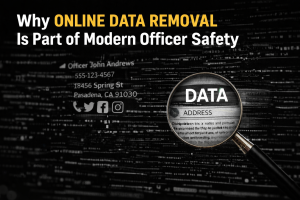
Modern officer safety recognizes that protecting officers today means addressing not only physical risks on the job, but also digital exposure and personal vulnerability beyond the badge.
Traffic enforcement places officers in highly visible, often unpredictable situations. While much of the public focus is on what happens during the stop, the impact can extend far beyond the roadside.
In today’s environment, footage from a traffic stop can be shared online within minutes. Names, badge numbers, and agency affiliations can quickly be paired with publicly available personal data found through data broker sites. Home addresses, family members, phone numbers, and property records are often only a few clicks away.
This creates a compounding risk. A routine stop tied to a viral post can expose officers and their families to harassment, intimidation, or targeted threats that have nothing to do with the original enforcement action. The danger is no longer limited to the moment of contact. It follows officers home.
This is where online data removal becomes a critical layer of officer safety. Reducing the availability of personal information limits how easily a bad actor can escalate a grievance from a traffic stop into a real-world threat. It is a preventative measure, much like training or equipment, designed to reduce exposure before harm occurs.
Privacy for Cops focuses on this proactive protection. By helping officers and their families remove sensitive personal data from online sources, agencies can strengthen safety without compromising transparency or accountability.
Lessons for Other Agencies
While every agency has its own context and constraints, several lessons can be drawn from South Pasadena’s approach:
- Pursue specialized grants that align with local safety priorities. Traffic safety funds can be a reliable avenue to enhance enforcement capacity without depleting general budgets
- Invest in officer training to ensure enforcement is professional, consistent, and defensible
- Use data to drive operations. High-visibility patrols and checkpoints should be informed by collision and violation data where possible
- Communicate with the community. Public presentations and reporting help residents understand the purpose behind enforcement
- Partner with others. Collaboration builds broader impact and shares the workload
These strategies can be adapted to departments of almost any size.
Final Thoughts
Traffic safety is a shared responsibility. Grants like the one awarded to the South Pasadena Police Department enhance enforcement and education efforts that save lives and protect communities.
For law enforcement professionals, thoughtful use of grant funds offers more than operational capacity. It offers an opportunity to build stronger relationships, foster transparency, and reinforce public safety in ways that align with both community expectations and officers’ duty to protect.
As departments continue to navigate complex safety challenges, targeted funding and strategic planning remain essential tools in the ongoing effort to keep roads safer for everyone.
Why This Matters Beyond the Grant
Traffic safety grants like the one awarded to South Pasadena show what is possible when enforcement, education, and planning align. They reduce preventable harm, support officer training, and reinforce trust at the community level.
But long-term public safety depends on more than funding cycles. It requires policies and practices that recognize how modern policing intersects with visibility, technology, and personal risk. When officers are protected both on duty and off, they are better positioned to serve with confidence, professionalism, and fairness.
Departments exploring traffic safety initiatives should consider how privacy protection fits into their overall safety strategy. The goal is not just safer streets today, but sustainable policing for the future.
Traffic safety initiatives protect the public on the road. Protecting officer privacy helps ensure those efforts do not create unintended risks beyond the stop.
If your department is exploring traffic safety grants or seeking best practices for enforcement that respects privacy and civil rights, reach out to Privacy for Cops for guidance and resources.
Police Officer Associations & Groups