
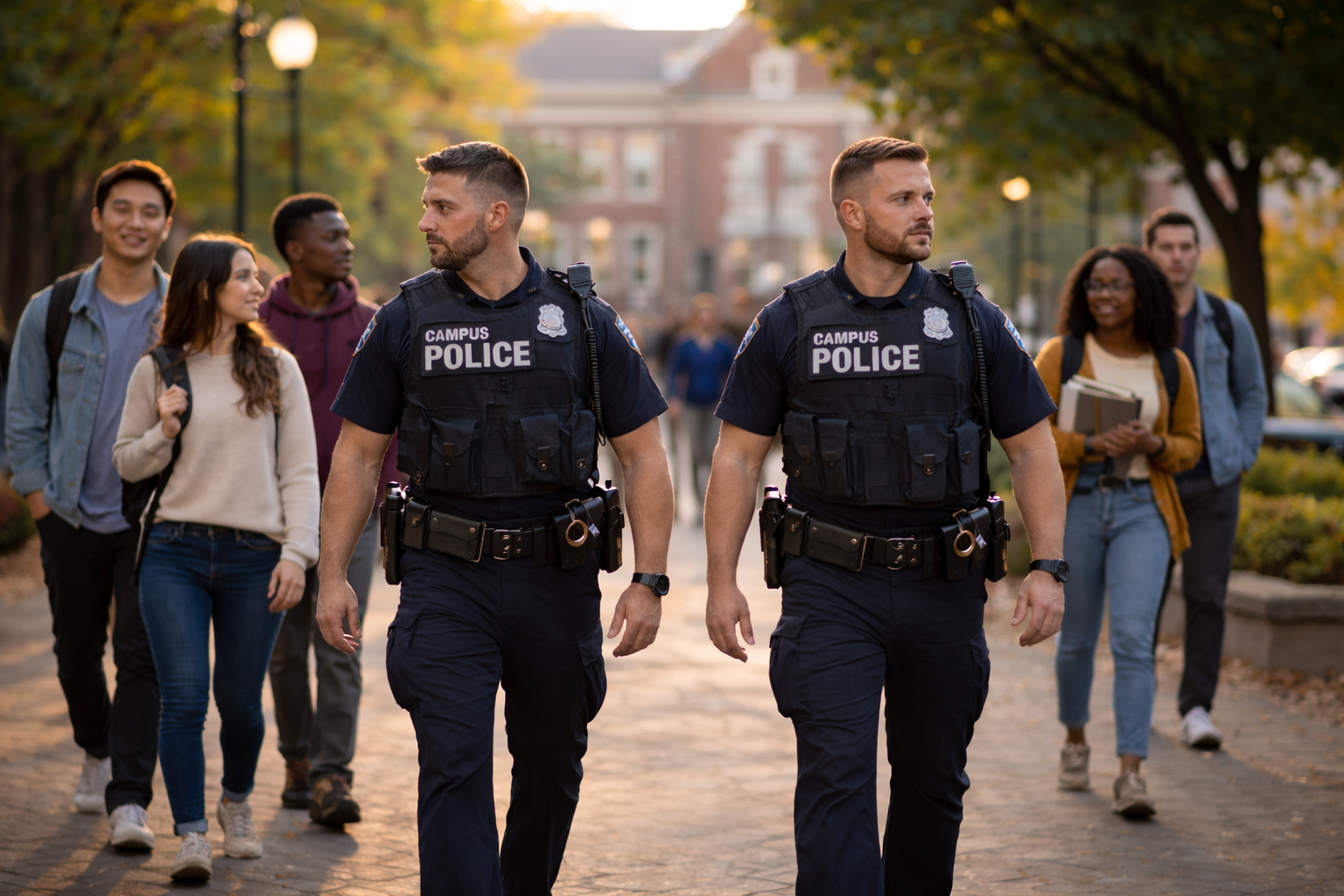
Colleges and universities are open by design, with publicly accessible spaces, minimal physical barriers, and a culture that values accessibility over restriction. While this openness is central to academic life, it also creates unique and growing challenges for the law enforcement professionals tasked with keeping these environments safe. Campus officers are increasingly expected to respond to complex threats that mirror those faced by larger agencies, all while operating within institutions that were never built with modern security realities in mind.
For decades, universities and colleges have symbolized openness. They are designed to encourage collaboration, debate, and free movement of people and ideas. While those values remain essential to education, they also create complex challenges for public safety professionals tasked with protecting these environments.
Campus law enforcement agencies today operate under conditions that look very different from those of previous generations. The risks they face are broader, more unpredictable, and often more politically and socially charged. From violent intruders and ideological extremism to protests that escalate rapidly, the modern campus is no longer insulated from the same threats confronting cities and communities nationwide.
Yet the challenges do not stop at the campus gates. Law enforcement officers everywhere are operating in a climate where threats extend beyond physical encounters. Personal information, once difficult to obtain, is now readily available online. This digital exposure has quietly become one of the most overlooked safety risks facing officers and public officials today.
Understanding how these realities intersect is critical. Protecting law enforcement in the modern era requires more than tactical readiness. It demands a holistic approach that addresses both physical security and digital vulnerability.
Why Campuses Are Especially Vulnerable
Universities are often described as “soft targets,” not because they lack capable law enforcement professionals, but because of how they are structured. Open access buildings, public events, dense populations, and limited physical barriers create environments that are difficult to secure without fundamentally altering campus culture.
Campus police are frequently asked to balance competing priorities. They must enforce the law while respecting academic freedom, student rights, and institutional governance. Decision-making authority can be fragmented among administrators, legal counsel, and public safety leadership. This can slow responses and limit proactive measures, even when credible risks are identified.
At the same time, campus officers are increasingly expected to respond to threats that mirror those faced by larger municipal agencies. These include active shooter scenarios, targeted violence, hate-motivated incidents, and politically driven unrest. The expectation to manage these risks often outpaces available resources, staffing, and legal authority.
The result is a system under strain. Officers are asked to do more with less, while operating in environments that were never designed with modern threat realities in mind.
The Expanding Threat Environment for Law Enforcement
What is happening on campuses reflects a broader shift in the threat landscape facing law enforcement nationwide. Today’s risks are not limited to traditional crime patterns. They include:
- Lone-actor violence driven by personal grievance or ideology
- Online radicalization that moves quickly into real-world action
- Organized harassment campaigns targeting officers and officials
- Escalating hostility toward public servants
- Increased visibility of law enforcement through social media and digital records
These threats often emerge with little warning and evolve rapidly. They are fueled by online ecosystems where information, misinformation, and personal data circulate freely.
In this environment, an officer’s role no longer ends when a shift is over. Exposure follows them home, online, and into their personal lives.
 The Digital Side of Officer Vulnerability
While much attention is rightly placed on physical safety, there is a quieter risk that deserves equal consideration: the widespread availability of personal information online.
Data brokers, public records websites, and people-search platforms routinely publish details such as home addresses, phone numbers, family members’ names, and past residences. This information is often aggregated automatically and sold without consent.
For law enforcement officers and public officials, this creates a unique danger. The same transparency laws and public data systems meant to support accountability can be exploited by individuals with malicious intent.
Digital exposure can lead to:
- Targeted harassment and intimidation
- Stalking of officers or their families
- Doxxing campaigns designed to incite fear
- Increased risk of targeted violence
- Identity theft and fraud
These risks are not hypothetical. Across the country, officers have seen their personal information used as a tool for retaliation or coercion. In an era of heightened tensions and polarized discourse, the consequences can escalate quickly.
Families Share the Risk
One of the most troubling aspects of online data exposure is that it rarely affects only the officer. Spouses, children, and extended family members are often listed alongside them. These individuals did not choose a career in public service, yet they can become unintended targets simply by association.
For many officers, concern for family safety weighs as heavily as concern for their own. Knowing that a home address or child’s school can be found with a simple search creates constant anxiety. That stress does not disappear when the uniform comes off.
Protecting families is not a secondary issue. It is central to officer well-being and long-term resilience.
Why Privacy Is a Safety Issue, Not a Convenience
Digital privacy is sometimes misunderstood as a personal preference or a matter of convenience. For law enforcement, it is a safety issue.
Just as officers wear body armor to reduce physical risk, minimizing online exposure reduces vulnerability in another domain. Removing personal data from public sites limits the ability of bad actors to plan, target, or intimidate.
This is Where Privacy for Cops Plays a Vital Role
As a nonprofit dedicated to protecting law enforcement officers and public officials, we focus on identifying and removing sensitive personal information from online data brokers and people-search platforms. We understand that most officers do not have the time, expertise, or resources to navigate dozens of removal processes on their own.
By handling this work on behalf of officers and their families, Privacy for Cops helps reduce an often invisible but very real risk.
Supporting Officer Focus and Effectiveness
Officer safety is not only about preventing harm. It is also about enabling focus and effectiveness on the job.
When officers are distracted by concerns about online exposure or family safety, it can affect decision-making, stress levels, and overall performance. Chronic anxiety contributes to burnout, which is already a serious issue in the profession.
By reducing digital exposure, Privacy for Cops helps restore a sense of control. Officers can focus on their mission knowing that proactive steps are being taken to protect their personal lives.
This peace of mind is not a luxury. It is a force multiplier.
Connecting Physical and Digital Security
The challenges facing campus law enforcement illustrate a larger truth. Safety in the modern world is multidimensional.
Physical security measures, threat assessment, training, and coordination remain essential. However, they must be paired with strategies that address digital vulnerabilities. Ignoring either side leaves gaps that can be exploited.
Universities, agencies, and policymakers are increasingly recognizing the need for integrated approaches. Just as campuses invest in emergency preparedness and communication systems, there must be equal attention paid to protecting the people tasked with responding to those emergencies.
Digital privacy is one of the few areas where proactive action can significantly reduce risk without compromising openness or civil liberties.
What Agencies and Officers Can Do Now
There are practical steps that can be taken to strengthen officer safety in this evolving environment:
- Acknowledge digital exposure as a legitimate safety concern
- Educate officers about online risks and data aggregation
- Encourage proactive removal of personal information
- Support nonprofit and professional services dedicated to officer privacy
- Advocate for stronger privacy protections in policy and law
Addressing these issues does not require abandoning transparency or accountability. It requires recognizing that unrestricted access to personal data can be weaponized and that reasonable safeguards are necessary.
Moving Forward with a Broader Definition of Protection
The threats facing law enforcement are not static. They evolve alongside technology, social dynamics, and global events. Campuses offer a clear example of how quickly environments can change and how difficult it can be to adapt without comprehensive strategies.
Protecting officers today means thinking beyond patrol zones and response times. It means considering where vulnerabilities exist before a threat emerges.
Digital privacy is one of those areas. It is preventative, measurable, and impactful.
Turning Awareness Into Action
Law enforcement professionals dedicate their careers to protecting others. They should not have to navigate unnecessary risk simply because their personal information is easy to find online.
If you are an officer, a family member, an agency leader, or a supporter of public safety, now is the time to take digital privacy seriously. Visit Privacy for Cops to learn how reducing online exposure can help protect those who stand on the front lines every day. Real safety does not end at the perimeter. It starts by protecting the people behind the badge, both offline and online.
Exclusive Privacy Plans