
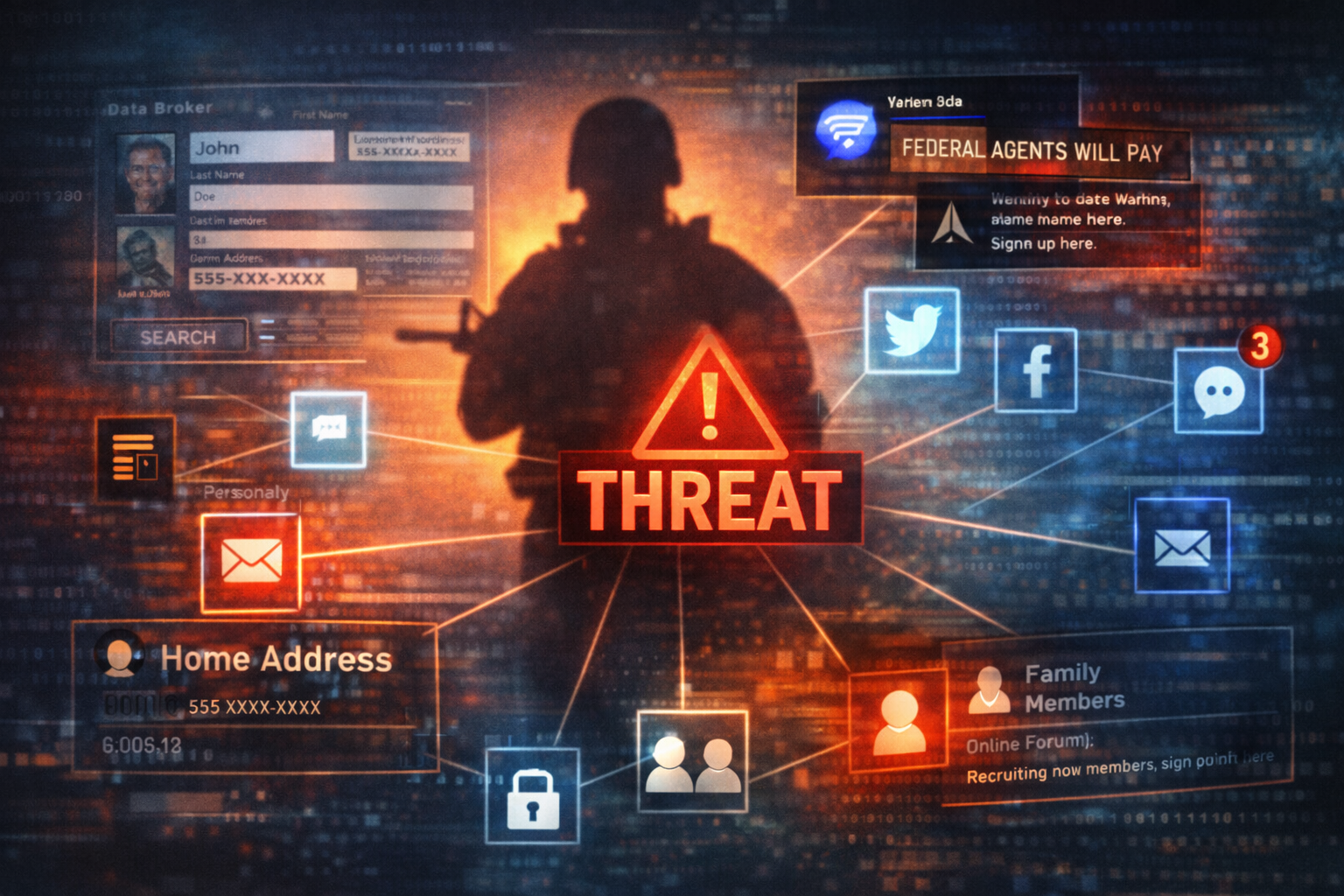
A recent federal arrest underscores how online rhetoric, radicalization, and exposed personal data create real-world danger for law enforcement and public officials
A Disturbing Reminder of a Growing Threat
In December 2025, federal authorities arrested a former U.S. Marine and former police officer who allegedly threatened to recreate the 1993 Waco siege against federal agents. According to court documents and reporting, the individual made online statements referencing the Waco massacre, expressed extremist ideology, and allegedly traveled with tactical gear while discussing plans for violence. Investigators cited social media activity, communications with extremist networks, and preparations that raised serious concerns about an imminent threat. While the arrest prevented what could have been a catastrophic act of violence, the case serves as a sobering reminder that modern threats to law enforcement often begin online, escalate rapidly, and intersect with digital exposure in dangerous ways.
This incident is not an isolated anomaly. Across the country, law enforcement professionals are increasingly confronted with individuals who use digital platforms to broadcast violent intent, recruit others, and seek legitimacy for extremist beliefs. When these individuals have military or law enforcement training, the risks become even more acute. What is often overlooked in these conversations is how easily accessible personal information can amplify those risks and place officers and their families directly in harm’s way.
The Digital Pathway from Rhetoric to Real-World Violence
The Waco siege has long been referenced by extremist groups as a symbol of anti-government ideology, and its continued invocation decades later demonstrates how historical events can be weaponized online. Today, digital platforms make it easier than ever for individuals to signal intent, share grievances, and find like-minded extremists without geographic boundaries. Social media posts, encrypted messaging apps, forums, and data broker websites form an ecosystem where ideology, logistics, and personal data intersect.
When threats surface online, law enforcement agencies must respond swiftly and decisively. In this case, federal authorities were able to intervene before violence occurred, highlighting the importance of intelligence gathering and interagency coordination. However, prevention does not begin and end with arrests. Prevention also means reducing the opportunities for bad actors to identify targets, locate personal residences, or intimidate officers outside of official channels. That is where privacy protection becomes a critical, and often underutilized, layer of officer safety.
Why Personal Data Exposure Is a Force Multiplier for Threats
Publicly accessible personal information has quietly become one of the most significant vulnerabilities facing law enforcement officers and public officials today. Data broker sites, people-search engines, and online directories routinely publish home addresses, phone numbers, family member names, and even maps to residences. This information is often aggregated without consent and sold or shared widely.
For someone harboring violent intent, this data removes friction. It allows them to move from abstract hostility toward law enforcement to specific targeting. It enables harassment, stalking, doxxing, and intimidation. In extreme cases, it facilitates physical harm. Even when no violence occurs, the psychological toll on officers and their families is real. The knowledge that strangers can easily access where you live or where your children go to school fundamentally changes how safely one feels at home.
The case involving the former Marine illustrates how dangerous intent can develop in digital spaces long before an attack is attempted. When that intent meets easily accessible personal data, the consequences can be devastating.
Privacy for Cops: Protecting Those Who Protect Others
The Public Safety Assistance Foundation, also known as Privacy for Cops, was founded to address this exact problem. As a nonprofit organization established by law enforcement professionals, we understand firsthand the risks associated with personal data exposure. Since 2008, our mission has been to help sworn officers, public officials, and their families remove personal information from online databases that make them vulnerable.
Our work focuses on identifying where personal data appears online, submitting opt-out and removal requests to data brokers and search platforms, and monitoring to ensure information does not reappear. We operate within the legal frameworks available in multiple states, including California, Colorado, Texas, Florida, Idaho, Nevada, Utah, and New Jersey, leveraging existing privacy laws to reduce exposure. For officers who are already balancing demanding careers, family responsibilities, and public scrutiny, navigating these processes alone can be overwhelming. We exist to shoulder that burden and provide a clear, secure path to privacy protection.
Privacy as a Core Component of Officer Safety
Officer safety discussions traditionally focus on training, equipment, and situational awareness. While these elements are essential, they are no longer sufficient in a digital age. Safety must now include control over personal information. An officer who wears body armor on duty but has their home address listed on dozens of websites is protected in one environment and exposed in another.
Privacy protection does not interfere with transparency or accountability. It simply ensures that sensitive personal details are not exploited by criminals, extremists, or those seeking to intimidate public servants. Reducing digital exposure makes it harder for malicious actors to escalate online threats into real-world harm. It also restores a sense of normalcy and security to officers’ private lives, which is vital for mental health, family stability, and long-term career sustainability.
The Broader Implications for Public Safety
When law enforcement professionals feel unsafe at home, the effects ripple outward. Recruitment suffers. Retention declines. Community trust erodes when officers are forced to withdraw or limit engagement to protect their families. Ensuring privacy is not only about individual safety; it is about maintaining a resilient public safety system.
The arrest tied to threats referencing Waco should prompt broader reflection on how society addresses radicalization, online extremism, and the unintended consequences of unregulated data collection. While law enforcement agencies work to disrupt violent plots, organizations like Privacy for Cops work to reduce the conditions that make targeting possible in the first place. Both efforts are necessary, and both serve the same goal: preventing harm before it occurs.
Moving Forward in a High-Risk Digital Environment
As technology continues to evolve, so too will the tactics of those who wish to do harm. Threats will increasingly surface online, and personal data will remain a valuable commodity unless stronger protections are implemented. Officers and public officials should not have to accept exposure as part of the job. Privacy is a right, not a privilege, and safeguarding it is an investment in safety, wellbeing, and professional longevity.
At Privacy for Cops, we remain committed to advocating for stronger privacy protections, expanding access to our services, and educating the law enforcement community about the risks of digital exposure. We believe that protecting personal information is one of the most effective, proactive steps officers can take to protect themselves and their families in an unpredictable world.
Take Control of Your Privacy
If you are a sworn law enforcement officer or public official, now is the time to assess your digital footprint. Do you know where your personal information appears online? Are your home address, phone number, or family details publicly accessible?
We’re here to help. Our nonprofit organization specializes in removing personal data from online sources and monitoring ongoing exposure, so you don’t have to navigate this complex process alone. Protecting your privacy is not about fear; it is about preparedness.
Visit PrivacyForCops.org to learn more about our services, eligibility, and how we can help you reclaim control over your personal information. In a world where threats can emerge with a few keystrokes, taking action today can make all the difference tomorrow.
About Us