
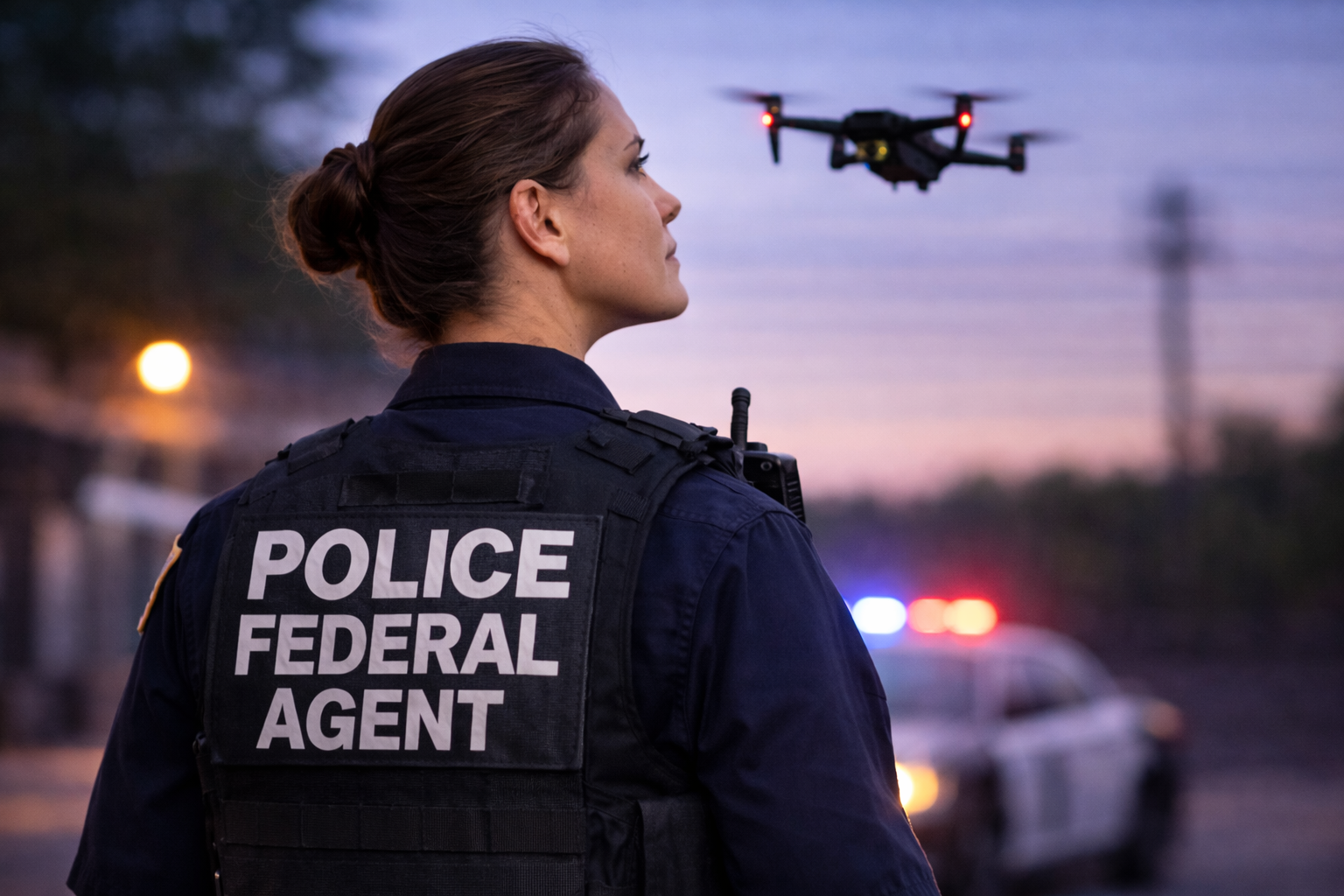
As drone activity accelerates across the United States, law enforcement officers are facing a rapidly evolving threat landscape. Once seen primarily as platforms for photography and hobbyist recreation, drones have now become tools with real potential for malicious use, whether for unauthorized surveillance, interference with critical infrastructure, or targeted attacks on public venues. According to recent analysis, drone incidents have already disrupted major international airports and raised high-level security concerns, signaling that the risk of misuse is no longer theoretical but immediate and real.
But beyond the broader landscape of public safety threats, law enforcement professionals face deeply personal implications as drones proliferate, especially when it comes to privacy exposure, operational security, and off-duty risk. At Privacy for Cops, we believe protecting officers is not just about responding to threats. It is about anticipating how emerging technology intersects with personal information, physical safety, and digital vulnerability.
This blog explores:
- Why drones matter to law enforcement privacy and safety
- The key threat scenarios officers must understand
- How departments and individuals can proactively protect themselves
- How Privacy for Cops helps law enforcement stay ahead of privacy risks
Why the Drone Threat Is Not Just a Technology Issue
Drones, also known as Unmanned Aircraft Systems, have become increasingly common in American airspace. In the United States alone, nearly one million drones are registered with the Federal Aviation Administration, with countless more operating without registration. While many are used responsibly, bad actors can exploit drone technology for surveillance, intimidation, and disruption.
Unauthorized drone flights over stadiums, public events, and critical infrastructure are increasing. Emergency planners are now preparing for drone interference at major national and international events, and lawmakers are considering expanded authority for law enforcement to respond to these threats. For officers on the ground, this trend has serious implications for both professional operations and personal safety.
How Drones Create Privacy and Safety Risks for Officers
One of the most overlooked dangers of drone technology is unauthorized surveillance. Modern drones equipped with high-resolution cameras can quietly capture video and still images from significant distances. This becomes a serious privacy concern when drones are used to observe patrol routines, training locations, off-duty gatherings, or residential neighborhoods where officers live with their families.
These incidents are not just invasions of privacy. They can reveal patterns, routines, and locations that can be exploited by individuals seeking to intimidate, harass, or harm law enforcement personnel. For officers already facing targeted threats, this level of exposure presents an unacceptable risk.
Drone proliferation also increases physical and operational safety challenges. Many local departments are still developing the tools and training needed to detect and respond to unauthorized drone activity. Even as federal investments support counter-drone initiatives, most agencies lack comprehensive detection systems or clearly defined response protocols. This gap can complicate perimeter security, slow response times, and introduce new risks during major incidents or public events.
Equally concerning is the connection between aerial surveillance and publicly available personal data. Drone operators, including hobbyists, can easily access data broker websites, social media platforms, and mapping tools that reveal home addresses, family connections, and daily routines. When this information is combined with visual data from drone surveillance, it creates a detailed profile of an officer without requiring sophisticated investigative skills. This convergence of technology and data exposure significantly raises the stakes for officer safety.
The Rapid Evolution of Drone Technology
The drone threat is not static. Newer systems are increasingly autonomous, capable of following preprogrammed routes while avoiding detection. Some are equipped with advanced zoom lenses, thermal imaging, or artificial intelligence that enhances tracking and observation. At the same time, counter-drone technologies are also evolving, including radio-frequency detection, signal disruption, and interception systems.
However, technology alone cannot solve the problem. Effective counter-drone strategies require clear policies, lawful authority, interagency coordination, and proper training. Without these elements, even advanced systems can be misused or underutilized, increasing legal and operational risks rather than reducing them.
Why Privacy Protection Is a Critical Part of Drone Readiness
While agencies work to address aerial threats, personal data exposure remains one of the most significant and controllable vulnerabilities facing law enforcement officers today. Drone surveillance becomes far more dangerous when an individual’s identity, address, and family details are readily available online.
At Privacy for Cops, we focus on reducing this risk by addressing the digital side of officer safety. Protecting personal information is not just about reputation management. It is about preventing threats from escalating by removing the data that enables targeting in the first place.
How Privacy for Cops Supports Law Enforcement Officers and Public Officials
Privacy for Cops specializes in helping law enforcement professionals protect their personal information and reduce online exposure. Our services include comprehensive data removal from data broker sites, search engines, and people-search databases that routinely publish officers’ addresses, phone numbers, and family connections.
We also conduct individualized risk assessments that identify where personal information is exposed and how it could be exploited. By addressing these vulnerabilities proactively, officers can significantly reduce the likelihood that emerging technologies like drones are used to target them or their families.
In addition, we provide ongoing monitoring to alert officers when new personal information appears online. This allows for rapid response before exposure becomes a safety issue. For departments and unions, we offer consulting services that help establish privacy best practices, strengthen operational security, and support officer wellness.
Practical Steps Officers and Departments Can Take Today
Understanding your digital footprint is a critical first step. If your personal information is publicly accessible online, it can be combined with aerial observation to create a detailed profile of your movements and routines. Removing this information significantly reduces risk.
Departments should also engage in counter-drone planning and ensure clear protocols are in place for responding to unauthorized drone activity. Training, documentation, and coordination across units are essential to effective response and legal compliance.
Equally important is partnering with professionals who understand privacy risk management for law enforcement. Technology-driven threats will continue to evolve, but proactive privacy protection remains one of the most effective ways to stay ahead of those risks.
Privacy Is Safety
Drones represent one of the fastest-growing challenges in modern policing, but they also highlight a broader truth. Personal information is a vulnerability unless it is protected. Officers dedicate their careers to protecting the public. They should not have to worry about their own families being exposed due to unchecked data collection and emerging surveillance technologies.
We are committed to securing digital identities, reducing exposure, and helping officers operate with confidence in an increasingly connected world.
Learn More and Contact Us Today!
Take control of your privacy before it becomes a target!
About Us