
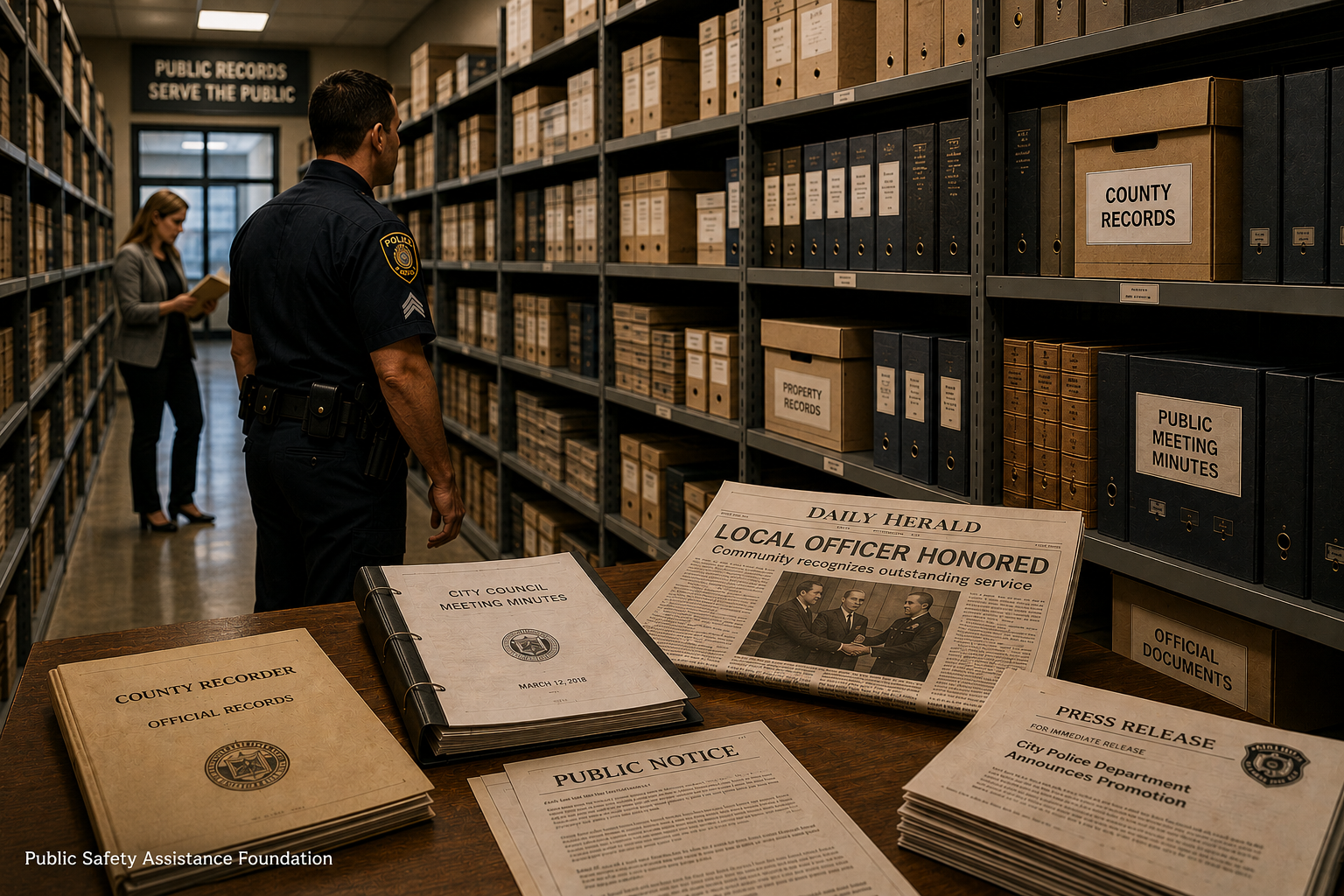
🔎 How news articles, public records, and official announcements can continue shaping online visibility long after publication.
Many law enforcement officers and public officials understand that personal information can appear online through people-search websites and data brokers. These sites often collect information from a variety of sources and make it easily accessible to anyone willing to search.
However, not all online exposure originates from data brokers.
In many cases, some of the most visible information online comes from legitimate public sources such as:
- news articles
- government websites
- court records
- public notices
- voter registration records
- property records
- official announcements
- and community publications
These sources serve important public purposes. They provide transparency, preserve historical information, and help communities stay informed.
Yet they also create a reality that many officers and public officials do not fully consider:
Public information can remain searchable for years, long after the original event has passed.
Understanding the difference between removable exposure and public information is an important part of managing online privacy in today’s digital environment.
The Search Result You Didn’t Create
Imagine searching your own name online.
You might expect to find social media profiles or perhaps information from a people-search website.
Instead, you discover something else.
- A local news article covering an arrest from years ago
- A department press release announcing a promotion
- A community newsletter recognizing volunteer service
- An award announcement
- A government meeting agenda
- A public records database
None of these items were posted by you.
You may not have even known they existed.
Yet they appear prominently in search results.
This surprises many people, because online visibility is often associated with personal posting habits. We tend to assume that information becomes public because someone shared it intentionally.
In reality, much of what appears online is created by organizations, agencies, news outlets, and government entities.
The information may be accurate.
It may be completely appropriate.
It may even be positive.
But it still contributes to an individual’s online footprint.
Public Information Has a Different Purpose
One of the most important distinctions in online privacy is understanding that not all information is treated the same.
Data broker websites and people-search platforms are designed to collect, aggregate, and distribute personal information. These sites often allow removal requests and may be subject to various privacy regulations.
Public information operates differently.
News organizations publish stories to inform communities.
Government agencies maintain records to promote transparency.
Courts preserve official documentation.
Counties record property transactions and legal filings.
Election officials maintain voter registration systems.
These systems were not created to expose individuals.
They exist because public access serves a legitimate function within society.
As a result, information that appears in these locations is often governed by different laws, procedures, and protections than information found on commercial people-search websites.
This distinction is important, because many people assume all online information can be removed through a single process.
That is rarely the case.
Different sources often require different approaches.
Positive Recognition Can Create Lasting Visibility
When people think about online exposure, they often focus on negative scenarios.
However, some of the most persistent online references originate from positive events.
Consider how often officers and public officials are recognized publicly for their work.
Promotions.
Awards.
Graduations.
Community outreach programs.
Charitable activities.
Special assignments.
Professional achievements.
These accomplishments deserve recognition.
The challenge is that recognition often creates a permanent digital record.
An article written today may remain searchable years from now.
A photograph from a community event may continue appearing in image searches.
A press release announcing a specialized assignment may remain accessible long after responsibilities have changed.
The issue is not whether these recognitions should occur.
The issue is understanding that visibility often accumulates over time.
One article may not seem significant.
One announcement may seem harmless.
But dozens of public references spread across multiple websites can gradually create a detailed picture of an individual’s professional and personal life.
Public Records Are Often Overlooked
Another source of online visibility comes from public records.
Many people do not realize how much information can be connected through publicly available records.
- Property records
- Business filings
- Court documents
- Professional licenses
- Campaign disclosures
- Meeting minutes
- Recorded documents
Various forms of public information exist at the local, county, state, and federal levels.
In some jurisdictions, certain information may qualify for confidentiality protections.
In others, individuals may need to proactively request removal, suppression, or redaction through specific procedures.
County records provide a good example.
Many counties maintain searchable online databases containing recorded documents and other public information.
Depending on the jurisdiction and circumstances, individuals may be eligible to request that certain information be removed from public display.
However, those requests typically must be made directly through the responsible agency and often require supporting documentation.
The process varies from one jurisdiction to another.
Understanding these distinctions helps set realistic expectations regarding what can and cannot be controlled online.
Voting Information Is Another Piece of the Puzzle
Voting records provide another example of information that many people do not realize may be publicly accessible in some form.
The specific rules vary by state.
Certain voter information may be available to political organizations, researchers, journalists, or other approved entities under state law.
In some cases, portions of voter registration information may become accessible through public records systems or authorized databases.
For law enforcement officers and public officials, understanding how voter information is handled within their state can be an important component of broader privacy awareness.
Again, this is not necessarily a matter of wrongdoing or improper disclosure.
It is simply another example of how information can exist within legitimate public systems.
The key takeaway is awareness.
You cannot manage exposure effectively if you do not understand where information originates.
Search Engines Connect Information Together
One reason public information has such a lasting impact is that search engines help connect information from multiple sources.
A single article may reveal very little.
A single public record may seem insignificant.
A single announcement may appear harmless.
However, search engines make it possible to locate and organize information quickly.
Over time, separate pieces of information can become connected.
A news article references an agency.
An award announcement confirms a position.
A community newsletter identifies volunteer involvement.
A public record provides another data point.
Individually, none of these references may seem important.
Collectively, they can create a much more complete picture.
This is why online privacy should be viewed as an ongoing process rather than a one-time project.
Exposure rarely comes from one source.
More often, it develops through the accumulation of many sources over time.
Understanding the Difference Between Removal and Monitoring
One of the most common misconceptions about online privacy is the belief that all information can simply be removed.
The reality is more nuanced.
Some information may be eligible for removal.
Some information may qualify for suppression or confidentiality programs.
Some information may require direct requests to government agencies or local jurisdictions.
Some information may remain publicly available because it serves a legitimate public purpose.
This is why ongoing monitoring remains important.
Monitoring helps identify where information appears, how exposure changes over time, and whether new references emerge.
It also helps individuals better understand the nature of their online presence.
The goal is not to erase public history.
The goal is to reduce unnecessary exposure wherever possible while maintaining awareness of information that remains publicly accessible.
Awareness Is the First Step
Online privacy is often discussed in terms of removal requests, data brokers, and monitoring services.
Those tools are important.
But awareness is equally valuable.
Understanding where information comes from.
Understanding which sources can be addressed.
Understanding which records may require direct action.
Understanding how public information differs from commercial information.
These distinctions help create a more realistic view of online privacy and exposure.
For law enforcement officers, public officials, and their families, the conversation is not simply about what appears online today.
It is about understanding how information accumulates, how visibility evolves, and how public records, news coverage, and official announcements can continue shaping online exposure long after publication.
Interested in learning more about how different types of online information contribute to online visibility? Explore our privacy plans and discover how ongoing monitoring and removal services can help reduce exposure while supporting safer digital boundaries over time.