
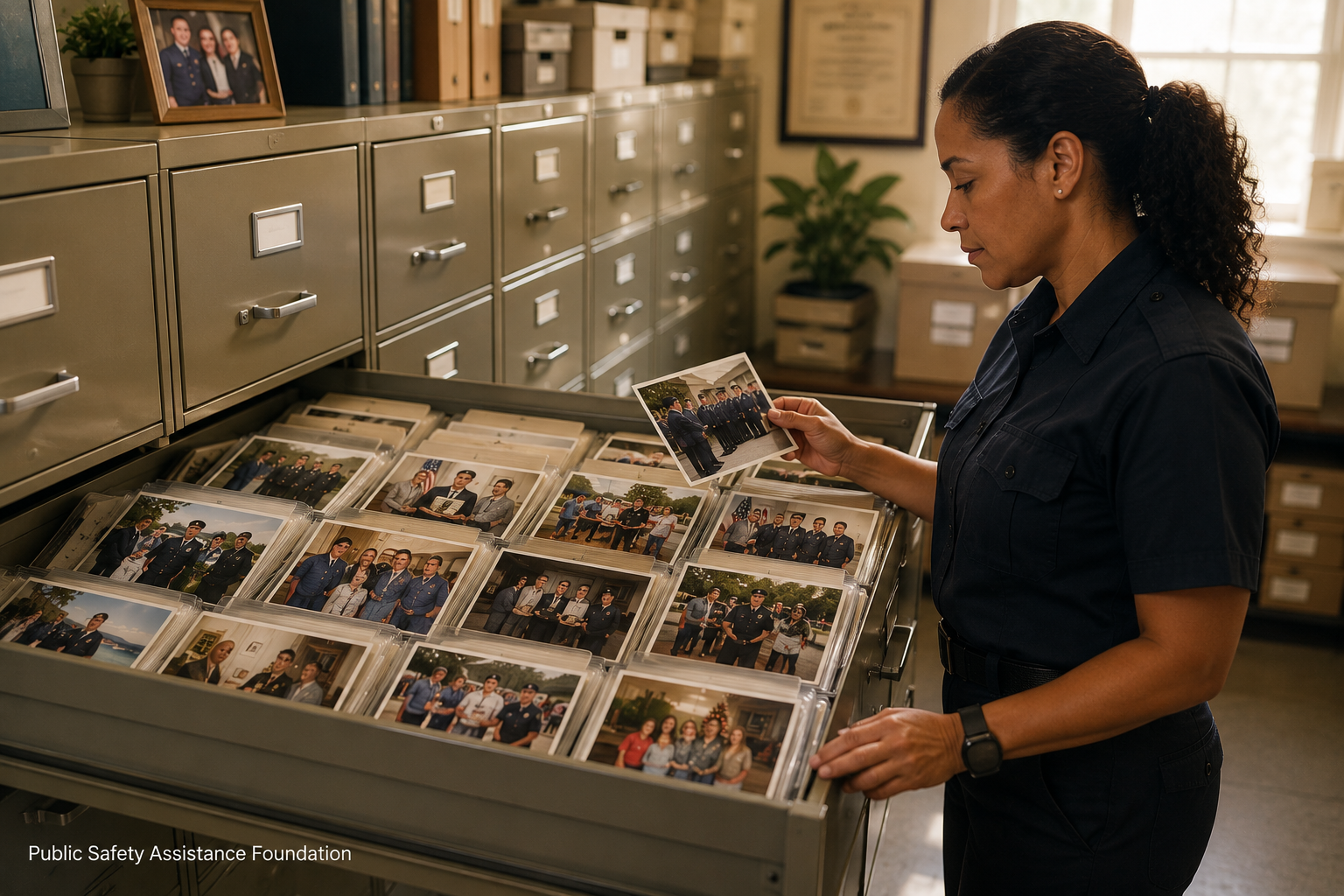
📸 The online image you forgot may still be telling your story.
When people think about online privacy, they often focus on what’s happening today.
A recent social media post. A newly published article. A fresh people-search listing. A public record that was recently added to a website.
Those are all important pieces of the privacy conversation.
But there is another source of online exposure that often receives far less attention—photos that were posted years ago and quietly remain available online long after the moment has passed.
A police academy graduation.
A promotional ceremony.
A retirement celebration.
A charity fundraiser.
A community outreach event.
A conference presentation.
An awards banquet.
A local news story recognizing outstanding service.
These images often feel harmless. In many cases, they were shared to celebrate accomplishments, recognize service, or preserve meaningful memories.
The concern usually isn’t the photograph itself.
It’s everything surrounding the photograph.
Captions, names, organizations, dates, locations, career milestones, professional relationships, and family members can all become part of a permanent online record. Over time, these individual pieces may contribute to a broader digital footprint that remains visible long after the original event has faded from memory.
For LEOs and their families, understanding how archived content contributes to online exposure is an important part of protecting personal privacy over the long term.
Photos Often Last Longer Than We Expect
The internet doesn’t operate like a family photo album tucked away in a closet.
Instead, it functions more like a collection of permanent archives.
Organizations redesign websites but leave old news pages online. Community groups maintain photo galleries from annual events. Association newsletters remain searchable for years. Local media outlets preserve stories indefinitely. Search engines continue indexing older content long after publication.
As a result, photographs taken ten or even twenty years ago may still appear in search results today.
Many people simply don’t realize those images still exist.
An officer may have changed agencies, promoted into a different assignment, retired, or moved across the country. Family members have grown older. Children pictured in those photos are now adults.
Yet the online record often remains unchanged.
While these archives serve legitimate historical purposes, they also create a timeline that others may be able to piece together with surprising ease.
It’s Not Just the Picture
When someone looks at an old photograph online, they’re rarely seeing only an image.
They’re also seeing context.
That context can often reveal significantly more information than the picture itself.
For example, a single event photo may include:
- Agency affiliation
- Rank or assignment at the time
- Date of the event
- Geographic location
- Professional associations
- Community organizations
- Volunteer involvement
- Family members in attendance
- Career milestones
- Awards or recognitions
Viewed individually, none of these details may seem especially significant.
Viewed collectively, they begin telling a detailed story.
Over months or years, dozens of archived photographs from different sources can gradually create a surprisingly complete picture of someone’s professional and personal history.
This illustrates an important principle of online privacy: exposure is often cumulative rather than immediate.
Every Caption Adds Another Piece
Captions are often overlooked, yet they can be just as revealing as the image itself.
A smiling group photograph might include names, titles, departments, event locations, and descriptions of why everyone gathered.
An awards ceremony may identify supervisors, coworkers, partner agencies, and career achievements.
A retirement article might summarize decades of service, previous assignments, specialized units, community involvement, and future plans.
Even a simple caption such as, “Officer Smith and family attended this year’s Shop with a Cop event,” provides more information than many people realize.
Over time, these descriptions become searchable text that search engines can index alongside the image itself.
While the photograph captures a moment, the caption often explains the entire story.
One Photo Can Appear in Many Places
Another important consideration is that online content rarely stays confined to a single website.
One photograph from a public event may eventually appear across multiple platforms.
An image originally posted by a police department might later be shared by:
- A law enforcement association
- A nonprofit organization
- A community partner
- A local newspaper
- An event sponsor
- A conference website
- A newsletter archive
- Social media accounts
- Search engine image results
Each additional publication increases the number of places where that information may continue to exist.
Even if one copy is eventually removed, others may still remain available elsewhere.
This isn’t necessarily the result of anyone acting improperly.
It’s simply how online information naturally spreads over time.
Archived Content Still Tells Today’s Story
One of the biggest misconceptions about online privacy is believing that older information eventually loses its relevance.
Unfortunately, search engines don’t always treat information that way.
Someone researching an individual today may encounter articles, event pages, newsletters, and photographs that span many years.
Together, those archives create a timeline.
They may reveal career progression, professional networks, recurring community involvement, organizational memberships, geographic movement, and other details that would otherwise be difficult to discover from any single source.
This is why online privacy isn’t only about preventing new exposure.
It’s also about understanding how older information continues contributing to today’s digital footprint.
Public Recognition Doesn’t Have to Mean Permanent Visibility
Recognition is an important part of public service.
Communities celebrate promotions, recognize years of dedication, honor acts of heroism, and thank officers for their commitment.
Those moments deserve appreciation.
At the same time, it’s reasonable to recognize that information published years ago may continue circulating in ways that were never anticipated.
The internet has changed dramatically over the past two decades.
Many websites that originally published photos never imagined that search engines, data aggregation, artificial intelligence, and modern indexing tools would make archived content so easy to locate years later.
Today’s digital environment gives old information new visibility.
That doesn’t diminish the value of public recognition.
It simply reinforces why long-term privacy deserves thoughtful attention.
Reducing Long-Term Exposure
No one can erase every photograph ever published online.
Nor should that necessarily be the goal.
Instead, effective privacy strategies focus on reducing unnecessary exposure where possible while recognizing that digital information accumulates over time.
Because online information is constantly changing, privacy protection isn’t typically a one-time event.
New references appear.
Older pages are rediscovered.
Archived content resurfaces.
Additional websites copy existing information.
Ongoing monitoring helps identify opportunities to reduce unnecessary exposure as those changes occur.
Rather than reacting only after information spreads widely, consistent monitoring supports a proactive approach that evolves alongside the internet itself.
Protecting Tomorrow Includes Understanding Yesterday
When people think about online privacy, they naturally focus on what they post today.
But yesterday’s digital history often remains just as important.
Old photographs may continue revealing agency affiliations, community involvement, professional milestones, family connections, and other details long after the original event has passed. Individually, those pieces may seem insignificant. Together, they can contribute to a broader picture of someone’s personal and professional life.
For law enforcement officers, public officials, and their families, reducing online exposure isn’t about erasing accomplishments or hiding meaningful moments. It’s about recognizing how digital information accumulates over time and taking thoughtful steps to support healthier online boundaries.
The Public Safety Assistance Foundation’s Privacy for Cops program provides ongoing online privacy protection designed to help reduce unnecessary personal information exposure for those who serve their communities. Through continuous monitoring and data removal efforts, our nonprofit helps support safer digital boundaries over time—because protecting your privacy isn’t only about what appears online tomorrow. It’s also about understanding what yesterday may still be revealing today.
Interested in learning how ongoing privacy protection can help reduce long-term online exposure for you and your family? Explore our privacy plans and discover how Privacy for Cops helps support safer digital boundaries over time.