
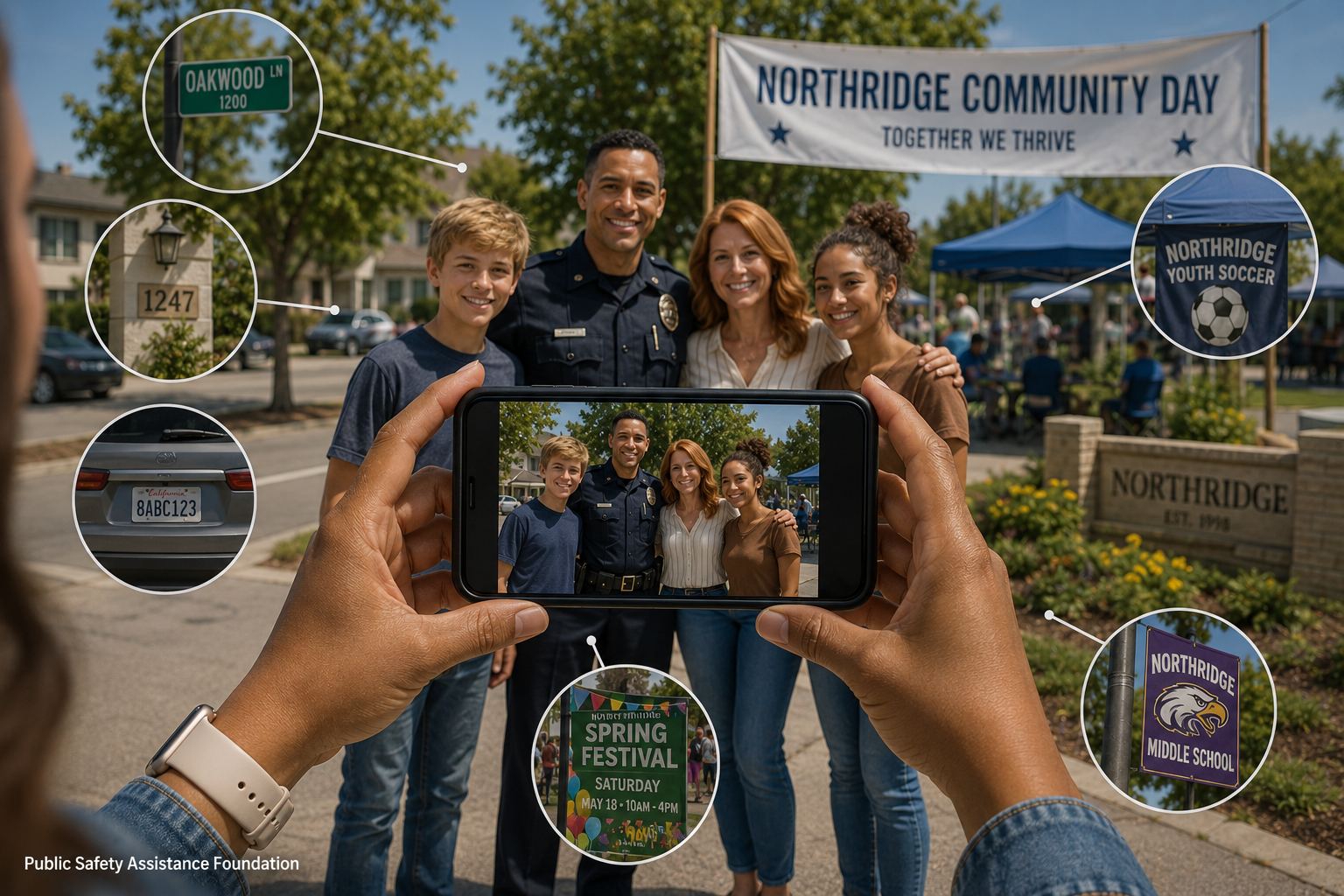
Sometimes the biggest privacy risks aren’t the people in the photo—they’re the details hiding behind them.
When most people look at a photograph, their eyes naturally go to the people in it.
A smiling family.
Friends gathered around a backyard barbecue.
A child celebrating a birthday.
An officer enjoying a well-earned day off.
The people become the story. The emotions become the memory.
But every photograph tells two stories.
The first is the one we immediately notice.
The second is the one hiding quietly in the background:
A street sign.
A school logo.
A vehicle parked in the driveway.
A neighborhood landmark.
A calendar hanging on the kitchen wall.
A family name printed on a sports jersey.
A package sitting on the front porch.
Most of us barely notice these details because they aren’t the focus of the picture.
Yet sometimes those overlooked details reveal far more information than the people standing in front of the camera.
Understanding what appears around the edges of a photograph can be just as important as understanding what appears in the center.
We Naturally Focus on Faces
Human beings are wired to notice faces before almost anything else.
It’s one of the first things our brains recognize.
That’s why family photographs feel so personal. We see expressions, relationships, and memories before we notice anything else.
A graduation photo reminds us of an accomplishment.
A vacation picture brings back a favorite trip.
A holiday gathering reminds us of time spent together.
The people are the reason the photograph was taken.
Everything else becomes background scenery.
Ironically, that scenery can sometimes reveal more information than we realize.
Not because anyone intended to share private details, but because cameras capture everything within the frame.
The Background Is Part of the Story
Every photograph contains layers of information.
Most people think only about the subject.
Few think about everything surrounding the subject.
A picture taken in the driveway may reveal license plates, house numbers, or neighboring homes.
A family photo at a school event may include banners, mascots, classroom names, or team logos.
A celebration inside the home might unintentionally capture mail on the counter, certificates on the wall, computer monitors, or family calendars.
Even reflections in mirrors, windows, televisions, or glass doors can reveal details that weren’t meant to be photographed at all.
None of these things seem significant by themselves.
They’re simply part of everyday life.
But cameras don’t separate what’s important from what’s incidental.
They record everything.
Small Clues Become Bigger Pictures
One background detail rarely creates a meaningful privacy concern.
One photo in front of a local park doesn’t identify where someone lives.
One picture at a community event doesn’t reveal daily routines.
One image showing a school sweatshirt doesn’t tell someone where a child spends every weekday.
The challenge isn’t one photograph.
It’s many photographs over time.
Online information rarely exists in isolation.
Instead, it accumulates.
A family member posts a graduation picture.
Months later, another relative shares holiday photos.
A community organization uploads pictures from a volunteer event.
An association publishes award recipients.
A local newspaper includes photographs from a charity fundraiser.
Individually, these moments seem harmless.
Together, they begin creating context.
Each image contributes another small piece to a much larger puzzle.
Information Layers Over Time
Privacy risks often develop gradually rather than all at once.
That’s one reason they’re so easy to overlook.
One photograph reveals a neighborhood.
Another reveals a favorite restaurant.
A third shows a youth sports team.
Later, another image captures the same community festival.
Eventually, someone viewing those photographs begins recognizing patterns.
Favorite locations.
Community involvement.
Organizations.
Family activities.
General routines.
None of those details necessarily reveal something dangerous by themselves.
But together they can paint a surprisingly complete picture of someone’s life.
This is sometimes called information layering.
Small pieces of publicly available information become much more valuable when combined.
The Audience Is Often Larger Than We Think
When people discuss online privacy, they often imagine someone intentionally searching for personal information.
That certainly happens.
But many privacy concerns begin much more casually:
- Neighbors
- Former classmates
- Parents from youth sports
- Community volunteers
- Friends of friends
- Association members
- Local media
- People simply scrolling through social media
Most aren’t looking for sensitive information.
They’re simply seeing what has already been shared.
Once a photograph is posted publicly or reshared by someone else, it may reach audiences the original poster never expected.
Images can be copied, archived, indexed, and redistributed long after they were first uploaded.
The background travels with them every time.
Why This Matters for LEO Families
Law enforcement officers already understand the importance of situational awareness.
They constantly observe details that others might miss.
Online privacy benefits from a similar mindset.
An officer may intentionally avoid discussing where they live.
Yet a family photo could unintentionally reveal recognizable neighborhood features.
An officer may choose not to identify a child’s school.
A celebration picture might include school apparel, event signage, or team logos in the background.
A holiday photo may show unique features of the home that appear repeatedly across multiple years.
None of these moments represent poor decisions.
They’re simply reminders that information often appears where we aren’t looking.
The same applies to spouses, children, grandparents, and extended family members.
Everyone enjoys sharing meaningful moments.
Few people stop to consider everything surrounding those moments.
The Goal Isn’t to Stop Taking Pictures
It’s important to remember that photographs preserve life’s most meaningful experiences.
Birthdays.
Graduations.
Vacations.
Anniversaries.
Community events.
Family reunions.
Youth sports.
Holiday traditions.
These memories deserve to be celebrated.
Online privacy isn’t about avoiding photographs or hiding from everyday life.
It’s about recognizing that every image contains more information than we initially notice.
➡ Sometimes a slightly different camera angle removes unnecessary background details.
➡ Sometimes a closer crop tells the same story without revealing extra information.
➡ Sometimes selecting one photo instead of another naturally limits what becomes public.
Small choices can make a meaningful difference without changing the memory itself.
Looking Beyond the Subject
Professional photographers often talk about composing the entire frame rather than focusing only on the subject.
That same idea applies to online privacy.
Before sharing a photograph, it can be helpful to briefly notice everything surrounding the people in the image:
- What’s on the walls?
- What’s visible through the windows?
- Are addresses, license plates, uniforms, or identification badges visible?
- Does anything unintentionally identify a location?
- Could someone unfamiliar with your family learn more than you intended simply by looking around the edges of the picture?
These aren’t questions designed to create anxiety.
They’re simply reminders that awareness often begins with observation.
The Bigger Picture
Most privacy challenges don’t begin with a dramatic event.
They develop quietly through dozens of ordinary moments.
One photo.
One newsletter.
One community event.
One family gathering.
One social media post.
Each may seem insignificant on its own.
Over months and years, however, those pieces can accumulate into a detailed picture that was never intentionally created.
That’s why ongoing online privacy isn’t focused on a single post or a single photograph.
It’s about understanding how information builds over time and taking thoughtful steps to reduce unnecessary exposure wherever possible.
Looking Beyond the Frame
Every photograph captures a memory.
It also captures a moment in time, a location, and countless small details that often go unnoticed.
Most people remember who was standing in front of the camera.
Very few remember everything standing behind them.
Those background details are worth paying attention to, not because every photograph creates a risk, but because small pieces of information can quietly accumulate across the internet over time.
Sometimes the most revealing part of a photograph isn’t the person standing in front of the camera—it’s the details hiding behind them. The same is true online, where small pieces of personal information can accumulate over time. Privacy for Cops helps reduce that exposure by removing personal information from hundreds of websites while providing ongoing monitoring as new listings appear.
Explore our Exclusive Privacy Plans to see how proactive online privacy can help support peace of mind for you and your family, both on and off duty.
Exclusive Privacy Plans